January 08, 2010
2009 review - Films
I saw 86 films in 2009. Here is the list, with approximate marks out of 10. The ordering is a fairly good chronological one. I have a feeling I've missed a few though.
The Princess Bride 10
Stardust 7
Hellboy 8
Alien vs Predator 7
The Karate Kid 9
The Katate Kid 2 6
The Karate Kid 3 6
The Karate Kid 4 6
The Librarian 2 6
JCVD 8
The Spiderwick Chronicles 8
The Hitch-Hikers Guide to The Galaxy 7
Next 7
Night at the Museum 8
Hot Fuzz 7
AvP 7
Watchmen 10
AvP 2 - Requiem 5
Cube 2 6
Cube 0 6
The Pirates Of The Caribbean 6
Coraline 3D 8
Night of the Living Dead 8
Dawn of the Dead (new) 7
Dawn of the Dead (original) 8
Day of the Dead 6
Ghost Town 7
The Butterfly Effect 8
Quantum Of Solace 6
I-Robot 6
WALL-E 6
Star Trek 8
The Little Vampire 7
Silent Running 7
Predator 8
Predator 2 8
Bedtime Stories 7
A Fistful Of Dollars 10
Harry Potter and the Half Blood Prince 7
The Ring 8
Arsenic & Old Lace 7
My Neighbour Totoro 8
Land of the Dead 8
Zoom 4
The Grudge 8
For a Few Dollars More 10
GI Joe 7
Stargate 8
First Blood 8
Guess Who 5
Tarzan 9
The Goonies 6
Race To Witch Mountain 7
12 Monkeys 8
Enigma 6
Bride Wars 4
Maverick 7
District 13 8
Adaptation 8
Rocky 7
When Worlds Collide 6
A History Of Violence 9
Twilight 8
The Accidental Hero 8
Transporter 3 8
The Witches of Waverley Place Movie 6
PS, I Love You 5
The Vampires Assistant 8
Mr Magorium's Wonder Emportium 7
Ruthless People 7
Wolverine 7
The Haunting Hour 4
The Haunted Mansion 5
Pirates of the Caribbean 2 5
Moon 7
City of Ember 7
Pocahontas 5
This Island Earth 7
Elf 8
Home Alone 10
The Santa Claus 6
Christmas with the Kranks 5
Avatar 9
Underworld - Rise of the Lycans 7
I'm willing to defend most of those ratings, but could be swayed slightly on a few of them.
I love watching films more than other TV, and if I had the chance, would watch one every day. However, a lot of my TV time was taken up with some pretty good US TV series. I watched the whole of "The Wire", Lost, Heroes, Flashforward, SGU, 24 Season 7, amongst others. These have the advantage of being about 1 hour long per episode - ideal just before going to bed.
You can see I've tried to revisit some classic movies, as well as watching the latest 3D efforts in the cinema. I've also mixed up family friendly stuff with scary gorefests.
Pretty good year, but I want to watch more this year.
Posted by se71 at 02:00 PM | Comments (0)
January 04, 2010
2009 Review - Books
Books
I read 21 books in 2009. Here is the list
The Ghost - Robert Harris
Martians, Go Home - Fredric Brown
Esio Trot - Roald Dahl
Just After Sunset - Stephen King
We Think, Therefore We Are - ed. Peter Crowther
Old Man's War - John Scalzi
Brother Odd - Dean Koontz
The Ghost Brigade - John Scalzi
Shock - Richard Matheson
The Girl With The Dragon Tattoo - Stieg Larson
Shock III - Richard Matheson
The Last Colony - John Scalzi
Random Acts of Heroic Love - Danny Scheinmann
The Hunger Games - Suzanne Collins
The Phantom Tollbooth - Norton Juster
Zoe's Tale - John Scalzi
Double Act - Jacqueline Wilson
The Girl Who Played With Fire - Stieg Larson
House of Suns - Alistair Reynolds
Flash Forward - Robert W Sawyer
Bad Science - Ben Goldacre
Outstanding find of the year is the Swedish author Stieg Larson, who sadly died not long after completing his 'Millennium' trilogy of crime novels. I'm currently working my way slowly through the final volume - slowly, because I know there will be no more.
John Scalzi wrote a great book called "Old Man's War" - then followed it with sequels of ever decreasing enjoyment, culminating in the final insult - "Zoe's Tale" - a book which tells the exact same story as the previous entry in the series, from a slightly different point of view. that idea can work, but needs a lot of skill. It didn't work here.
"The Hunger Games" is a real standout. It is teen fiction, but very well done, very gripping right from the beginning.
My last pick of the year is "Bad Science". Ben Goldacre's book is a must read for anyone wanting a little perspective on how we are being sold so much science crap by the media. Full of interesting facts about MMR, MRSA, homeopathy and why the Daily Mail seems to be categorizing every substance known to man into either the cancer curing or cancer causing camp.
Posted by se71 at 01:51 PM | Comments (0)
November 15, 2009
UK Chart Singles 15 November 2009
This week, I'm giving you the top 20!
Here is the Spotify Link
I seem to be getting bored of writing reviews of individual tracks.
I'll try harder next week, but of the new entries into the Top 10 I don't like Leona Lewis, N-Dubz, Britney Spears or Sugababes much. If they stick around till next week, I'll write more.
Finally got JLS on Spotify, it's very uninspiring.
1 The Black Eyed Peas - Meet Me Halfway up 2 | 8 weeks in chart
2 Leona Lewis - Happy new entry | 1 week in chart
3 JLS Everybody - In Love down 2 | 2 weeks in chart
4 Cheryl Cole - Fight For This Love down 2 | 4 weeks in chart
5 N-Dubz - I Need You new entry | 1 week in chart
6 Ke$ha - Tik Tok non-mover | 2 weeks in chart
7 Britney Spears - 3 new entry | 1 week in chart
8 Sugababes - About A Girl new entry | 1 week in chart
9 Jay Sean - Down (feat. Lil Wayne) down 5 | 3 weeks in chart
10 Alexandra Burke - Bad Boys (feat. Flo Rida) down 5 | 5 weeks in chart
11 Lady Gaga - Bad Romance down 1 | 3 weeks in chart
12 Jay-Z - Empire State Of Mind (feat. Alicia Keys) down 1 | 9 weeks in chart
13 Chase & Status - End Credits (feat. Plan B) down 4 | 2 weeks in chart
14 The Black Eyed Peas - I Gotta Feeling up 2 | 23 weeks in chart
15 Michael Bublé - Haven't Met You Yet down 8 | 5 weeks in chart
16 Westlife - What About Now down 8 | 3 weeks in chart
17 Robbie Williams - You Know Me new entry | 1 week in chart
18 Miley Cyrus - Party In The Usa down 5 | 3 weeks in chart
19 Whitney Houston - Million Dollar Bill down 5 | 6 weeks in chart
20 Snow Patrol - Just Say Yes down 5 | 2 weeks in chart
Posted by se71 at 07:19 PM | Comments (0)
November 08, 2009
UK Chart Singles 8 November 2009
Listen to the Top 10 UK singles at this Spotify link
1. JLS - Everybody In Love new entry | 1 week in chart
Still haven't heard this one - at least not consciously. Only song not on Spotify. Can't believe that is a good sign.
2. Cheryl Cole - Fight For This Love down 1 | 3 weeks in chart
A catchy song. I like the heavy percussion bass section in the middle (at 2:45). I'm not sure where she has found her slightly urban/London accent from - and it is annoying me more and more.
3. The Black Eyed Peas - Meet Me Halfway up 3 | 7 weeks in chart
Yes another chart entry for Black Eyed Peas. After one listen, it's not too impressive, however, as with many of their previous songs, after a few times, you get to quite like it. Good song.
4. Jay Sean - Down (feat. Lil Wayne) down 1 | 2 weeks in chart
Fairly typical dance orientated track. Someone should lock up the vocoder machine for a few years though.
5. Alexandra Burke - Bad Boys (feat. Flo Rida) down 1 | 4 weeks in chart
Burke's first single since the appalling, but massively selling Hallelujah last Christmas. This is a crowd friendly disco inspired feel of a song. Flo Rida gives a short, and largely ignorable rap in the middle just to give the song a more modern feel. It's OK.
6. Ke$ha - Tik Tok new entry | 1 week in chart
A new name to me - with a very silly '$' symbol in it.
A computer aided vocal to make her sound drunk, and lyrics about binge drinking. It would be funny if she wasn't trying so hard to sound like Lady Gaga - and failing badly due to lack of originality. Then it all goes eurodance. It's catchy, but vacuous.
7. Michael Bublé - Haven't Met You Yet down 2 | 4 weeks in chart
I'm not a huge Bublé fan, I'm not even a big fan of this song, but it's nice to see something a bit more traditional in the chart for a change. I guess this sounds a bit patronising - but the song isn't the strongest. I am suspecting the Terry Wogan and Radio 2 effect here.
8. Westlife - What About Now down 6 | 2 weeks in chart
Westlife seem as strong as ever. This song is one of their very typical ballads, a good track with great vocal performances. it might not suit everyone, but the band do their job well.
9. Chase & Status - End Credits (feat. Plan B) new entry | 1 week in chart
Maybe one day I will be able to look at a new top 10 and recognize every artist. This is my second discovery this week.
I like this one, sounds a bit less electronic than the rest of the chart - makes a nice change.
10. Lady Gaga - Bad Romance up 4 | 2 weeks in chart
If Lady Gaga didn't exist, someone would have to invent her. Almost single handedly giving the charts the good kicking it needs with the most interesting tracks this year. And outrageous videos; if you haven't caught them yet, they are so bonkers you have to watch them several times just to try and get 10% of what they might be about.
Bad romance continues the trend - weirdly addictive gutteral chanting, catchy chorus, and a video better than many science fiction films I've seen.
Posted by se71 at 07:55 PM | Comments (0)
November 01, 2009
UK Chart Singles 1 November 2009
Here are my short reviews of the official Top 10 Chart Singles in the UK this week. If you want to listen on Spotify - here is the link
This is my 5th week, you know the drill by now.
1. Cheryl Cole Fight For This Love non-mover | 2 weeks in chart
Quite a catchy song. I like the heavy percussion bass section in the middle (at 2:45). I'm not sure where she has found her slightly urban/London accent from.
2. Westlife What About Now new entry | 1 week in chart
New entry. Who would have thought 10 years ago, when Westlife appeared as a cheap alternative to Boyzone, that they would still be going. Not me.
However, they seem as strong as ever, and I actually quite liike some of the boy bands. This song is a good track, a ballad with great vocal performances.
3. Jay Sean Down (feat. Lil Wayne) new entry | 1 week in chart
Fairly typical dance orientated track. Someone should lock up the vocoder machine for a few years though.
4. Alexandra Burke Bad Boys (feat. Flo Rida) down 2 | 3 weeks in chart
Burke's first single since the appalling, but massively selling Hallelujah last Christmas. This is a crowd friendly disco inspired feel of a song. Flo Rida gives a short, and largely ignorable rap in the middle just to give the song a more modern feel. It's OK.
5. Michael Bublé Haven't Met You Yet up 4 | 3 weeks in chart
I'm not a huge Bublé fan, I'm not even a big fan of this song, but it's nice to see something a bit more traditional in the chart for a change. I guess this sounds a bit patronising - but the song isn't the strongest. I am suspecting the Terry Wogan and Radio 2 effect here.
6. The Black Eyed Peas Meet Me Halfway up 5 | 6 weeks in chart
Yes another chart entry for Black Eyed Peas. You might think from a first listen that this isn't much good. However, as with previous songs, after a few times, you get to quite like it. Good song.
7. Chipmunk Oopsy Daisy down 4 | 4 weeks in chart
English incoherent rapping, with metaphors based on baseball (baseball love/three strikes/home run) for some weird reason. The female vocal is OK and has grown on me, but I could do without the rap.
8. Whitney Houston Million Dollar Bill down 3 | 4 weeks in chart
Whitney has lost a lot of her trademark sound, her vocal is a lot less piercing. This is not a bad thing in my opinion, but nevertheless, without that, she is just another identikit vocalist. It sounds a bit old fashioned in a disco'ey 1970s way - a bit boring.
9. Robbie Williams Bodies down 5 | 3 weeks in chart
I don't like Robbie Williams songs in general, and this is no exception. Happily, it's falling down the charts already.
Mostly it's the lyrics on this one I dislike. From what I have made out so far, they just seem like random gibberish on a religion theme. Then it's the delivery, Robbie's odd singing/not singing verses, and sweeping chorus where he almost, but not quite, sings. Is that chorus the same as the Millennium one?
Truely terrible.
10. The Black Eyed Peas I Gotta Feeling down 3 | 21 weeks in chart
Second entry from this group in the Top 10. I've gotten to like this once more as the weeks go by - it took me a long time to get the massive "Where is the Love?" as well. This is a fun song, with a feel good lyric. Something you'd definitely want to play before going out partying.
Back next week.
Posted by se71 at 08:01 PM | Comments (0)
October 25, 2009
UK Chart Singles 25 October 2009
Here are my short reviews of the official Top 10 Chart Singles in the UK this week. If you want to listen on Spotify - here is the link
This is my 4th week, and I'm starting to get used to the songs. This is due to the cumulative effect of remembering tracks that have endured through the weeks, with a only few new entries. And I've also been watching the music channels on Sky.
1. Cheryl Cole - Fight For This Love 5/10 new entry | 1 week in chart
There was never any doubt that this would go straight in at Number One. Cole got massive viewing figures on the X-Factor on TV last weekdnd, and an endorsement from Simon Cowell. Also, it is quite a catchy song. I like the heavy percussion bass section in the middle (at 2:45). I'm not sure where she has found her slightly urban/London accent from.
2. Alexandra Burke - Bad Boys (feat. Flo Rida) 5/10 down 1 | 2 weeks in chart
Burke's first single since the appalling, but massively selling Hallelujah last Christmas. The X-Factor winner has taken her time and come back with a completely different kind of song, a crowd friendly disco inspired feel of a song. Flo Rida gives a short, and largely ignorable rap in the middle just to give the song a more modern feel.
I think it's just OK, still.
3. Chipmunk - Oopsy Daisy 4/10 non mover | 3 weeks in chart
English incoherent rapping, with metaphors based on baseball (baseball love/three strikes/home run) for some weird reason. The female vocal is OK and has grown on me, but I could do without the rap.
4. Robbie Williams - Bodies 4/10 down 2 | 2 weeks in chart
I don't like Robbie Williams songs in general, and this is no exception.
Mostly it's the lyrics. from what I have made out so far, they just seem like random gibberish on a religion theme. Then it's the delivery, Robbie's odd singing/not singing verses, and sweeping chorus where he almost, but not quite, sings. Is that chorus the same as the Millennium one?
Truely terrible.
5. Whitney Houston - Million Dollar Bill 5/10 up 9 | 3 weeks in chart
Didn't realise this was lower in the chart last week. I guess it was the appearance on X-Factor (which I didn't see) which has pushed it up. This is the third X-Factor related track in the top 5. Whitney has lost a lot of her trademark sound, her vocal is a lot less piercing. This is not a bad thing in my opinion, but nevertheless, without that, she is just another identikit vocalist. It sounds a bit old fashioned in a disco'ey 1970s way - a bit boring.
6. Taio Cruz - Break Your Heart 7/10 down 2 | 6 weeks in chart
Definitely my favourite track in the Top 10. This one is really catchy and has some staying power. Quite a clever lyric too, so all round a great song.
7. The Black Eyed Peas - I Gotta Feeling 6/10 down 1 | 20 weeks in chart
I'm getting to like this once more as the weeks go by - it took me a long time to get "Where is the Love?" as well. This is a fun song, with a feel good lyric. Something you'd definitely want to play before going out partying. just realised that it's been in the chart for 20 weeks - seriously, it's not that good.
8. Jay-Z - Empire State Of Mind 5/10 (feat. Alicia Keys) down 3 | 6 weeks in chart
Rapping terribly dull, Alicia Keys singing section screechy and annoying. She is so talented this is a waste, like that James Bond theme last year which did her no favours.
9. Michael Bublé - Haven't Met You Yet 5/10 non mover | 2 weeks in chart
I'm not a huge Bublé fan, I'm not even a big fan of this song, but it's nice to see something a bit more traditional in the chart for a change. I guess this sounds a bit patronising - but the song isn't the strongest. I am suspecting the Terry Wogan and Radio 2 effect here.
10. Young Soul Rebels - I Got Soul new entry - 1 week in chart
Billed as an "Urban soul super group", this is a charity single along the same lines as Band Aid with new artists including Pixie Lott, N-Dubz, tinchy Stryder and Chipmunk. Unfortunately, Spotify have removed this song, so I only heard it once. Sounded enough like the original to me to make no difference. Charity singles are rarely good, this is no exception.
If you played me any of these, I can now identify the track, and artist. Four weeks ago when I started doing this that was impossible - I don't think I'd have gotten one.
Posted by se71 at 06:55 PM | Comments (0)
October 18, 2009
UK Chart Singles 18 October 2009
Another week, another chart...
Listen on Spotify
1. Alexandra Burke - Bad Boys (feat. Flo Rida) 5/10 new entry | 1 weeks in chart
Burke's first single since the appalling, but massively selling Hallelujah last Christmas. The X-Factor wiiner has taken her time and come back with a completely different kind of song, a crowd friendly disco inspired feel of a song. Flo Rida gives a short, and largely ignorable rap in the middle just to give the song a more modern feel.
Give me a week or two to hear this more, but so far it seems just OK.
2. Robbie Williams - Bodies 4/10 new entry | 1 weeks in chart
Apparently if you make a new record, when you've spent a couple of years off, they call it a comeback these days. So Robbie is back. I should probably say here that I've hated his past records, so the chances of me liking this were slim. And lo, it came to pass, that I hate this song - a lot.
Mostly it's the lyrics. from what I have made out so far, they just seem like random gibberish on a religion theme. Then it's the delivery, Robbie's odd singing/not singing verses, and sweeping chorus where he almost, but not quite, sings. Is that chorus the same as the Millennium one?
Truely aweful.
3. Chipmunk - Oopsy Daisy 4/10 down 2 | 2 weeks in chart
English incoherent rapping, with metaphors based on baseball (three strikes/home run) for some weird reason. The female vocal is OK, but it's all a bit dull.
4. Taio Cruz - Break Your Heart 7/10 non-mover | 5 weeks in chart
This one has grown on me a lot. Nice melody, a bit throw away but pleasant to listen to. Quite a clever lyric.
5. Jay-Z - Empire State Of Mind 5/10 (feat. Alicia Keys) down 2 | 5 weeks in chart
Rapping terribly dull, Alicia Keys singing section screechy and annoying. She is so talented this is a waste, like that James Bond theme last year which did her no favours.
6. The Black Eyed Peas - I Gotta Feeling 6/10 up 2 | 19 weeks in chart
I'm getting to like this once more as the weeks go by - it took me a long time to get "Where is the Love?" as well. It's a fun song, with a feel good lyric. Something you'd definitely want to play before going out partying.
7. Shakira - She Wolf 6/10 non-mover | 6 weeks in chart
The voice manipulation is a bit rubbish and unnecessary as Shakira has a very distinctive vocal sound already. Not a bad song though - grows on you. Agree with a comment I read about the wolf howl - a very half hearted effort. The video has to be seen to be believed - that girl is bendy.
8. The Saturdays - Forever Is Over down 6 | 2 weeks in chart
Still not available on Spotify - review to follow maybe, but had a quick listen to a 30s preview and wasn't that impressed.
9. Michael Bublé - Haven't Met You Yet 5/10 new entry | 1 weeks in chart
This new entry is a breath of fresh air. I'm not a huge Bublé fan, I'm not even a big fan of this song, but it's nice to see something a bit more traditional in the chart for a change. I guess this sounds a bit patronising - but the song isn't the strongest. Is he the housewife's choice? I am suspecting the Terry Wogan effect here.
10. David Guetta - Sexy Chick (feat. Akon) 3/10 down 5 | 10 weeks in chart
Average dance sound - vocoder vocals. Lamenting the days when songs with derogarory terms about girls in the lyrics wouldn't get on the radio. This is lazy writing. But have discovered that I was listening to the album version last week - the single uses 'chick' instead of 'bitch', even though they deliberately mispronounce it to rhyme with 'bitch'. Why can't they just write one song - have some integrity, and take the radio ban
Posted by se71 at 06:44 PM | Comments (0)
October 11, 2009
UK Chart Singles 11 Oct 2009
Week two of my experiment to rate the UK singles chart.
If you want to play along, either tune your radio to a popular music channel, or download Spotify and click below to load up the playlist of this week's Top 9.
11h October 2009 - Top 9 Singles.
I'm currently missing one song - again!
1. Oopsy Daisy - Chipmunk
Straight into No 1. This is, I think, fairly common these days.
Once again, not my kind of song. Boring, utterly forgettable.
2. Forever is Over - The Saturdays
Not available on Spotify - review to follow, but had a quick listen to a 30s preview and wasn't that impressed.
3. Jay-Z - Empire State of Mind - 3/10
Rapping terribly dull, Alicia Keys singing section screechy and annoying. She is so talented this is a waste, like that James Bond theme last year which did her no favours.
4. Break your Heart - Taio Cruz - 7/10
This one has grown on me a lot. Nice melody, a bit throw away but pleasant to listen to. Quite a clever lyric.
5. David Guetta - Sexy Chick - 3/10
Average dance sound - vocoder vocals. Lamenting the days when songs with derogarory terms about girls in the lyrics wouldn't get on the radio. This is lazy writing. But have discovered that I was listening to the album version last week - the single uses 'chick' instead of 'bitch', even though they deliberately mispronounce it to rhyme with 'bitch'. Why can't they just write one song - have some integrity, and take the radio ban.
6. The Temper Trap - Sweet Disposition - 6/10
1980s sound, like a U2 guitar riff at the start, sounds OK. Decent vocal. Probably the only traditional song in the top 10. But again so bland it's slipping away already.
7. Shakira - She Wolf - 6/10
The voice manipulation is a bit rubbish and unnecessary as Shakira has a very distinctive vocal sound already. Not a bad song though - grows on you. Agree with a comment I read about the wolf howl - a very half hearted effort. The video has to be seen to be believed - that girl is bendy.
8. Black Eyed Peas - I Gotta Feeling - 4/10
Very average - even after 4 listens, I can't rememeber any of it. It's a fun song though, with a feel good lyric.
9. Pitbull - Hotel Room Service - 3/10
Terrible song - toneless singing in the chorus, tasteless lyrics, boring rapping, beeping in the background that I could create in 5 minutes. Have also stolen their main riff "Hotel, Motel, Holiday Inn" line from Rappers Delight by the Sugar Hill Gang. Was watching MTV Hits last night, and they refused to show the video as it was too explicit - what idiots Pitbull are.
The best thing to say about it is that it has quite a nice 15 second instrumental coda at the end.
10. Jay-Z - Run This Town - 4/10
As with New York, this song has some boring rapping, and an annoying female vocal - this time Rihanna
The whole...
Female vocal chorus which has a tune
male rapping over background verse
repeat
...is a tired formula - no one is listening to the rapping, just waiting for the singing. This is how several of today's top 10 are structured, and I just don't understand it. It has to do with the massive egos of the rappers themselves, but their lack of respect for their own abilities, and their less than average writing skills. Go and listen to some Eminem or Beastie Boys, or NWA or Grandmaster Flash - real lyrical rapping about real stuff that engages the audience.
Comments welcome, email me at robert@se71.org if you have problems with the site. See you next week.
Posted by se71 at 08:41 AM | Comments (0)
October 07, 2009
UK Chart Singles 04 Oct 2009
As I said in my last post, I'm going to write some reviews for the songs in the UK Singles charts.
If you want to play along, either tune your radio to a popular music channel, or download Spotify and click below to load up the playlist of this week's Top 9.
4th October 2009 - Top 9 Singles.
I'm currently missing Dizzee Rascal's entry at No. 10 - Bad Dizzee!
Before I started I had heard two of these songs on the radio, and seen one video. I've now listened through about 5 times. See the end for my conclusions.
1. Break your Heart - Taio Cruz - 7/10
Not bad, fairly nice melody, a bit throw away but pleasant to listen to.
2. Jay-Z - Empire State of Mind - 3/10
Rapping terribly dull, Alicia Keys singing section screechy and annoying. She is so talented this is a waste, like that James Bond theme last year which did her no favours.
3. David Guetta - Sexy bitch - 3/10
Average dance sound - vocoder vocals. Lamenting the days when songs with bitch and whore in the lyrics wouldn't get on the radio. This is lazy writing.
4. Shakira - She Wolf - 6/10
More rubbish voice manipulation - unnecessary as Shakira has a very distinctive voice already. Not a bad song though - grows on you. The video has to be seen to be believed - that girl is bendy.
5. Black Eyed Peas - I Gotta Feeling - 4/10
Very average - even after 4 listens, I can't rememeber any of it.
6. Jay-Z - Run This Town - 4/10
As with New York, currently at number 3, this song has some boring rapping, and an annoying female vocal - this time Rihanna (should have stayed under her umbrella)
7. The Temper Trap - Sweet Disposition - 6/10
1980s sound, like a U2 guitar riff at the start, sounds OK. Decent vocal. Probably the only traditional song in the top 10. But again so bland it's slipping away already.
8. Pixie Lott - Boys and Girls - 5/10
Nothing terribly wrong with this song, but nothing memorable or good either.
9. Pitbull - Hotel Room Service - 3/10
Terrible song - toneless singing in the chorus, tasteless lyrics, boring rapping, beeping in the background that I could create in 5 minutes. Have also stolen their main riff "Hotel, Motel, Holiday Inn" line from Rappers Delight by the Sugar Hill Gang. Quite a nice 15 second instrumental coda at the end.
Overall, I'm not that impressed. There is nothing here that I would consider buying - but I'm not terribly surprised by that revelation :-) I'm disappointed by the lyrics, and I'm astonished that people are buying Jay-Z songs - they suck in so many ways.
On the positive side Taio Cruz at No 1 is a catchy song I'm liking more and more, and I woke up with it in my head this morning. Good lyrics, nice voice. Surprised by the old skool euro dance sound though. And Shakira is also quite good, spoilt by bad production.
Comments welcome, email me at robert@se71.org if you have problems with the site. See you next week.
Posted by se71 at 10:43 AM | Comments (0)
April 18, 2009
Just After Sunset - Stephen King
Just After Sunset - Stephen King
I'm a big Stephen King. This is even though he has disappointed me a lot over the last twenty years. I still keep coming back. Partly it is because even though his later books are sometimes a bit pointless and lack direction, the journey is often enjoyable because he is such a good writer.
The rot set in in about 1985 when I bought the hardback of Skeleton Crew


After that, I didn't give up. As I said, I'm a bit of an addict. I also read the collection Nightmares and Dreamscapes
Therefore I wasn't much bothered when "Just After Sunset" came out. I would probably have read it at some point, but I got the hardback for Christmas, and decided I may as well give it a go. I'm not going to describe any of the stories - I see little point in doing that for a short story collection review. What I will say is that these stories are a lot stronger than anything I've read by King for years. Some are horror as you'd expect, but the strongest I think are pure thriller. What many people, I guess the majority in fact, don't know about Stephen King is that he has a rare ability to write stories of pure emotion. His horror gets the most press, and his films are more famous than his books. But he can write about people and situations , and make you care about them, in a way I seldom encounter. This is the real reason I read his books. He only manages to do this in this book once - but once is enough.
Highly recommended, not every story hits the mark, but almost all are well worth reading.
Posted by se71 at 10:20 AM | Comments (0)
Esio Trot - Roald Dahl
Esio Trot - Roald Dahl
Not sure how I avoided reading this short book over the years. Maybe I instinctively knew it wouldn't really be worth the, admittedly small, effort.
This is not a typical Dahl book. There is an inventiveness about it, and it's surely original, but it doesn't have any of the gruesome, hilarious, horribleness we have come to expect. Instead, we have a love story about two middle-aged people who are brought together by a trick with tortoises.
Only read if you must finish all of Dahl's books - even though it is short, it's only one idea, and you know the ending already by about one quarter of the way in.
Posted by se71 at 10:13 AM | Comments (0)
March 07, 2009
Watchmen
Watchmen - The Movie Review
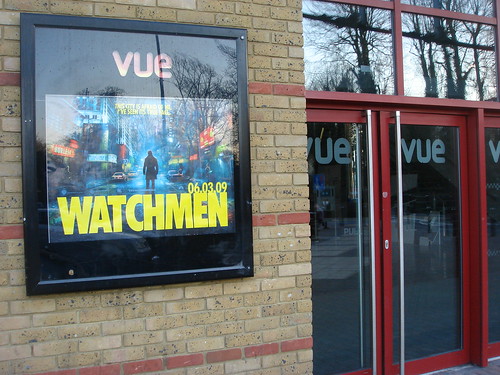
The short version - it's excellent, but is definitely for adults only unfortunately.
I'm not going to review the graphic novel by Alan Moore and Dave Gibbons, even though one of my copies is signed by the artist. Scandalously, I don't consider myself properly qualified, having only read it for the first time last year. I picked it up so many times in Forbidden Planet over the preceding two decades, but the price tag always made me hesitate, and say to myself "I'll just wait and get it in the sales". The sales did finally arrive, and I ended up with two copies - one signed one for the shelf, one to read.
Why all the preamble then? This is a movie review, not a comic review. The reason is so that you understand that I don't actually have a lot of the emotional investment that many other reviewers have. Comic fans 'love' this book, have been waiting a very long time, for something that the author has said was unfilmable, to reach the screen. They will tell you that the ending is different, maybe they won't like the omission of the comic within the comic story "Tales of the Black Freighter". Maybe they've lived with the characters so long that the actors will never live up to their expectations. I have none of those misgivings, and yet, unlike the majority of cinema goers, I have actually read it, so I think I'm in quite a small category of people who only quite liked the comic.
With the story fairly fresh in my mind, I went into the first day screening with some trepidation that inevitable changes would have been made to fit such a dense work into only two and three quarter hours. But Watchmen is uncompromising, and in my opinion, included everything important - everything I remember anyway.
So - to the movie. Imagine if there really were a group of masked heroes, fighting crime on the streets of New york. Heroes like Batman, not Spiderman. These people use their fists to beat up the bad guys, with a few handy tools and a flying ship, but mostly just their fists. Then imagine further that they were driven underground by an anti-vigilante movement, and most of them have retired. The action takes place in an alternate universe where this has already happened, and it's 1985, and the world is in the middle of the cold war. Richard Nixon is in his fifth term as President, and his finger is hovvering over the armageddon button.
Once masked man, Rorschach, discovers that someone is killing off his ex-colleagues, and starts to investigate. He gets a pretty poor reception along the way from his old gang, but we get a chance to see each of them with flashbacks filling in the backstory. These shifts in time, along with the alternate universe setting, and Dr Manhattan's concept of knowing the past and the future as one time, make it a pretty challenging experience, but every scene is so full of interest that even if you don't fully understand it, it's still enjoyable to watch. I've done some reading around this, and I missed a ton of references I'll only fully discover with a DVD and director's commentaries; I'm looking forward to that. (One example is a tiny scene, where a masked hero saves Batman's parents from murder at the back of an opera theatre - so this universe has no Batman).
Dr Manhattan, I mentioned him above, is the only real superhero in the film. He is a man turned superman, with massive powers over time and space. He has lost most of his humanity and is so apart from it that he doesn't seem to understand right from wrong any more. He is also blue, and naked most of the time.
Jackie Earle Haley is a revelation as Rorschach - the prison scenes are my most memorable, and his line "I'm not locked in here with you, YOU'RE locked in here with ME" summed up his anger, persecution complex, and egotistical personality so well. In the book we don't get to see him say this directly, it's much better in the film. I also loved The Comedian - a great character, must have been so much fun to play. I was a little disappointed with a couple of the others - Night Owl II was a bit too wishy-washy at times, so that when it came time for him to be hard it was less believable. And Carla Gugino I felt was wasted, all that old person makeup.
I was completely surprised by how much music there was in the film. Quite a few scenes dispensed with any dialogue and just ran a full 3-4 minute song - from Dylan's "The Times they are a changing" for the opening titles, to Nat King Cole's "Unforgettable", from Phillip Glass to Wagner. In most cases, I really liked the songs, and it was great to hear them loud in a cinema, but they didn't work as soundtracks to the film. They jarred me out of the scenes, out of the action, and made me think about the song. This isn't a soundtrack's job, you should hardly notice the music unless it's wrong.
If you've seen '300' you'll already be familiar with the ultraviolence of his fighting scenes - we get them here too.
We also get sex, and some hints at violent sex as well. And of course a huge blue naked man walking around. Was this necessary, or gratuitous? Tough call, but I would have cut a bit, and left more to the imagination. I would have made the film a '15' certificate - the '18' is going to kill the audience figures, and even the DVD rentals, and wasn't necessary. It's a shame that so many people who would have loved this film are not going to be allowed to see it, and it would not have hurt artistically I think. If a film is definitely horror, or definitely soft porn, then include everything you need and give it an '18', but maximise your audience unless there is an overwhelming need not to.
Phew, nearly finished. Conclusion - Zack Snyder has made a remarkable film, that looks fantastic. He has taken the comic, and had storyboarding help from the original artist in crafting the scenes, and it all works. It looks authentic, and I can't see any fan of the original, or anyone else, knocking it for this. It's fairly long, but I wanted more, as it's fascinating from beginning to end. I loved it, and would encourage everyone to go and see it - we need more of this kind of cinema, so we should support the people who make it.
Posted by se71 at 07:20 PM | Comments (0)
February 23, 2009
JCVD
This is a tremendous film, easily my favourite of the year so far. [1]
I know you'll find this hard to believe - it has quite a few things going against it. Jean-claude Van Damme isn't known for great art, or great acting and it's almost completely in French with English subtitles. But what makes it work, and why I loved it, is how it mixes real life with fiction, messes about with time lines to reveal itself to us in different ways, and, of course, has the very excellent Mr. JCVD himself giving the best performance of his life.
Did you see "Being John Malkovich"? There are very valid comparisons to that movie, where the lead actor plays a fictionalised version of himself. This one doesn't have any of the weird science fictional aspects though, it's all played completely straight.
Very briefly, the plot. A fading action movie star returns to his native country to try and recover from a divorce and custody battle for his daughter. He is short on money, short on good movies to act in. We see him enter a Post Office, and soon after, there are shots - it's a robbery.
From this opening we are constantly kept guessing - first about what is happening inside, and then how it will all play out in the end. It is a fantastic, funny, tragic and exciting ride. It is also shot in a sepia tinged way that make it look moody and rough, and looks great on Blu-Ray on a big screen TV.
I urge you to see it - there will not be a film it again. The six minute monologue straight to camera is unbelievable, and yet, it exists.
[1] though there isn't that much competition to be honest in the department.
Posted by se71 at 01:38 PM | Comments (0)
January 19, 2009
The Ghost - Robert Harris (Review)
The Ghost - Robert Harris
My first book of 2009, and not a promising start. His first book "Fatherland" appealed to the alternate history nerd inside me, and wasn't a bad detective story. But this is a watery, weak affair that seems to stumble along trying to find excitement, and even when there is some, it manages to turn the volume down and play it in slow motion.
The narrator/hero of this story is a ghostwriter by profession. I don't think we ever get to know his name, which is a clever trick by Harris - ghostwriters of course are never mentioned on the covers of the books they have 'written'.
He gets the job of writing the autobiography of former Prime Minister of Britain, Adam Lang. The previous person who tried to do this drowned, suicide assumed, but we know that it must be a suspicious death.
Lang and his wife are obviously grotesque parodies of Tony and Cherie Blair, which oddly enough makes this book less interesting rather than more.
So the writer goes to Martha's Vineyard to meet Lang, and spends a short time interviewing him as a political crisis looms. Gradually he uncovers irregularities in Lang's past, and starts to wonder whether his life may be in danger too.
It sounds like a good book, but it's clumsily handled. Characters are cardboard cutouts, and perform randomly as the plot requires. I was reminded of the author Frederick Forsyth for some reason as I read through; it seems like his kind of plot, and I wished someone with his skill had tackled it instead.
Buy it here, or not, whatever. I'd advise against it.
Posted by se71 at 05:01 PM | Comments (0)
December 31, 2008
A Game of Thrones - George R.R. Martin
A Game of Thrones - George R.R. Martin
Book 40 in my 52 books in 52 weeks in 2008
This is my final book for 2008 - so you know I didn't make it to the full 52. This is a shame, but I didn't know I'd lose four months of train commuting, so it wasn't to be helped. Nevertheless, this is I think ten books more than 2007, so I'm very pleased about that. I'm still cycling to work, so 2009 is looking like a 20 book year. We'll see, maybe I'll get a new contract.
How many epic fantasy series can one person read? When each book is about 1000 pages, and authors insist on upwards of ten books, it is a real struggle. You need to choose carefully. I read "Magician", the first in the Riftwar series by Raymond E Feist not that long ago. it was OK, but I didn't feel inclined to continue. Robert jordan's "Wheel of Time" books get a lot of bad press, particularly the later ones. I don't know much about any other series, but this one from George R.R. Martin gets universal acclaim, so I felt it was time to start. for anyone interested, I only just managed to finish it in 2008, at about 30 minutes to midnight, and it took me a couple of months to get through it, a chapter a night.
The first thing to say about this book is that it is really brutal. If it was a film, you'd maybe want to look away occasionally, or have a sick bag handy. Human life is cheap in this medieval society, justice is swift, and it doesn't pay well to be a woman, even a rich one.
The second thing is the almost complete lack of fantasy. There is a bit of course, and heavy hints for more to come in succeeeding volumes no doubt, but this is primarily a book about the politics of ruling a large kingdom when the people in charge all hate each other.
I did enjoy reading this. You get a total immersion feeling from the world you are inhabiting. There is a big cast of characters, and the chapters flit between them giving you views of the situations from all angles. The country itself seems to be about the size of England. In the north, it is freezing all the time and a huge wall has been built across the northern part country to keep the Others/Wildings out. What are the Others? I'm still hardly any the wiser. The climate is variable, but it seems that every ten or twenty years a mini ice age occurs. No one can predict exactly when it will happen, but in the time of the novel, it is overdue, and definitely imminent. Winter is coming.
Any epic fantasy without battles, heroic deaths, treachery and deceit and all those good things would be pointless, so we're not disappointed in those areas. But it is reallllly long, and there are so too many characters that it is easy to get lost a bit along the way. The narrative shifts from person to person and each has their own individuality that you come to recognise, but the bit players, all the knights and outlaws and so on, merge into one at times.
This book is merely a prelude to the ones to come, like a pilot episode of a long running TV series. It introduces the cast and sets the scene for all the shows to come. And it has a great climax to get you to come back for more. I'll be back.
Posted by se71 at 11:30 PM | Comments (0)
December 29, 2008
World War Z - Max Brooks
World War Z - Max Brooks
Book 39 in my 52 books in 52 weeks in 2008
Finishing off the year with a couple of books that go back to the basics of some good old SF/Fantasy/Horror. First off, this one, which all the cool kids have been reading, and I've looked forward to since I first heard about it in the spring. Coincidentally, Penny Arcade also featured it while I was reading it - here in a funny cartoon.
What would happen to the world if zombies were real? I do not think this is a disaster scenario that the United Nations are considering, but no need, Max Brooks has it covered.
This is a clever story told from the point of view of the survivors of a World War against zombies. Some of these are ordinary people, some soldiers, and they come from all four corners of the world, from China to Israel; Cuba to Australia.
Every story is in the form of an interview, and each interview follows chronologically if not geographically on from the last. It begins with a doctor who discovered the first outbreak in a remote Chinese village. As the infection spreads, interviewees come from neighbouring countries, until the whole world has to deal with the zombie horde.
I was worried a bit about the detailed political and military knowledge I might need to follow to get me through the book, and in places it does get a little overwhelming. It quickly switches tack though away from this bigger picture to tell individual stories of survival and heroism - some would be great standalone short stories.
It is a very enjoyable and grizzly read, and a testament to just what you can do if you take one ludicrous idea, assume it is real, and extrapolate from there. I loved the way the zombies, with no mental facilities except the desire for human flesh, walk into seas and lakes and get lost (they don't drown of course, just wander around).
There quite a few neat touches like this.
so, finally, a book that does live up to the hype. Read it.
Posted by se71 at 11:47 AM | Comments (0)
November 30, 2008
Coraline - Neil Gaiman
Coraline - Neil Gaiman
Book 38 in my 52 books in 52 weeks in 2008
Bored of the usual kids books, this promised to be a bit more exciting, and possibly scary, so I chose it to read to my daughter. It also helped that I knew a full length feature film is coming up very soon.
It's quite a spooky story, about a bored little girl who finds a doorway to another world where cats speak, and she has another mother and father who promise to make her life more fun if she stays with them.
There are some nice images, particularly the other mother's black button eyes. There is also a small cast of very colourful characters. Like the Wizard of Oz, these characters have their real and other world equivalents.
I liked it more than I thought I would, and remember it better than I expected to. It is quite insidious in the way it tunnels into your mind, clever. The storytelling was a big success too. Looking forward to the film.
Posted by se71 at 11:01 AM | Comments (0)
November 16, 2008
No Time For Goodbye - Linwood Barclay
No Time For Goodbye - Linwood Barclay
Book 36 in my 52 books in 52 weeks in 2008
Sometimes a book is so heavily promoted it's almost impossible for me to resist reading it. This thriller is a Richard and Judy book club pick. High literature it is not, but it was easy to read at my desk.
Some of the online reviews you might see, like the ones at the top of this page on Amazon are way over the top. The reader reviews are a lot more realistic however.
The plot has a great hook - a teenage girl (Cynthia) has a row with her parents and goes to bed, then in the morning her whole family have disappeared, never to return. Did she kill them? Were they murdered by someone else for some unknown reason? Did they just leave - and if so, why did they not take her?
Move on 25 years, and now Cynthia is married with a family, and starts to try and hunt down the truth herself. Lots of ideas, and it is quite fun for a while. But at the same time, it's also quite annoying. The logic is a bit silly. There are a couple of scenes with a medium who Cynthia thinks might help, but this is pointless for her and for us. Her husband seems clever sometimes, yet at others is very dim, all for the sake of the story - if he worked out the answer too quickly what would we do? This is bad, he should be more consistent.
The final chapters wrap things up quite well, and it's not a bad solution. but this is a holiday book, a bit of distraction for an airport lounge, not a great seat-of-the pants thriller.
Posted by se71 at 12:01 PM | Comments (0)
October 29, 2008
The Consolations of Philosophy - Alain De Botton
The Consolations of Philosophy - Alain De Botton
Book 36 in my 52 books in 52 weeks in 2008
Several years ago I was visiting a friend and this book was on their side table. I picked it up and browsed through it and it looked really interesting. Not interesting enough for me to subsequently pay around £7.99 for it though. Then "The Times" newspaper started a promotion of giving away free books every day. I checked each morning, and amazingly one day this one was the pick, and so I got it free with a 70p newspaper. Bargain.
But unfortunately, the promise of my early browsing experience wasn't fulfilled. I learned quite a lot about philosophers through history, as there are quite lengthy biographies. I learned a bit more than I wanted to about De Botton's sex life. And though I think the consolations promised are in there, the books was too wordy and didn't contain enough lists and bullet points to make them stand out - so I've pretty much forgotten them. This is a shame, because I think a little judicious editing could have helped to emphasise the relevant points he was making. I expected more of a self-help book than a rambling discourse.
Definitely an interesting book about philosophy, but it needed to be a bit more practical for me.
Posted by se71 at 11:31 AM | Comments (0)
October 06, 2008
Mamma Mia
The review of the film, not the stage musical.
I got dragged (though not kicking and screaming, I like Abba a lot) to the cinema to see this last night. I was quite interested to see what this would be like, quite apprehensive about it, and was pleased and disappointed in equal measure.
Lets start with the positive. The singing was really pretty good. It is first and foremost a musical, so if you do not get the music right, you're in real trouble. The only fly in that particular ointment was Pierce Brosnan - listening to him was tough going. The musical numbers themselves were well coreographed, hardly ever boring, and worth watching. The premise of the story, of a young woman inviting three men to her wedding to try and discover which one is her father is also interesting, and the Greek island setting is also beautiful and well used. Also, the three main actresses are very good.
But.
The songs are shoehorned into this story like a size 10 foot into a size 4 sandle. They have only managed to get a few toes of meaning to poke through the strap of plot. Err, hmm, that analogy doesn't really work does it. Anyway, what I'm trying to say is that the plot progresses a little, and then it's time for a song, and in many cases, the one chosen is hardly anything to do with the plot at all. "The winner takes it all" was the worst - no idea at all why Meryl Streep would want to sing that to Brosnan at that point. Some almost work, and some have had a few words changed to make them a little more appropriate, but all in all, I found it very jarring. A musical normally has songs written especially for a story, and move that story along. Here, the story just stops, they sing a song, and then it goes on again. I did laugh though at how they named Harry after a line in "Our Last Summer", even though they got flower power about 20 years too late.
I know every Abba song very well indeed - maybe if you know them less well you can let some of this detail wash over you? Maybe I should just lighten up a bit?
My other objection is just that this is completely a girls film. There are no guns or aliens, only a very perfunctory car chase, but plenty of bumbling males, sisters doing it for themselves, tissues and issues, and hearts on sleeves. You get the picture.
Verdict: women will like it, fans of Abba will like it if they just listen to the excellent music, and women fans of Abba will love it.
Posted by se71 at 03:23 PM | Comments (0)
September 25, 2008
Fringe = X-Files
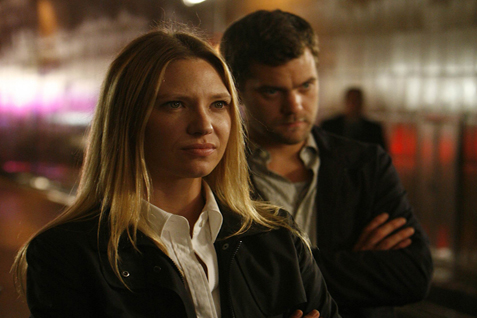
Watched the first episode of "Fringe", the new SF series from the US. It was just like an episode of "X-files".
No Mulder or Scully, but a pair of not dissimilar stars - nerdy genius male, emotional but resourceful female. Obviously some kind of relationship will build between this couple.
Mysterious happenings that seem to be outside normal science. Very familiar look and feel - did they use similar locations?
I'm not saying it's a bad thing to be like another successful series, but somehow this first episode, even though it reportedly cost $10M to make, didn't really grab me that much. Where did they spend that money?
Hopefully it will get better as we get used to the characters.
Update:
In 5 episodes, it probably got worse. Each episode has so much kooky 'science' it makes me want to throw stuff at the TV. I think there is an underlying story arc that has a lot of promise, to do with some bald dude observing everything, but I'm not sure I have the patience to go on.
Update 2:
Reluctantly I continued and finished the whole first series. I actually got used to seven impossible things happening before breakfast every day, and got quite interested in the story arc instead. Quite looking forward to series two.
Posted by se71 at 11:29 AM | Comments (0)
September 01, 2008
52 Books in 52 Weeks - August 2008
This was my last good chance for a while to get some reading done. I'm now commuting to work by bike, and have lost up to 10 hours forced reading time a week. I will have to try and read more in the evenings and weekends to try and make amends for that.
Quake was as depraved a read as I can remember, sort of fun like a slasher movie, but disappointing in it's lack of plot, and I think I won't read any more of Laymon's books now.
Ravenheart was marvellous, part three of the Rigante series which I started only a few months ago. Stormrider, the fourth and final part of this series was really good, but got bogged down near the end with too much military detail. I also feel that it was a set-up for another part, which sadly we'll never now see.
Mystic River is a standard thriller, which tries to be something more, and doesn't quite make it.
Finally for August, a nice short read in the Booker Prize winner Disgrace. Set in turn of the century South Africa, it's a story of one man's fall from grace, and an allegory for the state of the whole country; I didn't like it that much, mostly because I couldn't understand anyone's motives, but also because of the way it just stopped when there was much to resolve.
31 Quake by Richard Laymon
32 Ravenheart by David Gemmell
33 Mystic River by Dennis Lehane
34 Stormrider by David Gemmell
35 Disgrace by J.M. Coetze
Posted by se71 at 03:16 PM | Comments (0)
August 30, 2008
Disgrace - J.M. Coetze
Disgrace by J.M. Coetze
Book 35 in my 52 books in 52 weeks in 2008
On my shelf for quite some time - another Booker prize winner. One of my rare adventures into non English/American authors too, as Coetze is South African.
And unsurprisingly, this is a novel about apartheid, or more particularly, the end of apartheid, in South Africa. It would be nice if a foreign author could write an award winning book that wasn't quite so predictably parocial.
The narrative follows an educated middle-aged white man, David, working as a lecturer. He seduces a young student and when caught, is asked to apologise or lose his job. For no real discernable reason he decides to be difficult about this, and ends up on a road trip to visit his single daughter who is working a small farm miles from the city.
While staying with the daughter, David gets to experience the violence and despair of his country, and to understand more about the state of the races and their pecking order in the new South Africa.
OK, doesn't sound too bad from that synopsis, but it's depressing and frustrating. I couldn't realte to any of the people, who reacted differently to any normal person might expect to the situations they were in. Maybe this is really how people are, but Coetze did not make me believe in them.
I hated this book. I hated all the characters in it. I hated it's worthiness. I hated its inconclusive ending. I hated that the characters did things without any clear motivation. Even though it's short, I was still glad to finish this book.
Posted by se71 at 10:33 PM | Comments (0)
August 22, 2008
Stormrider - David Gemmell
Stormrider - David Gemmell
Book 34 in my 52 books in 52 weeks in 2008
The final book in the Rigante series of epic fantasies. Though it starts well and is as full of the excellent characters Gemmell is known for creating, I found myself wishing it was over by about 2/3 through. Why? Well it was all to do with the interminable battles. I like a good battle as much as, in fact more than, the next man. But if they go on too long, I lose sight of the intricacies of the logistics and tactics that only a real war general could be expected to follow. So I got lost. But the fighting continued.
It was a bit of a shame for me, as I have loved all the books - even this one up to about the middle of it.
Worth reading only if you've read the other three. Actually, you could get away with just reading "Ravenheart" and "Stormrider", and missing out the first books, "Sword in the Storm" and "Midnight Falcon" - but you'd be a fool to do that.
Posted by se71 at 10:35 PM | Comments (0)
August 14, 2008
Mystic River - Dennis Lehane
Mystic River - Dennis Lehane
Book 33 in my 52 books in 52 weeks in 2008
I like a good thriller once in a while - not too many, but when my mind is chock full of lightspeed spaceships genetically enhanced mutants, sometimes I need a break, and I find these kinds of books light relief.
This one hit the spot nicely and was another of my beach reads on my annual holiday. I chose it because I have seen Lehane's name around the bookshops for years, because I've heard good things about the Clint Eastwood movie it was made into, and because it was very cheap in a secondhand bookshop.
"One of the finest novels I've read in ages" says the blurb on the back. Well, let's not get carried away shall we - that reviewer obviously has poor judgement or has made some very unlucky choices in books lately. It's a competent thriller, no more, no less. It tries to be more, tries very hard, and almost succeeds. Maybe the film managed to distil the best parts. Don't get me wrong - it is a good book and I enjoyed reading it a lot. At over 500 pages it isn't short but it kept me going with no flagging.
The story is about three men, who suffered a trauma as boys, and drifted apart. But as adults living in the same neighbourhood, they are all still connected, and become more so when a murder is committed. One man is a cop, another a criminal, both want to solve the crime their way.
It's tense stuff, and you'll be kept guessing what really happened all the way. So enjoyable definitely, like an episode of CSI or Law and Order, but it's no Godfather.
Posted by se71 at 10:44 PM | Comments (0)
August 07, 2008
Ravenheart - David Gemmell
Ravenheart - David Gemmell
Book 32 in my 52 books in 52 weeks in 2008
This is book three in the Rigante series. I read the first two earlier in the year, and finished off the series with Stormrider right after this one. Both these were read by a beach in the Caribbean, not that that matters, but it helps explain how I got through them so quickly.
Set a few hundred years after the previous adventures, the heroes tales are almost legend to the people of the Rigante. we're still in a feudal setting, with warriors and a bit of magic. We get a brand new hero in Jaim Grymauch who is almost a match for Druss himself.
As usual, Gemmell delivers. Unfortunately, the connections to the previous books are a bit too thin to make it a proper series in my eyes - but that is a very small criticism.
Posted by se71 at 10:14 PM | Comments (0)
August 01, 2008
52 Books in 52 Weeks - July 2008
Only 3 books this month. The Kingsolver was recommended by a friend, and I loved the first 2/3 a lot - really worthwhile. It waned a bit after that, but was a very good read overall. Steinbeck I've had on my list forever, and it was good to finally tackle this giant - a very interesting and well written book. Alice Munro is on pretty depressing form, always good with her short stories, but it would be nice if she would lighten up occasionally.
August might be better, two weeks on the beach to read, but what to take? If I take War And Peace, I'll probably not finish it. Decisions, Decisions.
28 The Poisonwood Bible by Barbara Kingsolver
29 Of Mice And Men by John Steinbeck
30 The Love Of A Good Woman by Alice Munro
Posted by se71 at 07:35 PM | Comments (0)
Quake - Richard Laymon
Quake - Richard Laymon
Book 31 in my 52 books in 52 weeks in 2008
I read a fantastically funny/creepy/perverted horror book by Richard Laymon called "Island" many years ago. I've tried a few others over the intervening years, but nothing has ever come close to that first one.
Laymon is a great writer and gives plenty of suspense and adrenalin pumping prose, but a novel needs more than that. There is a great big hole in the center of "Quake" which never gets filled in. Why would an earthquake cause people to suddenly turn into murdering savages? A certain amount of looting and pillaging might be expected when it's first realised that the police are far too busy to chase down and catch everyone. In this story, the quake causes masses of people go completely homicidally crazy. But not all of them - many are unaffected.
It is left to the reader to speculate on the causes of this frenzy, but we just do not have enough information. even when you get to the end, and I won't give that away, you haven't enough to go on give any kind of closure to the story. I found this aspect very frustrating.
Some of the action is pretty good, Laymon can build tension and excitement. But a lot of the situations are very contrived and unrealistic. As in the famous comic strip 'Jane' from years ago - the girls seem to lose their clothes for no good reason quite a lot of the time.
Definitely an 'X' rated book, and unfortunately, not a great read.
Posted by se71 at 02:32 PM | Comments (0)
July 29, 2008
The Love Of A Good Woman - Alice Munro
The Love Of A Good Woman - Alice Munro
Book 30 in my 52 books in 52 weeks in 2008
I'm a bit behind in my reviews. This always means that the reviews I write are shorter, as it only takes a few weeks for the details to fade, and the character's names too, especially on shorter books that were quick reads. This is exaggerated a lot when it comes to collections of short stories, like this one. I can remember reading the book, and liking the stories, but without leafing through it, or looking it up on the internet, I cannot actually remember one of the stories from it.
So, my review would be something along the lines of "great stories about real life from one of the most popular short story writers alive today". That's a bit lame, I know. Sorry.
Posted by se71 at 01:43 PM | Comments (0)
July 14, 2008
Of Mice And Men - John Steinbeck
Of Mice And Men - John Steinbeck
Book 29 in my 52 books in 52 weeks in 2008
It's good to read some of the classics. It's even better when they are interesting, entertaingin, and short. This book is all three. Oh, and it's even better if it's a book your child is studying at school, so you can read it together.
I actually know nothing about this novel before I started it. Except that it was set in the depression in America. I always prefer to start a book with a clean slate like that.
This is the story of two itinerant farm workers, George and Lenny. The are travelling from ranch to ranch, trying to save some money to buy a place of their own to settle down in. George is smart, and looks after Lenny, who is mentally disabled Lenny finds it difficult to distinguish right from wrong, and it's mostly his fault that they have to keep leaving their workplaces.
As this is a standard textbook for many schools, much has been written about it, and I wouldn't really like to try and compete with the multitude of criticisms out there. It's a very interesting book that has a lot of action, and some really good tension. It explores many weighty topics, including poverty, racism, friendship, and disability, but in a matter of fact way that never makes the story drag.
I recommend the book highly.
Posted by se71 at 01:20 PM | Comments (0)
July 02, 2008
The Poisonwood Bible - Barbara Kingsolver
The Poisonwood Bible - Barbara Kingsolver
Book 28 in my 52 books in 52 weeks in 2008
There are very many books in the world that I will never read, and this could easily have been one of them. The outine isn't promising. An evangelical American baptist minister in the late 1950s decides to take his wife and four daughters to the Belgian Congo to be a missionary there. So that's religion and history as main topics - not usually my cup of tea.
However, I was talking to a friend about books this came up as one of their favourite, and I was told that I must read it. So I tried to get a copy but baulked at the full price and eventually got it second hand off Amazon. It was thicker than I'd imagined, but I finally made a start, and was glad that I did, as it turns out that it is one of the best books I've read recently.
Each of the females in the family get to tell parts of the story. It starts tantalisingly with Orleanna Price, the wife and mother, writing from 30 years in the future after she has returned home to America. She hints at terrible things that happened, and quickly lures you in so that you cannot stop reading until you find out what it is.
All the first person narratives from the Congo are written by the daughters. Ruth May is only about five years old, Leah and Adah are pre-teen twins, and Rachel is the teenager. After only a few chapters, you can recognise their unique voices from the way they 'talk', and from how they are reacting to life in the jungle. You quicky realise that their father Nathan is a bit unhinged. His mission is not even fully sanctioned by the church, and he refuses to accept any logical arguments on how to live in this new environment, alienating himself from the villagers with entreaties to baptise them in the crocodile infested river.
Emotions run high, and as disaster approaches the tension makes this a real page turner. I found it hard to out this down up to the emotional climax, which is unfortunately only about 2/3 of the way through the book.
If the novel had stopped there I would have been very happy with it. if I was to make a film of the book, I would definitely stop it there. But instead, it changes quite a lot, and turns into more of a history of the Congo region over the succeeding thirty years rather than just a family saga. The politics overwhelms this final stage too much, and though the case against the white man in Afica is pretty strong, I'm sure that the native people are not blameless either. However, America in particular, white people, and men, all get a very thorough bashing, and there are no bad Africans, or women at all, just a few who are corrupted by circumstances and by their colonial overseers. A bit more balance wouldn't have gone amiss. I found this less compelling. It was interesting, and I learned a lot, but I cared a lot less about the characters, and was glad when it finally came to a conclusion, of sorts.
I do highly recommend this book to anyone of any age; it is a marvellous piece of story-telling which you will not forget in a hurry.
Posted by se71 at 11:39 AM | Comments (0)
July 01, 2008
52 Books in 52 Weeks - June 2008
No real excuse for the low volume this month. disappointed by most of my choices however. Bach's book is very short and a reread to see if it was still as good as I remembered - it wasn't. Chabon's was highly recommended, but wasn't good. Reynolds is a favourite author, but this one was a bit flat, and the Hoban book was me filling in the gaps, light and fairly enjoyable, but a bit insubstantial.
24 Jonathan Livingstone Seagull by Richard Bach
25 The Yiddish Policemen's Union by Michael Chabon
26 The Prefect by Alastair Reynolds
27 The Bat Tattoo by Russell Hoban
Posted by se71 at 07:25 PM | Comments (0)
June 27, 2008
The Bat Tattoo - Russell Hoban
The Bat Tattoo - Russell Hoban
Amazon link to The Bat Tattoo - Russell Hoban
Book 27 in my 52 books in 52 weeks
I do quite enjoy the writing style of Russell Hoban, though I'm sometimes not quite sure any more what else it is that leads me back to reading his fiction. This is a fairly slight love story, about a pair of late middle aged people meeting and gradually connecting. The story has most of the Hoban trademarks; art appreciation and art history, sex, religion, and pleasingly it takes place around the streets of London, many of which I know well.
Rosewell Clark and Sarah Varley are the two main characters. Both are suffering from losses, and through a chance meeting at the V&A museum, along with a few other unlikely coincidences, they start to get to know each other. Clark is an estranged American earning a living making increasingly bizarre wooden sex toys for a mysterious patron. Sarah sells antiques at a market stall in Covent Garden. Some fun is made of the oddities of modern art at a competition in which Rosewell plans to enter a piece of his own.
I guess there is an intelligence here that is lacking in a lot of the books that you'll find in the top ten lists at the local bookstore. Hoban doesn't play with your emotions, he tells thoughtful but honest stories, and never gives easy answers to the philosophocal questions of life, love and death that he asks. The books are easy, and challenging, at the same time. His is a unique voice which I continue to enjoy.
[Note: I found a much better review on the Guardian website here. They like it a lot too.
Posted by se71 at 10:11 AM | Comments (0)
June 20, 2008
The Prefect - Alastair Reynolds
The Prefect - Alastair Reynolds
The Prefect - Alastair Reynolds
Book 25 in my 52 books in 52 weeks.
Another competent and entertaining science fiction book from Reynolds. Unfortunately, it's not that much more than that. There are not any great concepts in here and no compelling mysteries (well, a little one). It is set in the same universe that a lot of his previous novels have been. This time that action is centered near a planet which has thousands of orbiting habitats. The prefect in the title is a future lawman; part policeman, part judge, not unlike Judge Dredd. He is investigating a crime, where an explosion destroyed one of the habitats. But it's not that simple, of course, with conspiracies going back twenty years that threaten the future of the whole system.
I enjoyed it, but was unconvinced by some of the elements. The prefects are not allowed guns, but do have a weapon called a whiphound which is almost as deadly. A junior prefect makes a change to some computer code, and it is distributed, unchecked, to live systems. This is highly unlikely to take place, but is required by the plot, and so a major story element is nonsense, which annoyed me.
I think the focus on this small area of space was a mistake, and I'm looking forward to the next novel much more ("House Of Suns") as it promises a much larger canvas.
Posted by se71 at 04:14 PM | Comments (0)
June 11, 2008
The Yiddish Policemen's Union - Michael Chabon
The Yiddish Policemen's Union - Michael Chabon
Book 24 in my 52 books in 2008
I am a science fiction fan, this is pretty obvious from my book choices. This recent novel won the Nebula Award, and has been nominated for the Hugo award - the top two awards in science fiction. In an attempt to explore new authors, I thought that would be a pretty good recommendation. I was wrong.
Chabon has written a detective story, one which leads from a simple murder, to an international conspiracy, not unlike Dan Brown's Da Vinci code. It's written in the Sam Spade gumshoe tradition, with a detective who drinks too much, smokes too much, has issues with women - you know the scene. He is Jewish, and I should have guessed from the title, but this isn't just a part of his character, it permeates the whole book. Every character is Jewish, the whole plot revolves around Jews, and their religion. Chabon uses a lot of Jewish words without explanation, and also makes up a few new Jewish sounding words, so that I spend a lot of time in the dark about what the hell was going on.
Oh, I did mention is has been classed as science fiction - didn't I?
This is not science fiction. Did Robert Harris's 'Fatherland' get onto the science fiction shelves - No? Like that novel, this is an alternate history book. In Fatherland, also a detective story, Germany wins World War II, and a detective in Germany some years later has to solve a crime. Here, the historical difference is that in 1940 many of the Jews in Europe are relocated to a remote island called Sitka in Alaska, and the Holocaust, though not averted, is reduced. World history is altered in other ways, some quite interesting, but never really explored, only mentioned in passing. In a way, this is a blessing, as the politics of the Israel/Arab/Palestinian situation is complicated enough, so if you don't understand that deeply, then the subtle changes that make it different will not help.
This 'What If' exercise is a device to explore the Jewish condition, to see how Jews would live if they'd been allowed to, and it's just plain boring unless you have some interest in that area. I feel cheated by this book, it was a complete waste of my time.
It is however a clever book, and there is a good detective story trying to get out. Chabon is no fool, he writes well and has interesting characters and relationships. Sometimes his detective hero Landsman gets into some unbelievable scrapes, and even more unbelievably gets out of them again, but that's forgivable in a detective story. I could have liked this a straight detective novel.
But I was sold something else completely, there is no science in this at all. The all pervasive religiousness of the story annoyed me immensely. I know I'm coming across here as anti-Jewish, but I'd feel exactly the same way about any other religion (I read a book by Russell Hoban last year called 'Pilgermann' which had way too much Christianity in it for example). A lot of praise has been given to the book by the SF community as it's a mainstream author who is straying into genre territory. I disagree with this; we have enough good SF authors and books out there; we don't need Chabon, and McCarthy ("The Road") and their like to raise the profile with their brand of SF-Lite.
Posted by se71 at 11:55 AM | Comments (0)
Jonathan Livingstone Seagull - Richard Bach
Jonathan Livingstone Seagull - Richard Bach
Book 23 in my 52 books in 2008
This is cheating somewhat, it's a very short book indeed, and I've read it before (though a very long time ago). I seem to remember quite liking it, and I was looking for something undemanding to read in bed while suffering from an annoying cold, and I saw it on the shelf.
[Spoilers below]
I didn't like it as much this time. I'm older and much more cynical. It seems to be some kind of fable or parable, with heavy religious overtones. The narrative is about a seagull, a special bird, who wants to learn to fly as fast as possible. Spoiling the story totally now, He abandons his flock, and is ourtcast by them, but keeps trying. Eventually he attains a skill so advanced, he visits heaven, and can transcend space and time. He becomes a teacher of other gulls (disciples) who go on to become teachers themselves spreading his word (gospel) to unbelievers (me!)
Actually, not only did I not think it good, I was insulted by it's simplicity. Not only is there all this heaven stuff, but something that annoyed me was that the gull always knew exactly how fast he was flying in MPH - that's a bit of a stretch of the imagination. Maybe not as much as believing in different levels of heaven and moving through the space/time continuum like Doctor Who, but enough to niggle.
I have no idea why this sold over 1 million copies, or why it was made into a film with a concept album/soundtrack by Neil Diamond (which I haven't heard). It's not worth it. But as a piece of 1970s pop culture, and a less than 30 minute read, I guess it has some historical interest.
Posted by se71 at 11:26 AM | Comments (0)
The Steep Approach to Garbadale - Iain Banks
The Steep Approach to Garbadale - Iain Banks
Book 22 in my 52 books in 2008
Another fiction, as opposed to science fiction, novel from Banks. Slowly but surely I'm nearing completing the full set (the SF I'm bang up to date, with just the recent hardback, 'Matter' outstanding).
The beginning is a bit disconcerting, as you try to work out who the book is going to be about, but it quickly settles down and we get the story of a man called Alban, born to priviledge, in a rich family successful through the business of selling a game that is not unlike monopoly.
There are several themes here; Alban's mother's death, the proposal by an American company to take over the family firm, and Alban's lovelife, especially his relationship with his first cousin Sophie. They are all handled interestingly, you feel as if a conclusion will be reached, you enjoy the journey. In short, you feel throughout as if you are in a safe pair of hands, and won't be disappointed. Nor are you. However, I wasn't quite interested enough a lot of the time. Alban didn't seem to ever make his mind up about anything, or have any clear plan, and so it was difficult to get behind him.
His family were a quite a bunch of eccentrics, quite amusingly described, and one scene with Sophie was so well crafted, and had such a deliciously filthy punchline, I got a few looks on the train as I tried and totally failed to suppress my schoolboy sniggers. The whole book was saved by that page in my opinion.
Sometimes I feel as if there ought to be a section in the bookshop for mainstream novels that contain enough sex to be reclassified onto the erotic shelves. Sometimes I think the authors go a bit further than we really needed for the plot. Banks has done it again, here. In fact, it seems to me to be an increasing trend. I think it's lazy writing, and annoying, as I'm not likely to recommend books containing detailed sex to my mum, or my children to read. My 10 year old asked me the other day why books don't have certificates, like films do, U, PG, 12, 15, 18. I had to guess at an answer, which I think is that they are in a way self certificated - the barriers of entry are higher and a child is unlikely to pick up an adult book filled with violence and sex. Even if they start to read it, if they are mature enough to do that, perhaps they are already mature enough for the content. A film has no such barrier - if it's on screen, anyone can see it. This subject is a particular bugbear of mine, one day I'll try and rationalise it all out.
'The Steep Approach to Garbadale' is a fairly traditional novel, well written, slightly flat in a way, but enjoyable and with a few great trademark Banks scenes.
Posted by se71 at 10:20 AM | Comments (0)
May 29, 2008
Watchmen - Alan Moore and Dave Gibbons
Watchmen - Alan Moore and Dave Gibbons
Book 21 in my 52 books in 2008
This is a graphic novel, perhaps the most famous one of them all in the comic community, though perhaps not outside of it. This is quite likely to change however when the movie version comes out in the near future. When I found out they were turning it into a film, that was my impetus to finally go and buy a copy after all these years.
Now for the heresy - it's not really very good. I found it slow, plodding, repetitive, fairly dull from a superhero point of view, and its politics were heavy handed and obvious. The artwork wasn't my kind of thing either, being fairly plain, flat, and static; I like more colour, and more realism, unless it's stylised stuff like Frank Miller.
The story is an alternate universe scenario. What if a bunch of fairly normal people decided to become masked crime fighters, vigilantees like Batman, but lacking his gadgets and using mainly their fists. I'm nodding off already. This is what happened in the mid part of the 20th century, until there was a backlash, and most went into voluntary retirement. Now, it's 1985 (around the time the novel was published) and it looks like someone is killing them. One of the heroes, Rorsache, starts to inverstigate, writing notes in his journal, which we get extensive passages from that reveal the history of the Watchmen.
Most of the story is detective fiction. The only real superhero stuff is a character called John, who was in the traditional bizarre accident, and was transformed into an omnipotent being who can transform matter, teleport, and see all time. Pretty impressive stuff, but massively underused.
A kid sits on a pavement reading a comic throughout, and this pirate story is also reproduced, interlaced within the Watchmen story. There seem to be attempts to connect the two, and it was either too subtle for me, or too vague, but I just didn't see the point.
I wish I'd read it in 1985, as the cold war and the politics of the day are heavily featured, and our impending armageddon due to mutually assured destruction seemed a real threat then. I think I would have felt more engaged emotionally. The world's problems have changed, and I'll be interested to see if the film being made now updates the plot to include global warming, or the war on terror, instead.
Overall, I was sad not to have liked Watchmen, as I always thought I would. I was kind of saving it for a rainy day, which was a mistake. As always, I think my creed of less politics, more science fiction, would have helped massively.
Posted by se71 at 09:51 AM | Comments (0)
May 28, 2008
A Quiet Belief In Angels - RJ Ellory
A Quiet Belief In Angels - RJ Ellory
Book 21 in my 52 books in 2008
Another "Richard & Judy" bookclub pick. When will I ever learn? I blame my sister for this one, we both saw it, and thought it looked good, and encouraged each other a bit to read it.
Ellory is trying to write like one of the giants of American literature, like Steinbeck or Hemmingway. He writes long paragraphs of flowery prose, and repeats things again and again, in case he thinks we didn't get it the first ten times.
Yes, I know there were murdered girls, stop telling me their names! It doesn't actually make a difference to the plot to repeat them again and again and again!
And relax.
But he isn't writing "To Kill A Mockingbird" - that's been done already! He's writing a thriller. But even a slow-boiler thriller should be a bit more exiting than this.
OK, back to the plot. It's not actually a half bad story, I quite liked it and it's quite rightly placed firmly in the detective fiction section. Joseph Vaughn is the protagonist, and right at the start we know he has spent his life tracking down a murderer, and shot him in an anonymous hotel. The rest of the book is told in flashback, as Joseph tells us about his harrowing life, and we try to guess whodunnit..
A serial murderer is stalking a small town in Georgia in the Southern United States in the late 1930s. He is killing little girls, ones Joseph knows. Joseph swears to protect the girls, but he fails, and ever afterwards feels overwhelming guilt about it. His life goes from one tragedy to another, becoming almost increasingly bizarre and unbelievable.
Very many authors these days seem to equate volume with quality. There are far too many words here. This needs tightening up. It's also only written from Joseph's viewpoint, so we get no idea about what's happening with the other people. This can work, but I noticed quite a few places where he knew things that happened when he wasn't even there, and his childhood views and vocabulary were far too advanced for his years.
All in all, quite a difficult book to get through, almost worth it in the end to see how the story pans out, but I'd advist not starting it.
next:
Watchmen by Alan Moore and Dave Gibbons
The Steep Approach to Garbadale by Iain Banks
Posted by se71 at 02:28 PM | Comments (0)
Close Range by Annie Proulx
Close Range by Annie Proulx
Book 20 in my 52 books in 2008
This is a collection of about a dozen short stories, the most famous of which is of course the final one - Brokeback Mountain.
All the tales are about cowboys in Nevada, and you can see Proulx has done considerable research on this, especially the history, as many feature the economics and weather of this part of the world. I'd like to say there is a good mix of comedy and pathos, but if I tell you that the most amusing part of the whole thing is a story about a man freezing to death and having his leg sawn off by someone who wants to steal his boots, you might start to get the measure of the piece.
This is all about tragedy. Rodeo riders get maimed and half killed, car crash victims go mad, people die in the freezing conditions. The depression is unrelenting, and 'Brokeback Mountain" itself is hardly a barrell of laughs, though I'm not giving away anything here in case you still need to see the film.
However, the writing is good, immersive, and I felt I started to get to know these people a bit. I still don't understand them, it sounds like a completely awful and unfulfilling life to choose.
You might be tempted to pick up this volume and just read "Brokeback Mountain". I'd advise against that. It is easily the best story here, but like a good piece of clasical music, where the variations of the themes in the opening movements make the finale even more satisfying, you need to consume the whole thing here to get the full emotional impact.
Recommended, but this is grim, gritty stuff.
next
A Quiet Belief In Angels by RJ Ellory
Watchmen by Alan Moore and Dave Gibbons
The Steep Approach to Garbadale by Iain Banks
Posted by se71 at 02:03 PM | Comments (0)
The Neutronium Alchemist - Peter F. Hamilton
The Neutronium Alchemist - Peter F Hamilton
Book 19 in my 52 books in 2008
This is the second volume of the massive "Night's Dawn" space opera trilogy. I made a bit of a mistake leaving so long an interval between reading this and "The Reality Dysfunction". Hamilton has provided no synopsys, and you're expected to hit the ground running in terms of plot and characters, and I found that a bit tricky sometimes.
However, I quickly got stuck in for the marathon read, managing maybe 40 dense pages a day. This is challenging stuff, but always interesting and never slow paced. There are always battles, arguments and chases with spectacular ideas and revelations around every page-turn.
But when an author decides they need nearly 3500 pages to tell a story, you have to ask the question, Why? Couldn't some of the slack be cut and still leave all the important stuff? Isn't a lot of it unnecessary filler? And the answer is that I don't think you could here. It's a remarkably complex story, taking place across many star systems in the galaxy.
The story is about a type of very unusual virus. It is discovered and begins to spread in the first volume, and continues apace here. How would a planet cope, or an orbital habitat? You can be sure that there would be more than one way, and several different scenarios are played out here, which is interesting, as well as the interactions between the different 'solutions'.
There are big ideas about death here too, and the religious implications are touched upon a little more than before, but still not that much.
In short, I loved it. I could have read 5 other books in the same time period, but I'm happy with my choice.
next:
Close Range by Annie Proulx
A Quiet Belief In Angels by RJ Ellory
Watchmen by Alan Moore and Dave Gibbons
The Steep Approach to Garbadale by Iain Banks
Posted by se71 at 11:39 AM | Comments (0)
May 02, 2008
52 Books in 52 Weeks - April 2008
A very slow month indeed, as I expected. This is why I hammered through so many books in the first three months of the year. This month my commuting time was spent on a massive science fiction tome, full details next month.
I only actually finished a single book this month, and it wasn't even fiction.
William Goldman - Which Lie Did I Tell?
This is a book about how to write screenplays, and if anyone knows how to do that, it's Goldman. It's got some great insights, and realistic tips on what you should and and shouldn't do. It's also chock full of anecdotes where he namedrops Hollywood stars like mad.
And did he really write "Good Will Hunting" ? Find out here, maybe :-)
Posted by se71 at 09:02 AM | Comments (0)
April 25, 2008
Which Lie Did I Tell? - William Goldman
Which Lie Did I Tell? - William Goldman
Book 18 in my 52 books in 2008
This is a book about how to write screenplays, and if anyone knows how to do that, it's Goldman. It's got some great insights, and realistic tips on what you should and and shouldn't do. It's also chock full of anecdotes where he namedrops Hollywood stars like mad.
And did he really write "Good Will Hunting" ? Find out here, maybe :-)
Posted by se71 at 12:28 PM | Comments (0)
April 02, 2008
52 Books in 52 Weeks - March 2008
A slow month, only 5 books, due to starting a large book half way through the month which I'm still ploughing through.
Wings by Terry Pratchett
Excellent conclusion to the funny and interesting children's fantasy series.
Pig Island by Mo Hayder
Quite hard to define, horror thriller perhaps, but not that horrific really, and more, sort of, creepy.
Camouflage by Joe Haldeman
Magnificent SF story about immortal changelings who have been living on earth for millenia amongst us.
Strangers by Taichi Yamada
Ghost story set in modern day Japan. Suffers I think from being strangely translated in places. Very downbeat, but not bad.
The Five People You Meet In Heaven by Mitch Albom
Really terrible morality lecture couched in fiction. At least it's short.
Proper individual reviews are still to write, must get on with that.
Posted by se71 at 02:51 PM | Comments (0)
March 26, 2008
The Five People You Meet In Heaven - Mitch Albom
The Five People You Meet In Heaven by Mitch Albom
Book 17 in my 52 books in 2008
A very popular book, no idea why, it's very dull, predictable stuff in the main.
A man dies and goes to heaven. He is told that he will meet five people from his life who will explain things to him. (five, a stupid arbitrary number, which is never explained. What if you lived on a desert island and only ever met one other person?). Once the explanations are over, you, and they, will all be able to move on to another plane of existence.
He duely meets these five people (they're all dead too, of course, and have just been waiting for him). Luckily he is old, and so has many different periods of his life the author was able to utilise, including a spell in the Vietnam war. After each one, we get a 'lesson learned' lifed straight out of a religious self-help book.
Don't waste your time on this sentimental, poorly written rubbish, unless you're really in need of someone telling you that everything will be alright, that everything bad happens for a reason, and that you'll be happy in heaven when you die.
Posted by se71 at 11:25 AM | Comments (0)
March 22, 2008
Strangers - Taichi Yamada
Strangers - Taichi Yamada
Book 16 of my 52 books in 2008
On the lookout for something new, I was intrigued by a very glowing review of this book by a blogger I read.
I didn't think it was a poor book, but I'm a very long way from being as enamoured by it as that reviewer.
This is a ghost story set in modern day Japan. It is an English translation of the Japanese original, and suffers a bit from that in the cheesy dialog. Harada is a 48 year old TV writer, recently divorced, and living alone in an almost empty apartment block. He forms a relationship with a younger woman who seems to be one of the other few residents. Around the same time, he is wandering the streets of his home district when he catches sight of a man who looks like his father. The two strike up a conversation, and Yamada goes back to the man's home, where he meets his wife, who is also the spitting image of Yamada's mother. Both are young, and his parents are dead anyway, so how could they possibly be real.
Weeks go by, and Yamada visits the couple more, but then his girlfriend and ex-business partner start to notice something strange about him.
It's all very sad, and a bit disturbing. Is it real, or is Yamada falling apart. It's difficult to get into this man's mind to understand his feelings and motivations. I'm not sure it's something a westerner can really understand completely without a more thorough knowledge of the Japanese culture.
It's a short book that only took a few days to finish, and yet it has stayed with me.
Posted by se71 at 10:43 AM | Comments (0)
March 15, 2008
Camouflage - Joe Haldeman
Camouflage - Joe Haldeman
Book 15 of my 52 books in 2008
This is a good solid science fiction story from the old school. What would happen if an alien was living amongst us, and had been here for hundreds or thousands of years? It can change it's form to look human, or to look like a fish and live in the sea. So what would it do?
Trying not to give too much away, the major theme of this book I thought was morality. Can an alien learn to be a moral person? And can it fall in love? Are these human traits universal?
The narrative is always interesting, characters develop nicely over time, and there are a lot of fun situations which get interesting resolutions. The climax is maybe a bit flat, a bit rushed, and I wanted more exposition. Nevertheless I'd recommend the book highly.
Posted by se71 at 10:02 AM | Comments (0)
March 11, 2008
Pig Island - Mo Hayder
Pig Island - Mo Hayder
Book 14 of my 52 books in 2008
An author whose books I've seen on the shelves for a few years now. This one was second hand, in good condition and cheap, so I got it.
Horror is a genre I've neglected in my reading recently. No particular reason. I think I've grown out of it a bit. I should do a little research and see if I'm missing anything good.
There are two types of horror story. One is probably more of a violent thriller - 'Silence Of The Lambs', 'Misery' or "Psycho" are examples. In these the fear is driven by real world people and events. Psychopaths, rapists and serial killers are the kind of people in these. They can be very effective indeed, and in fact, can be much more scary than the second kind.
In the other type of story, supernatural creatures and phenomena create the scares. Fear of the unknown is exploited in stories like 'Dracula' and 'Salems Lot', and in films like 'Alien' and 'A Nightmare on Elm Street'.
Some stories like to play with their audience, alternating between paranormal and real, giving the reader a constant guessing game about whether there really is a realistic explanation for the spooky happenings going on. Pig Island is one of them.
In Pig Island, the main narrator is a reporter who makes his living by investigating weird stories, and debunking the ghosts or goblins he doesn't find as hoaxes. He is covering a story on an island off the west coast of Scotland where a strange creature has been spotted in the woods. Is it some kind of bigfoot, or has the strange cult living there summoned the devil or one of his beasts from hell.
He goes to the island and meets the cult, who seem like a peaceful lot, except for one member who lives alone, estranged from the rest. Something terrible happens, and then the pace hots up a bit.
This is quite an entertaining read. The main plot is a bit far fetched, but I what do you expect? There is a weird sub-plot with the reporters wife, who seems to be completely bonkers, and this never really gets resolved properly. Another negative is that is all gets a bit gynecological, with more medical information than I needed to know - if Hayder is trying to gross out her readers, it's worked.
Very readable, but I'm not convinced by the author, and will probably not be trying any more. There are plenty of other authors to try.
Posted by se71 at 06:41 PM | Comments (0)
March 04, 2008
Wings - Terry Pratchett
Book 13 of my 52 books in 2008
This is the third and final book in the Nome trilogy; I quite recently finished number two, 'Diggers', and some of what I wrote about it unsurprisingly also pertains to this volume.
In a nutshell, Nomes are a race of people, living on Earth for thousands of years, but never seen by humans because they are very small, and move very quickly. In the first book, Truckers, two different tribes meet, and steal a truck. In the second 'Diggers', Some of them steal a digger. In this one, there is quite a lot of flying.
If you thought that the first two books were good, then this one will blow you away. It has a much larger scope, much. Masklin, from book one, and some of the store nomes, take the Thing (a black box, which is an ancient Nome computer) on Concord and go to Florida to try and get on NASA's Space Shuttle.
This is a lot of fun, and the Nomes get into plenty of scrapes. There is a neat conclusion where all the Nomes get back together, and we get to learn more about tree frogs.
Posted by se71 at 09:32 AM | Comments (0)
First Blood - David Morrell
Book 12 of my 52 books in 2008
I first read this book in the late 1970s. I loved it then, and eagerly waited for the movie. Stallone did a good job, and made a lot of money from the franchise, but he changed too much to my mind, and lost the subtlety that you get from reading. This is understandable, and I guess excusable. I really recommend that you go back to the original text though if you like action, but also like to think intelligently about why it's happening.
Rambo is a decorated Vietnam veteran, drifting from town to town after the war. Teasle is a town cop, a veteran himself of Korea, but a flawed man going through a divorce. When these two encounter each other, the timing is just right for sparks to fly. Teasle doesn't want his neat town disturbed by vagrant troublemakers. Rambo is tired of being moved on for no reason and decides, when Teasle tries to make him leave, that he's had enough.
We get a really good viewpoint of both people, the focus switches almost eqwually between both men and we see how they think. Even from the start we can find ourselves to rooting for both of them, not sure which should overcome. Even though the body count escalates remarkably quickly, it's believable, and almost inevitable.
The conclusion is the only real way events have shaped it to go, and I'm not going to give it away here, but it's both shocking and satisfying.
A truely excellent book, give it a chance. I don't usually push Amazon reviews, but each reviewer there has given it 5 Stars, even those who hated the films.
Posted by se71 at 09:31 AM | Comments (0)
February 26, 2008
The Book Thief - Markus Zusak
Book 11 of my 52 books in 2008
I'm a sucker, as I've said before, for reading books that are popular and prominently displayed in the bookshops. This one seemed to be getting good reviews, so even though it was one of "Richard & Judy's" book picks, I gave it a go.
I was also intrigued by the thought of a book narrated by Death, but this is just the SF/fantasy fan in me and Zusak didn't really give me much of a fix in that area. There is little cleverness here in the use of this trick, and in fact, Death is really just what other people would call an omniscient narrator.
How did 'normal' German people react to what was happening in their country during World War II? That could be the story told here,and was what I expected. It works to some extentr, except that there are very few actual normal people. A book full of normal people, and their reactions to extraordinary circumstances is possible, and I would have liked a few more of them. But this is in many ways written like a children's book. The characters are all larger than life, with many episodes constructed for slapstick comedic effect. On the other hand, maybe this is needed in a book otherwise fo full of dreadful themes. That's my main problem with the book; when thinking about it, I hate it, and I like it, and I think some things should be changed, and then I think maybe they are needed after all.
To the story. A young girl called Liesl is the titular Book Thief. She is adopted by a family near the German town of Munich in 1939. Her mother has abandonded her, and her tragically sad journey gives her nightmares for many months.
She soon adapts to the new life, but only really makes one new friend, a boy called Rudy. As 1939 turns to 1940 and onwards, the effects of the war are very strongly felt. There is rationing and everyone is very poor. Lisel is taught to read by her new Papa, and though she cannot afford books, manages to steal some, and these become the only things she treasures. I thought the whole book theme, paradoxically, was the worst part of this novel. It feels contrived and unbelievable.
Many of the shocks the book throws at us are cushioned beforehand. So when a major character is injured or dies (there is a war going on, remember), you are prepared, and it's not quite so upsetting. This gets overdone, and is almost annoying. I think the author is trying not to upset his younger readers.
In summary, I liked it a lot at the end, but many parts were clumsy. It was very readable, and never had a chance to get boring - the 500 pages do fly past. but it's more of a teenagers book probably than an adult one.
[This review has been the most difficult I've written recently, and has actually taken several re-edits to get even close to being finished, and I'm still really unhappy with it. So it goes]
Posted by se71 at 12:43 PM | Comments (0)
February 17, 2008
Diggers - Terry Pratchett
Book 10 of my 52 books in 2008
This is the second instalment of a small trilogy of books that are primarily aimed at children - "The Bromeliad". [1]
In the first, "Truckers", a group of Nomes (small people that live under the floorboards in a large department store) escape from it's imminent demolition by stealing a truck. This is not a mean feat when you're only a few inches tall.
Now they are living in a disused quarry, and in case you haven't guessed, a digger might well be a key part of the plot. Looking forward to re-reading the third one - "Wings", wonder what that will be about :-)
Like all Pratchett's books, this one is funny and clever, entertaining but also with a lot of intelligent things to say about people and the world in general. I first read this trilogy in the early 1990s, and at the time I was struggling with the idea of becoming a fully fledged manager at the company I was working at. These books actually helped me to understand a lot about the nature of leadership believe it or not, and I guess persuaded me I didn't really want it. I left the job soon afterwards.
Highly recommended for children of all ages.
[1] very interesting name for a trilogy - see here
Posted by se71 at 10:52 AM | Comments (0)
February 15, 2008
No Country for Old Men - Cormac McCarthy
No Country for Old Men - Cormac McCarthy
Book 9 of my 52 books in 2008
I'm going to have a lot of trouble reviewing this without spoiling the story for you. I'll try, but am not promising anything, so if you haven't read it, or seen the multi Oscar nominated film version from the Coen brothers, then look away now.
This is a bleak story, which starts off violently, continues in that vein, then somehow manages to get even grimmer by the end. If you're looking for some glimmer of hope, some redemption, you're going to be disappointed, because just about everyone loses in one way or another in the end.
It starts off fairly conventionally. A man named Moss finds a pile of money that was supposed to be used in a drugs transaction, and he takes it. The people who own the money want it back, so he goes on the run. A violent psychopath called Chigurh is one of the people chasing him, and this man is one of the scariest people you'll encounter in fiction. The local sheriff tells quite a lot of the story in first person, and the book is really about him. The story however climaxes a bit too soon, and the rest of the book then clears up a few loose ends (though nowhere near all) and judders to a kind of stop.
Like a lot of fiction, the narrative action itself isn't really the thing that's most important. It's what keeps you reading of course, an essay on the topic wouldn't have the same, or anywhere near as large an audience. No, what you'll take away from this is the sense of despair of a man nearing retirement looking at his country falling apart. He looks at the drug related killings, and thinks that things have gotten much worse since he was young. People have changed, the world is going to hell, and there is nothing he can do about it.
McCarthy repeats his prose style from the last novel, "The Road". It's sparse, sort of stilted. People have conversations where they say things without really saying them. And there are no quotation marks so it gets very tricky to tell sometimes who is saying what. There are whole scenes where you have to pick up clues to know who they are about, which is a bit annoying, and I found myself rereading several pages once when I realised I'd gotten it completely wrong. When it's good though, the scenes are startlingly real and intense, and the book is unputdownable at those times. Chigurh likes to talk to people before he kills them - and maybe he'll let them live, you are never quite sure.
And like the original and only good, Rambo story "First Blood" (even if you don't like Sylvester Stallone, you owe it to yourself to go back the the source novel by David Morrell), this is a book about the alienation of America's young men returning home after a war. Vietnam is the obvious one here, but WW1 and WW2 are also represented. I spent a lot of time guessing the time period in which the book is set, from the ages of the characters, and the wars they were in, and I came up with early 1980s - McCarthy really makes you work for it.
It's a good book, but the pacing needs workm and I expect it will make a great film. It feels like it was written especially for the screen, and in fact, especially for the Coen brothers. I look forward to watching it, but I think I'll need a stiff drink afterwards.
Posted by se71 at 09:40 AM | Comments (0)
February 12, 2008
Animal Farm - George Orwell
Book 8 of my 52 Books in 2008
This is cheating a little, as it's a very short book, and also a reread. I wanted to refresh my memory of it before passing it along to someone else, so that we can discuss it meaningfully together. It's at least 20 years since I read it, and I'd forgotten many of the small points, so I'm glad I read it again.
What can I say about it that has not been said thousands of times before. Not much. Everyone knows that this is, as it's subtitled in fact, a "Fairy Story" about farm animals taking over their farm from a farmer. Everyone also knows that this isn't what it's about at all, it is a story about politics and how workers are controlled by their leaders.
I'm not that hot on different political systems. Communism is the main target here; I know this from my meagre back knowledge of Orwell and the history of the Russian Revolution. The animals overthrow their oppressive owner, but gradually, their new society reverts to a similar, or even worse, condition. The pigs, as cleverest, set themselves up as leaders, and like it a bit too much. They use misinformation, distraction, and eventually terror to force the other animals to obey them. It happens quite gradually, and it's really very clever and it is satisfying to watch the plot work out, even when you know how it's going to end.
Any government is in danger of exhibiting the dangers seen here. This novel is as relevant today as it was during World War II when it was published. As a story for children it is very violent and callous in places - but then, so are many traditional fairy stories. I highly recommend this then to all ages, and in fact, will now look out for one of the animated versions on DVD to play at home.
Posted by se71 at 10:30 AM | Comments (0)
February 08, 2008
The Songs Of Distant Earth - Arthur C. Clarke
The Songs Of Distant Earth - Arthur C. Clarke
Book 7 of my 52 books for 2008
I've had this book kicking around my house for years, and picked it up this week because I couldn't really decide what else to read, and it's quite short, and I really do need to read what I've bought before buying too much more.
When I first stareted reading SF, I devoured Asimov and Sheckley and Heinlein, but for some reason only managed a couple of Clarke's books (2001/2010). More recently I read "Rendezvous with Rama", as it's regarded as a classic, and it was OK but utlimately a bit unfulfilling. Sadly, I feel the same way about this novel.
The premise is that in the future, life in our solar system becomes impossible, and so seed ships are sent to planets around other stars. They are automated, and contain enough genetic material that machines can recreate humanity and other forms of earth life and plants in the new world. On one such planet, Thalassan, people have thrived on a world mostly covered with water. 700 Years after they arrived, something thought impossible happens; a ship full of real people from Earth arrives.
The narrative follows the interactions of these two different cultures. There is some future history of Earth, some philosophy on the nature of God, a bit of genetic nurture/nature talk. Interesting topics of course, and intelligently handled.
So what's the problem? All the elements for a great story seem to be here. Part of the answer lies in the age of the piece. It's based on a novella from 1957 (this updated/extended version was written in 1985). In the 1950s it was easier to get away with throwing in a few speculative ideas, a spaceship, and a couple of aliens to make a story. I've become spoilt recently with Alistair Reynolds, Iain M Banks, and Stephen Baxter [1] who manage to fit a whole lot more into their fiction - mystery, excitement, violence, mind boggling ideas, and really wild things. It's hard to go back to the old 'classics' which read a bit like children's stories of the future to me now.
Secondly and related to the first point maybe is that all the characters behave in such a caring and supportive way to each other that it's just a bit boring. Some evil thoughts are revealed, but nobody actually actions them. You would think that a threatened ship's mutiny would be a bit interesting, but it's all over amicably in a few pages. One thing I did quite enjoy was the outrageously unsubtle digs at religion we get in here.
I've often thought that I'd have time eventually to get round to reading a lot of 1950s-1970s SF that I missed. However, when I do, I'm quite often disappointed like this. Yesterday's futures have a hard job of staying fresh, and unfortunately The Songs Of Distant Earth has gone stale.
Update:
Not long after writing this, Arthur C. Clarke died. I felt a bit bad that I'd just given a fairly poor account of one of his books. I'm going to stand by it though, and really hope I can find a novel of his that I like more. Clarke did a lot of good for science fiction, probably more than any other author. Surely his whole reputation isn't based on 2001 (and that geosynchronous orbit thing) ?
[1] Baxter and Clarke have collaborated, maybe I should try one of those books
Posted by se71 at 10:29 AM | Comments (0)
February 05, 2008
The Woods - Harlan Coben
Book 6 of my 52 books for 2008
After what I thought was a bit of a disappointing read last year, "Promise Me", this one is more of a return to form for Corben, in fact surpassing anything else I've read by him.
This one is about a violent crime 20 years in the past that left four teenagers dead and tore apart several families. Paul Copeland is a prosecutor trying an important case when his past comes back to make him doubt what really happened in the woods all those years ago.
The opening few pages are terrifically emotionally charged, and Corben keeps piling it on throughout the book. The only annoying thing is that his characters make amusing quips at the most inappropriate of moments. I completely lost my sense of disbelief at these times as it's so jarring, and so not what people would really do.
As well as the solving of the mystery, there are thought provoking ideas of what is right and wrong morally. Is it better to tell the truth or tell a white lie that keeps your relative out of prison. Would you stand up to corruption if your life was threatened? What about your child's life. What would you do to protect them? Happily, the days of black and white are long behind us, and we get many shades of grey here.
As the mysteries gradually unravel, and the skeletons (almost) literally come out of the closets, it all gets a bit complicated, and barely believable, but just manages to stay on the right side of plausibility. This is as it should be, a bit of mind stretching is good exercise.
Something Coben does well is to include new technology in his books. In a lot of fiction you'd think that mobile phones had never been invented, nevermind the internet. Here phones go off all the time, just like real life, and when someone wants to track down an old flame, he Googles for her and gets a photo from her work website. Since CSI, TV have made progress in this area, though they go a bit far into what's actually possible. But people do use Google for all sorts of things these days. It's become part of the language, so authors who want to reflect real life ought to reflect that.
It's a really good thriller, and commendably for this genre, manages it without trying to gross the reader out.
Posted by se71 at 01:51 PM | Comments (0)
Galactic North - Alastair Reynolds
Galactic North - Alastair Reynolds
Book 5 of my 52 books for 2008
This is a collection of about eight short science fiction stories. They are linked, some more closely than others, and all are set in the same universe as the Revelation Space series of novels. In fact, many of the same characters appear in these stories, so it's requiered reading if you want to see what those conjoiners, demarchists and ultras are getting up to.
For the uninitiated, the galaxy has been colonised, and people travel between the stars in suspended animation. Some of these people have to a lesser or greater extent modified their minds and bodies to include cybernetic enhancements. They don't get along with each other that well.
These stories follow a sort of progression into the future, even the far future. Each is packed full of interesting science, have satisfying and sometimes unexpected conclusions, and are just the right length to be meaty enough to have substance, but not too stodgy to leave you bloated.
Very enjoyable, recommended, but mostly will be enjoyed by dedicated Reynolds followers.
Posted by se71 at 01:34 PM | Comments (0)
January 25, 2008
The Rotters' Club - Jonathan Coe
The Rotters' Club - Jonathan Coe
Book 4 of my 52 books for 2008
I first became aware of this through the TV adaptation. I never actually watched it, but saw plenty of trailers and thought it looked quite interesting. It's the story of a group of schoolkids growing up in the 1970s, which is what I did, so maybe, I thought, I'd be able to identify with them, and find it a satisfying read - it also looked very funny.
However, it's a very disappointing read all round, for quite a few reasons. The first unforgivable thing is that Coe doesn't even finish the story - I had no idea that this was not a one-off book. There are several very annoying loose ends, and the publishers have cheated readers by not alerting them to this on the front cover.
The second thing is that the characterisation is not very good. I could forgive the author for leading me down the garden path by not finishing the story if I was itching to find out what happens in the sequel, but the characters are too poorly defined in my head, even after about 500 pages, for me to care that much. I struggled to remember which one was which. He's also included prologue and epilogue stories set in the characters' future which are cryptic and make little sense. These people aren't even named, and it will only become clear who they actually are the next volume. Annoying.
Thirdly, the story Coe seemed to want to tell was about how great working class Labour party supporters are and how the 1970's shafted them. He shoehorned his characters into situations where all the strikes, and IRA bombs, and Welsh nationalism struggles, and inner city riots happened to them. This came across as very forced, and his political views, unfettered by any counter arguments, jarred quite badly with mine, so the whole mishmash left me completely cold.
Though I didn't really care that much about anyone in the book, I would quite like to know what happens to them, I hate loose ends, but I'm not reading the sequel. Can someone who has please tell me?
Posted by se71 at 09:32 AM | Comments (0)
January 24, 2008
Origin - Stephen Baxter
Book 3 of my 52 books for 2008
The third in the Manifold series, ostensibly the last, but I fear Baxter has not tidied up half the plot holes he created, and have a bad feeling he never will. In fact, there are a few new ones.
In this outing, Melenfant is back, and Emma Stoney, and Nemoto and a few of the secondary characters from the previous two volumes - "Space", and "Time" reappear also.
Baxter's astonishing trick is to have exactly the same people in each book, in largely similar but parallel universes. In each universe, Malenfant is an aging astronaut in the early 21st century, trying to get NASA to to send him to the stars. There are large differences between these universes however, and in this way Baxter explores different solutions to one of our most intriguing cosmological questions - Fermi's Paradox. Fermi asked the question - if there is life on other planets, why haven't they come here already? The universe has had billions of years for life to develop, and even at relativistic speeds there is plenty of time for us to have been visited, or contacted, by aliens. So where are they?
In Origin, two connected events change the world completely in an instant. One is that the Earth's moon disappears and is replaced by a larger red moon. This causes massive disruption to the ocean tides, and widespread loss of land and life. A smaller anomaly but no less significant is that a blue circle appears in the sky over Africa for a few minutes. Malenfant's wife Emma and some others fall into it and strange hominid creatures fall out.
Malenfant believes that Emma has been transported to the red moon by this blue circle and launches a mission, helped by Nemoto, to find her.
I loved the alternate universe theories, and the descriptions of how the universe might evolve, and why life developed on Earth, but we haven't seen it any elsewhere. I wished that Baxter would give us come conclusions, but the plot becomes more and more complex, and never does to my satisfaction. It is interesting in this area however.
But I did not love this book. The author took extreme liberties with his loyal readers, and veered into some very weird, violent and unpleasant anthopological episodes. There were hundreds of pages of unrelenting miserableness, where character's lives were torn apart, they were frequently raped and tortured and many murdered and even eaten. This served very little purpose except to show off how clever the author is in imagining new societies. It didn't advance the science fictional elements of the plot, it was shocking, gratuitous, just plain unnecessary. Readers following on from books one and two would not be expecting this, and it is unfair to change the feel of the series in this way without warning.
A disappointing 'conclusion' then, I hoped for much more. Am I mascosistic enough to persevere with the short story collection "Phase Space" set in the same multiverse? Probably.
A very slight spoiler, but my advice, unless you are a completist like me and must read every word, is to only follow the human, and higher human characters' stories, and completely ignore those of the lesser hominids. It's easy to do this, as their sections are prefaced by their names (Fire, Shadow etc). You'll save yourself some time, and get just the real SF, which is the only interesting bit anyway.
Posted by se71 at 09:57 AM | Comments (0)
January 04, 2008
I Am Legend
First of all, I want to say that I really enjoyed watching this. It's the first real grown-up movie I've seen on the cinema screen for years, so maybe it's impact on me was greater than it might be for a more frequent multiplex visitor. I came out feeling I'd seen something quite special, and thinking Will Smith was a much better actor than I'd ever expected.
Having said all that though, and looking back with a more level head, I do have some reservations. I want to know what that Bob Marley stuff was doing in there. I want to know what god had to do with it; those butterflies bother me. And I want to know what the zombies ate when they couldn't get a bit of Will Smith.
Yes, it's a zombie film. And like 28 Days/Weeks Later, they are fast zombies - really fast. Will Smith plays Robert Neville, the last human survivor in New York of a plague that killed nearly everyone worldwide. He shares the city with his dog, some wild animals that have ventured back from the countryside, and zombies, which are infected humans who didn't die but lost their sanity and are frenzied killers. Luckily, they cannot come out during the day, and hide in the dark, so Neville is free to roam the city.
A series of flashbacks fills in the story for us on how the disaster happened, as Neville tries to find a cure and only just manages to retain his sanity in the empty city.
The film looks very good, obviously far surpassing the 1970's version with Charlton Heston called "The Omega Man". In the main it stays true to that story, and to the novel on which it is based, though
I was a little disappointed with the ending. This doesn't stop it being a very watchable and enjoyable film.
Posted by se71 at 01:28 PM | Comments (0)
Midnight Falcon - David Gemmell
Midnight Falcon - David Gemmell
Book 1 of my 52 books for 2008
This is the second in the Rigante series of heroic fantasy, a sequel to "Sword In The Storm" but much more like a continuation of the same novel than a different story. The action takes place around 20 years after the first volume. It largely concerns Connavar's illigitimate son Bane, and his attempts to make sense of his life.
A full review is somewhat unnecessary, everything I said about The Sword In The Storm holds true here. It's a fantastic book and resolves all the loose ends very satisfyingly.
Posted by se71 at 12:58 PM | Comments (0)
December 28, 2007
The Golden Compass
This is a review of the movie, not the book, though as my title isn't "Northern Lights", UK based people could probably work that one out. Unusually for me, I think the Americans were right to rename this for their market. The Golden Compass makes a lot more sense, and fits into the naming schema of the other two volumes (The Subtle Knife, and The Amber Spyglass).
There is a lot to commend this film. The effects are marvellous, with more CGI animals morphing from rats to birds or fighting each other than you can shake a stick at. And there are armoured fighting polar bears of course. The pace never lets up and the tension is high throughout so it never gets boring. The acting is on the whole very good, though Lyra's accent is all over the place, and Mrs Coulter whispers menacingly a bit too much for my liking. Nicole Kidman is perfect as Coulter though.
I won't reveal much of the story, except to say it's a fairly standard fantasy quest, but with some serious religious overtones that you can in fact choose to completely ignore, which the kids will do. A likable pre-teen girl (Lyra) travels to the frozen north to search for her friend, and other children who have gone missing, presumed kidnapped. This takes place in a parallel world to ours, which is similar in many ways, but subtly different. One main difference, is that everyone's soul lives outside their body in the form of an animal, called a daemon. These daemons are a marvellous creation, giving the story much of it's narrative, and the film a lot of its eye candy.
Fun for all the family.
Posted by se71 at 02:45 PM | Comments (0)
December 19, 2007
Sword In The Storm - David Gemmell
Truely excellent heroic fantasy from the sadly missed David Gemmell, no one does it better than he did. This is the start of the Rigante saga, and I'm really happy that I have another three books to go.
This volume concerns the early life of Connavar, also known as Sword in the Storm, also known as Demonblade. He lives in a remove community of people in Rigante tribe. They have battles with neighbouring tribes, but in general live a fairly settled life. Connavar gets to know a traveller from the distant land of the Stone people, who says that one day their way of life will be destroyed, when these fearsome warriors come across the sea and enslave them. So Connavar decides to travel to this land to find out what can be done to protect the Rigante.
As usual, we have magic, tragic deaths, heroic actions, and very real people who are neither black nor white in character - everything has subtle shades of gray. There is also an awful lot of sex, this book is not for kids. Gemmell tackles all sorts of issues, including disability, adultery, illigitimacy, prostitution, paedophilia; they may have a medieval leverl of technology, but their human problems are still relevant and understandable to us. His people live short but fast and very hard lives, but do love the good times they manage to make for themselves. The darkness is always tempered by light, which is one of the authors great skills.
If you could level one criticism, it would be that occasionally coincidence and fate play too much a part - but then, this is fantasy, not historic fiction - it goes with the territory. Also, the main narrative does not resolve the story, so you really do need get th next one.
I loved this book, and I'm well into the sequel already (Midnight Falcon), and loving it too.
Posted by se71 at 10:16 AM | Comments (0)
December 07, 2007
Elf
As silly family Christmas films go, this is a rather good one. Will Ferrell (Buddy) is completely inoffensive as a human who accidently gets adopted by Elfs, and works in Santa's grotto at the North Pole. When he grows up, he finds out the truth that he is adopted, and heads off to New York to find his father.
Even though he isn't a very skilled Elf, in human terms his skills are prodigious such as throwing snowballs with complete accuracy, making christmas decorations out of anything. These get him out of, and into, a lot of scrapes. But it is his inexhaustable good cheer and enthuasism (perhaps caused by the mountains of sugary food he eats) that is infectious and makes this feel-good movie feel good
The supporting cast are all good, Zooey Deschanel as love interest pays it just right as a cynical girl won over by the Christmas spirit at the end. And the ending (spoiler alert) where Buddy saves Santa, and everyone sings carols, is not cloyingly sentimental, just really happy.
Add in some knockabout slapstick comedy, one of the funniest lines I've heard this year "He's an angry elf" and you've got a film with just about nothing wrong with it.
Posted by se71 at 02:45 PM | Comments (0)
Before Sunrise
This was highly recommended to me, and that would usually be enough. However, because I knew something of the plot, and know there is a recent sequel, Before Sunset this piqued my curiousity even more. So I watched this basically just so I can watch the sequel.
Julie Delpie and Ethan Hawke play Celine and Jesse, a young couple who meet on a train and decide to spend just one magical evening together in Vienna. Apart from a few very brief walk-on parts, theirs is the only dialog, as they talk about life and love whilst walking around the city by day and through the night until morning.
That's it - this is not a plot driven film, the only thing to wonder is will they or won't they consummate their relationship, and will they actually just split up in the end. I'm not giving either of those away.
It't very romantic, very slow, the actors are charming, even if their performances are a little amateur at times. I liked it, though I wouldn't rave about it, and I am a little disappointed that some strong language took it to a certificate 15, otherwise it could easily be a family film.
Looking forward to seeing what happens in the sequel though - it should be very interesting to see whether the acting is better, and to see how their lives turned out. And I hope Hawke has gotten rid of his ridiculous goatee beard.
Posted by se71 at 02:08 PM | Comments (0)
November 06, 2007
Blog A Penguin Classic
I heard about a Penguin marketing ploy recently which meant I could get a free book in return for writing a review of it. I applied at Blog A Penguin Classic and the book duely arrived. Not one I'd have chosen myself, and in fact, not one I enjoyed very much.
However, and deal is a deal, and I wrote my review, and submitted it on the site. I was honest, adding some background information to try and disguise the fact that I really didn't have that much good to say about the book.
Several weeks passed, and I started thinking that Penguin had rejected my piece. All the other reviewers seemed to be much more positive than me. But I got a mail today, and my review of Selected Fables by Jean de la Fontaine is now published. Woo Hoo!
Posted by se71 at 02:20 PM | Comments (0)
October 02, 2007
Three Men In A Boat - Jerome K. Jerome

I picked this up in my local bookshop. It was prominently displayed at the front of the store, and I asked if it was a series and if they had any others. Unfortunately they didn't know about any series.
You'll notice the price, only £2. This is perfect for an old copyright free book. This edition is also very thin and light, just right for commuting.
It's also, so far, very good.
Update: Just found it here and checked, and it says there it was published in 1994. So what's it doing still for sale. Weird.
Update:
Now I've finished reading it, and wonder why it took me so long to ever get round to it. I found it a charming book, full of amusing insights into human character. It's really very funny in places, and I wouldn't be surprised if P.G. Woodhouse's Bertie Wooster character wasn't in some way indepted to the three men here.
Three very priviledged young men decide to take a couple of weeks off work (though their work seems more like a pasttime than an actual necessity) and boat up the river Thames from Kingston. As they pass through the historic towns, the narrator, J., gives some brief descriptions of the places, and also some amusing anecdotes he happens to think of. They pass through some places I know very well, and even come to a pub that was my local for many years, the Stag in Datchet.
Nothing much really happens, but the enjoyment is in the journey, and the alternative picture of 19th century England given is a pleasant antidote if you've been overdoing the Dickens a bit.
Posted by se71 at 04:56 PM | Comments (2)
The Riches
A new drama from the US, a sort of cross between Desperate Housewives and The Sopranos, this one is most notable for it's interesting casting. Hugh Laurie and Ian McShane have been waving the flag for Britain recently in 'House and 'Deadwood', convincing the native population in the US apparently that they aren't upper class twits, or sleazy antiques dealers, but true born and bred yanks. So now the powers that be in TV have taken what would have been until very recently the most unlikely Eddie Izzard and given him a chance to pretend he is a gypsy from America's deep south. The accent is all over the place in my opinion, maybe he'll grow into it. Maybe no one will care as long a he keeps throwing in the funny one-liners. The beard is maybe a mistake, and he needs to get some trousers cut to the correct length as the material clumping at his ankles make him look a bit small in the long shots. He is, as always though, very watchable and you want him to be in every single scene.
As his partner in crime and on screen wife is yet another Brit, the implausably named Minnie Driver. This casting isn't quite so hard to believe, as many people think she is American already having seen her in films like "Gross Point Blank" and the massive "Good Will Hunting". Some attractive actresses seem to think their looks are a drawback, and choose roles against type to prove how talented they are. Helena Bonham Carter turned her back on costume dramas and went as far as dressing as a monkey to disguise herself. Driver hasn't gone that far here, but as she emerges from prison at the start of this episode, with her stringy hair, drawn expression, and throaty gutteral southern drawl, she does a very good job of coming over as the lowlife she is portraying. I anticipate much more make-up and expensive clothes later in the series to make the most of the contrast that is obviously being set up.
As to the plot itself, the premise actually has a lot of promise. We have a family of travellers who make their living moving from town to town in a campervan stealing and swindling. There is a big community of these people, but all is not well with inter family feuds coming to a head when they try to force Izzard's daughter into an arranged marriage. The family flee, and when fate throws an opportunity into their laps, Izzard sees it as a chance at a fresh start as a normal family living the American dream.
I can see the family's new life, pretending to be people that aren't, and under constant threat from being discovered both by their new friends, and by the gypsy families, as being one which has a huge potential for drama, and for comedy. I hope they let some of Izzard's ad-libs though; I've read that he did quite a bit and that they had to cut a lot of it out, so maybe the DVD extras will be worth watching. I think the first episode was good, but was obviously trying to pack a lot of back story in for the future and suffered a little for that. I really hope the potential it has is realised in weeks to come.
Update:
Appallingly late update, apologies. I watched another three or four episodes, but kept forgetting it was on, and eventually gave up. If you are forcing yourself to watch a program, then something is wrong. I think it was the complete unbelievability of the plot. This plot could have worked, but the writing was bad, and didn't do enough to convince us that, in particular, Izzard's character could wing it as a lawyer. Driver's character was just a whining waste of space. And those accents, terrible. How it got renewed for a second season I'll never know.
Posted by se71 at 09:50 AM | Comments (0)
September 29, 2007
Set In stone - Robert Goddard
Oh dear, oh dear, oh dear. This is a really poor effort from Goddard. I'm used to fairly obscure and intricate plots. I'm even used to the dogged hero who takes up a cause for no real reason and nearly gets himself killed travelling the length and breadth of the country searching for people to interrogate for information to solve some mystery or other. I can put up with that, but I can't handle a spooky house that has ghosts, and makes people do weird uncharacteristic things, including suicide and murder. Stick to thrillers Mr Goddard, with a plot that actually makes sense when you get to the end, and leave the spooky stuff to James Herbert. I hate to leave this review with nothing positive, so I will say that I've enjoyed several of Goddards other books, especially "Into the Light", so I hope this one is just an aberration, and will try again. One more chance is all I'll give him though.
Please give this one a miss, and save yourself a few hours of your life to do something more productive, like, well, pretty much anything.
Posted by se71 at 11:51 AM | Comments (0)
Joanna Newsom - Royal Albert Hall, 28th September 2007

(c) Georg Schroll
I was never quite sure how I'd cope with an evening of Joanna Newsom live on stage. I love the CDs of course, and have listened to them endlessly all this year. But I've been disappointed in the past by live performances from artists, and some of the YouTube videos of Joanna's other live appearances do not show her talents as well as they might.
However, as soon as the first note on the harp of "Sawdust and Diamonds" sounded, and her voice rang out amazingly clearly, I was lost completely for the next two hours. She has a quirky voice, which can take the uninitiated a little time to get used to. However some of the rougher edges seem to have vanished now, perhaps as a result of playing live and growing into the songs. If she continues in this way her music I think will become more commercial, but I hope she doesn't lose the unique style. The result however is that she now sounds far more professional, but still pleasingly individual.
Interspersing tracks from all her CD releases, with a rendition of a traditional Scottish song in the middle, the whole evening passed very quickly. Mostly she was onstage with her "Ys Street Band", three musicians on percussion, violin and what looked like a mandolin to me. The arrangements, though necessarily different to the CD, were very effective. Some songs allowed Joanna to show off complelety alone, and her virtuousity on the harp, easier to appreciate with no distraction, was amazing.
She finished off with a brand new song and then I was a bit disappointed that my favourite hadn't been played. What sort of act would play in an encore a 17 minute epic single track. The very popular "This side of the Blue" had also been missed, and it was used in a UK television advert, so I thought that was the obvious choice. I was totally amazed then when at 10:45pm, the official end time for the concert, Joanna and her three piece band returned and gave us what I felt was the complete perfect ending to the day - "Only Skin". This song has everything, and for the last year, ever since I first heard it, I've counted it as my favourite song ever, by anyone. It's loud and soft, always emotional, fast and slow, intricate and complex, and simple and pure. It stands up to multiple listens, back to back, day after day, and I'm always a little disappointed when it finishes. I got everything I wanted from it tonight. In the segments of the song where only simple harp and voice played quietly, five thousand people held their breath so that they could catch every nuance, and it felt really special to be there.
Of course, everything that Joanna did this evening made the audience feel that they were in a special place. She had as her support act Roy Harper, who played the entirety of his 1971 album "Stormcock". Both artists enthused about each others' talents in their introductions, Newsom going so far as to say this evening was one of the high points of her life. She also smiled and laughed a lot, and made a big issue of getting someone to go backstage and get her cameraphone. She asked for the houselights to turned up, and took a few pictures of the audience. The Albert Hall is a fantastic venue, and looking up at everyone from that stage, especially considering the history of the place, must be quite a feeling. Even when she stumbled on a line in the encore, she just laughed and continued instantly. No one minded. It was that kind of evening.
Posted by se71 at 10:54 AM | Comments (0)
September 27, 2007
A Song of Stone - Iain Banks
The action takes place in a fictional country and time, where lawlessness has taken over in a war that seems to have no purpose.
A Lord (Abel) and his lady (Morgan) have decided to leave their castle before it is captured by bandits, and set off on the road as refugees. The same day however they are captured by a female leiutenant (Loot) and her ragtag company of soldiers. They are forced back to the castle, and this is where Abel plays a dangerous game, sometimes helping the soldiers, sometimes attempting sabotage, with death a real possibility at any time.
This is a novel of war and lust, and really very unpleasant on both counts. It starts depressingly, and only gets worse as it goes on. The aristocratic narrator plays with language for it's own sake. Some of the paragraphs are little more than old fashioned flowery wallpaper; you can see how someone might have once found it interesting, but it's now become too fussy and overwrought to be palatable. So you find yourself skimming from boring descriptive passages, slap bang into decapitation, incest and rape.
I suppose as a condemnation of war and the baseness of human nature, this works. There is no glorification of conflict, no compassion overcoming evil. However without some positivity, the relentless pessimism just drags you down as a reader and depresses you. Abel is a very original character, part Marquis De Sade, Machiavellian in nature, and completely amoral. Even though you feel you ought to be on his side against the soldiers, he's so unpleasant you can't, and so watching the plot unfold is more of an intellectual exercise than it should be. Who wins or loses isn't really important, and perhaps this is what Banks wants us to understand.
So though I think it could be a valuable book, the x-rated sex and the thoroughly nasty violence are so uncomfortable, and some of the prose so overblown and pretentious, that I'd never recommend it to anyone.
Posted by se71 at 01:52 PM | Comments (2)
Unnatural Causes - P.D. James
Published in 1967, and hampered by some strangely inappropriate political incorrectness, this novel has dated really badly. Agatha Christies 1960's novels were also out of kilter with the times. Dining at one's club, employing servants and having a country retreat may be things that people still did (and still do), but they weren't treated as normal, in the way they would have been before the war. Society moved on, and English crime fiction took a while to catch up.
Casually mentioning that someone is a cripple, and actively disliking them for this same reason, isn't something a writer would contemplate allowing their hero to do nowadays, yet Inspector Dalgliesh does just that here. He come across as a moody unpleasant person in fact, which I wasn't prepared for. I've never encountered him before, I seem to have somehow missed all the TV series and novels. I'm not sure I want to again.
If these were my only complaints, we'd probably still be OK, but the plot itself is contrived and stupid as well. Dalgliesh is on holiday by the coast when a local writer is found dead in a boat with his hands cut off. This remote part of England is populated by a small community of fairly tedious people who dislike each other, but seem nevertheless to spend a lot of time in each others company. Though it's not his case, Dalgliesh gets involved anyway, antagonising the implausably named Inspector Reckless who gets the case.
The action heads up to London briefly, where we meet a reserved butler and a streetwise prostitute. Along with the egotistical writer and the underappreciated secretary, James has really made no effort here to give any of the novel's characters and individuality. Cardboard cutouts going through the motions.
And when we finally get to the end of the chase, the murderer has very kindly provided a taped confession of why and how they actually did it (yes, that really happens a lot in real life doesn't it?), but by then, you don't really care that much anyway.
This is a terrible book, one I started, gave up for a couple of months, and then finally finished just because I don't like leaving books half read; and because it's very short. I wish I'd never started it though.
Posted by se71 at 01:03 PM | Comments (0)
September 19, 2007
Time - Stephen Baxter
Reid Malenfant is a terrible name for a hero, it's just jarring to parse everytime you come across it. And yet, this is the man we're going to follow through the multiverse (or manifold, as that seems to be the new name for it), watching universes being born and dieing with a gung-ho devil-may-care attitude, and maybe an underlying sensitivity, after all, book characters cannot be black or white any more, we need shades of gray.
The plot here is very complicated, and I'm not sure at all what I can reveal here without it being classed as a spoiler. If you are worried at all, stop reading now. Even if you do read on though, don't expect to understand much, I didn't.
Set in the near future, the Carter hypothesis is predicting the end of civilisation on Earth within 200 years. Malenfant is a rich businessman with a yearning for space. He encourages everyone to reach for the asteroids as a stepping stone to the rest of the solar system and eventually galaxy. At the same time as this, 'blue' children are appearing all over the world, who are a super geniuses, and the general population are afraid of them. Also, squid are being augmented to enable them to communicate with humans.
There is a lot more happening, including a discovery of a strange monolith that seems to be of extra-terrestrial origin, and messages from the future. Everything comes to a head very quickly, and there are more scientific ideas than bacteria on a kitchen chopping board.
The title is a bit of a giveaway that some kind of time travel will happen. If you are going to do that, you have to expect your readers to either take it with a pinch of salt as an interesting plot device, or to take you apart with shouts of "Ha! What about causality?". And so that's my main complaint really, he takes everything very seriously, but doesn't explain it (because that's just about impossible anyway) in any way that makes enough sense. My other complaint is how Reid seems to be able to monitor things happening in distant universes, or across our solar system, instantly. Nevermind that the links are supposed to be only one way, or that we have a small law concerning the speed of light, it's all explained away glibly to keep the story going. And lets also not bother to explain how one squid can turn into a colony of super intelligent cephalopods with capabilities to build spacecraft in a few years. and these 'blue' children, where did their intellignece come from?
Malenfant describes himself as a Space Cadet, and the book tries hard to be a combination of Flash Gordon exploration, and future social commentary, and deep cosmological thinking. Though it's a cracking good read, the cracks get larger and larger in the plot, and eventually you fall through, and the ending is really absurd.
'Space' is a kind of sequel to this, and I'm sorry to admit it, but I think I will have to read on, and see if this mess resolves itself. I sometime I think i'm just not smart enough to understand these kinds of books; this one and Greg Egan's 'Schild's Ladder' have had me a bit stumped recently. But then I remember that I'm actually not unintelligent, I've studied some of this stuff quite a bit, and I still think the authors are taking liberties that they shouldn't do if they want to produce readable fiction.
Posted by se71 at 04:07 PM | Comments (0)
American Doll Possee - Tori Amos
American Doll Possee - Tori Amos
I've bought every Tori Amos CD since her debut Little Earthquakes, and DVDs and quite a few CD singles when I've been able to get them. I have occasionally been a bit disappointed in the beginning, and have then warmed to them, and then loved them ("To Venus and Back" may be a possible exception, I'm still working on that one).
I was expecting the same here, but my initial disappointment on the first two listen was worse than usual; I actually disliked the songs that I wasn't indifferent to. I persevered, I am not without endurance. I liked it even less, and forced myself to keep going. I finally couldn't take it any more, and gave up. I may never play it again.
Please to be ignoring the idiots on Amazon who give this 5 stars. Tori is a genius, listen to any other album and you will find gems of sheer perfection, but do not under any circumstances let this one near your ears, ever.
-------
The above is the review as I'd actually like to leave it, but it seems unfair not to actually mention any of the songs, and why they are bad. The premise for this album is that there are five different personalities singing songs in their own style. Unless you are going to study the lyrics and photos, and really work at understanding these differences, it's all a bit pointless as they all sound, unsurprisingly, like Tori. So lets just forget that and move on.
The opener "Yo George" isn't completely awful, and it's short and nicely sung, but Tori's anti-war effort is just an excuse for a bad pun. "Big Wheel" is also OK, though there is an annoying drum counting middle segment that spoils it. "Bouncing off Clouds" would be an OK filler track on a good album. From here on though, the next 20 tracks get worse. "Teenage Hustling" just goes on and on with seemingly little variation in the note being sung and an annoying rough guitar sound. "You Can Bring Your Dog" also has this guitar. "Fat Slut", at 41 seconds is more of an interlude, but one I could have done without. Despair sets in until "Father's Son" which I'd forgotten, and is quite nice. The next few songs are totally forgettable, a complete waste of listening time. It's not that they are bad, but when each finishes, you get a "so, what was that all about?" feeling. Imagine a comedian telling a shaggy dog story for four minutes, then walking off without delivering the punchline; the time spent wasn't completely unenjoyable, but you feel cheated at the end. Would you let him to it to you again, and again? There are the odd flashes of sounds that are familiar, licks and hooks stolen from other albums, but hacked to remove the originality, and hence the quality. And on it goes, gradually dragging you down, till you can't take any more. My media player says I've listened to this album six times, I know it's a few more more than that, but even so, and having just worked through them all again, I think I've forgotten the songs already.
Posted by se71 at 03:21 PM | Comments (0)
September 18, 2007
Schild's Ladder - Greg Egan
This science fiction novel is definitely the most complex I've ever attempted. Some might say it's one of the 'hardest' SF novels ever, and I'm tempted to think that this was one of Egan's aims when he wrote it. This occasionally works for me here; I like mind expanding hypotheses about quantum physics and cosmology, but near the end this book stretches the bounds of believability way past breaking point and lost me completely.
There is a lot of good stuff here which I enjoyed. People live forever, and if they by accident suffer a 'local' death, the most recent backup of their mind is used to create a new body, or even just an acorporeal personality. Distances are travelled at light speed across the galaxy, as you just transmit yourself as electromagnetic waves; whole planets can be evacuated in this way with no loss of life. Personalities can be duplicated (though the ethics and consequences of this aren't explored), they can be shrunk to the femtoparticle level, they can have their time perception altered so that a microsecond becomes months or years of subjective time. All good stuff.
But there is a huge amount of fairly tedious theoretical maths, which is treated as real. This is quite right of course within the frame of a novel, but Egan goes even further, expanding the ideas to a level which starts to seem absurd, rather than enlightening. A new type of vacuum is described, and as it gets more and more bizarre, you realise that the story can go anywhere Egan likes, the internal consistency required of SF is gone as he just makes up another amazing phenomenon to take his characters whereever he wants.
So it's good, but it's also bad, I hesitate to use the phrase 'too clever by half', but a bit less cleverness might have made a better story. I'm not going to go into the plot in detail at all, either you like the sound of it by now, or you don't.
But I still think everyone should buy it, in the brand spanking feel good edition - the tactile cover is brilliant. You can see it here, but go to a shop and look at the others in the series too, and touch them.
Posted by se71 at 10:06 AM | Comments (0)
September 13, 2007
Heroes
I'm still watching the TV series Heroes, all about a group of people with super-human powers coming together to save the world. It has it's moments, but last night I found myself drifting off a bit.
Problem 1 : Use your powers
We really need more action, or more interesting back stories. There is a flying man, but he stayed firmly on terra firma. There is a man who paints pictures of the future, but he didn't even touch a brush. There is a man who can read people's minds, and one who can time travel - one didn't appear at all last night, and the other only got a line at the very end. I could go on - but all we got was a couple of body regenerations, and a couple of weird dreams. The bad man I guess got to kill someone weirdly, but it just wasn't enough.
Problem 2 : Learn to Act
There is a father and son on the run from the police and the boy's mother. We had to listen to some really awful dialog from these two having heart-to-hearts about their situation. It sounded like they were reading it from cuecards. Also, our main hero, Peter, is just not convincing enough - and please, would someone tell him to get his hair cut to stop him continually brushing it out of his eyes. How can he fight evil if he can't even see it. Mr Horn Rimmed Glasses has a pixie-like assistant, she also can't act.
Problem 3 : Special Effects
The special effects really are not very good. Mr Flying Man landed in the desert, and we saw him skidding across the sand, but it looked a bit like Master Chief in the computer game Halo when he jumps off tall places - very false with poor physics. When the cheerleader regenerates from some appalling injury, the gradual fades from bloody face to clean face just look a bit odd - and where does the blood go anyway.
Conclusion: Rushed
It's all starting to look as if they are trying to fit 10 episodes of material into 24, and rushing out the scripts without enough care and attention, and keeping the first take, when a few more tries at a scene are required. I also watched the 'making of' show - these people come across as very arrogantly proud of their work, work which really doesn't deserve it. It's as if they think that by keeping saying how brilliant they all are we will believe it, in some kind of global hypnotism - hmm, the show's success so far maybe means it's working.
I will keep watching though, it's not as if it's actually a bad show, it is enjoyablewhat, and what else is there on TV? ,
PS - and why are all these Americans still using payphones, it's 2007 guys, got mobile.
Posted by se71 at 09:36 AM | Comments (0)
September 12, 2007
The Road - Cormac McCarthy
I've read "All the Pretty Horses" and quite liked it - not enough to yet have a go at the rest of the Border trilogy, but I thought it was an interesting and well written story.
I've also read and watched a lot of science fiction, and contemplated post apocalyptic civilisation more than most both in fiction and in my own thoughts.
Marrying together science fiction and 'proper' literature' doesn't really happen that much. Either a book is SF, and thus crappy genre fiction, or it's a deep meaningful mainstream story about real people and their feelings. Contemplating real people in fantastic situations doesn't seem to be something the general public can cope with without compartmentalising it into non-worthy SF. Most authors stick in one or the other area, Ian Banks is a notable exception, and recently PD James had a big success with the futuristic "Children of Men", though she is also a genre author really who usually does crime books.
But does this one work. Short answer is probably No.
A man and his son are walking along a road in a world of the future, where everything, including animals and plants, is dead. Only a few people survive, living off the scraps of food left in tins and packets, scavanged from houses and shops. They wear masks to protect them from the permanent dust; the sky is gray, and at night it gets so dark you cannot see anything and have to stop walking completely. Where are they going? And more inportantly, what will they do if they get there?
A lot of people have written stories about this kind of scenario. It's endlessly fascinating to predict what people might do - band together for protection - revert to primitive feudal times - fight wars until no one was left. I'm particularly reminded of some of P.K. Dick's short stories, or David Brin's "The Postman". Then there are films like Mad Max, or even The Planet of the Apes sequence. But this is not strong on science, and not that strong on ideas either. It needs more of a purpose. It needs some attempt at describing why the earth is as it is, and how long it's likely to stay that way. I was particularly disappointed at the lacklustre ending with it's semi-religious overtones, which didn't make me think I'd spent my reading time profitably.
So I wouldn't say it is good science fiction. Is it good fiction? Well yes, once it gets going, it's quite interesting, and quite exciting at times too. The slow progress is handled with a light touch and never really becomes dirgelike. I never found myself bored, though some of the conversations between father and son were a bit enigmatic for no good reason. McCarthy throws in a few odd words he's found in a thesaurous sometimes, but not too many.
This book has actually won prestigious awards, including The Pulitzer and The Quill. I really don't know why it's getting lauded so much. If Stephen King had written it, he'd have put it in one of his short story collections and people would have liked it, but it would never have won any prizes.
I'm pleased that 'normal' people may be exposed to fantasty fiction that they might otherwise not have seen. But I'm disappointed that they are not getting a proper plot, with a scientifically thought out scenario.
If you want excellent challenging prose, and a story set in a fascinating post civilisation world, then have a look at "Riddley Walker" by Russell Hoban.
Posted by se71 at 09:54 AM | Comments (0)
Kingpin
Kingpin
I think I've mentioned before my aversion to watching The Farrelly brothers films. The always look so tastless from the previews. I'm not always averse to a bit of tastelessness, but seldom seek it out.
Feeling sore and tired from a long day that started with me falling off my bike, I settled down alone to watch TV and this film came on. I've just been bowling coincidentally, so a bowling film didn't seem like a bad idea.
This is a story of a promising young bowler Roy Munson (Harrelson), who naively gets betrayed by a more experienced professional Ernie McCracken (Murray) and loses his bowling hand in a revenge attack by some bowlers they hustled. Sounds amusing yet? Years later he is a seedy drunken salesman and comes across an Amish man Ishmael (Randy Quaid) who is a great bowler. He decides to teach this man to win, and they set off to Reno for a £1 million competition. On the road trip they hook up with gangster's moll Claudia (Vanessa Angel).
There is quite a bit of grossout humour, but it's all fairly censor friendly and only merits the movie getting a 12 rating. It really is very funny, like the running gag where Roy holds out his false hand to show people the prize bowling ring which he wears, and they misinterpret and say "It's a rubber hand". Hmm, honestly, it's funnier in the film. The Amish people are stereotypical cutouts - and of course they build a barn which is a movie certainty. Bill Muray is fantastic as the folically challenged Ernie - his bizarre comb-over hairstyle should get it's own billing in the credits.
The whole is greater than the sum of the parts. The humour is good natured, the story surprisingly touching in many ways, and I was really quite surprised to like it quite so much.
Posted by se71 at 09:15 AM | Comments (0)
July 31, 2007
A Spot of Bother - Mark Haddon
A Spot of Bother - Mark Haddon
As a quick review is better than no review at all, and I wanted to spare anyone who like me, thought "The Curious Incident of the Dog in the Night Time" was a pretty good book and decided to read Haddon's follow up, I'm telling you now that this isn't much good, so don't bother.
Posted by se71 at 05:07 PM | Comments (0)
July 11, 2007
Wimbledon
Wimbledon is written to such a well established blueprint, which is so obviousright from the start, that it all seems a bit pointless. Aging tennis pro Peter Colt (Paul Bettany) is England's only hope to win Wimbledon, but he's not really very good (no real world parallels there then!). He falls in love with American champion Lizzie Bradbury (Kirsten Dunst) and suddenly his game dramatically improves. But what will happen if they break up before the end of the tournament - could he still win?
Lizzie has an overbearing father trying to keep the lovers apart. Peter's parents are rich eccentics, and their characters are firmly rooted in the American view of Englishness. They are having relationship problems of their own, but Peter's tennis starts to bring them closer together. Peter's potential nemesis on court is another film stalwart painted with a very broad brush, and is a bit too much of a brat to believe in.
So it's part romantic comedy, and part underdog does good. It works very well in both these areas, and is never boring. It's the kind of film which you smile all the way through, but never actually laugh. The tennis is actually exciting, and looks very real, and is actually the best thing in the film.
So while it's enjoyable to watch, there isn't really anything outstanding in this film. I hate to knock it because it's really quite pleasant, but I wanted a few really funny scenes, and I wanted a few less unbelievable stereotypes stuck in for the American audiences.
Posted by se71 at 12:06 PM | Comments (0)
May 30, 2007
Coneheads
Coneheads
Long time since I've taken the time to write a review - work keeps me far too busy unfortunately, and even this one has to be short.
Dan Ackroyd plays an alien who crashlands with his wife on Earth and gets stranded. They are quite unusual characters, but manage to fit into society even though they have huge cones for heads. They even have a daughter who grows into an attractive teenager, with a bald conehead of course.
Some government officials get on their trail to try and deport them as illegal aliens. Things come to a head when eventually their race come to take them back to their home planet, and they aren't all sure if they still want to leave Earth.
I thought this was perfectly fine as mindless entertainment. You could make a case for a deeper meaning, about immigration, and how if you work hard in a new country you can have the american dream, but I'm not going to here.
Posted by se71 at 02:19 PM | Comments (0)
April 23, 2007
Pilgermann - Russell Hoban
There is usually a sense of masochism in reading Hoban's novels, but this was the most impenetrable and least enjoyable one I've encountered so far.
The lead character, Pilgermann, is a Jewish man living in medieval times. He is maimed by Christians and then outcast from his home and goes on a pilgramage to Jerusalem, meeting many people and things, some alive, some dead, on the way. He ends up a slave in Antioch, where he designs a magnificant mathematical design which is turned into a massive mozaic just prior to the famous siege there.
Some figures in the story are mythical, and some real historic characters, and it's all narrated by Pilgermann from the modern day perspective as he looks back from our century to his past life.
Hoban is endlessly creative, and he is showing his intellect off here outrageously with so much history, religion, philosophy and art that your mind boggles with it all. It is interesting, bizarre, horrific, and funny, but it's brilliance is it's downfall, as there is just too much to try and take in, and some of it really is very dry. A lot of prior knowledge of these subjects is also assumed, as without it, the points he is making go right over your head, and I just didn't have the time or sufficient interest to do this research.
So I wouldn't recommend this book unless you want a thorough pounding on early Judeo/Muslim/Christian politics, are not squeamish, and don't mind your novels having no real discernible point.
[Ps - this doesn't mean Riddley Walker isn't still one of my top 10 books ever]
Posted by se71 at 03:06 PM | Comments (0)
March 15, 2007
number9dream - David Mitchell
After the roller-coaster ride that was Cloud Atlas, I was really looking forward to pludering the small back catalog of Mitchell's work; this book and the previous one Ghostwritten.
From Mitchell's brief bio in the inside cover, it says he spent a few years living in Japan. He has made full use of what he learnt about the country and it's people in this book, as his hero is a 19 year old Japanese man and most of the action takes place in present day Tokyo. It's all very authentic sounding, with some small details thrown in to convince us he knows what he is talking about, like the Kanji symbols making up Eiji's Japanese name being unusual.
Eiji Miyake moves from his home in the countryside to try to find his father, who he has not ever met, in Tokyo. He does not even know his father's name, but has some leads. The narrative progresses fairly normally, except for some disconcerting daydream excursions. Eiji gets a dead-end job, rents a small room, desires a waitress in a cafe.
Not for the faint hearted - Eiji gets mixed up with the Japanese mafia - the Yakuza. There are some very violent scenes which come as a bit of a shock after the more sendentary opening chapters. I wasn't totally convinced by the plot here as well; Eiji risks life and limb for information on his father - information I'd probably not want to die for. However, this section is the most exciting and interesting part of the book.
The latter sections are a bit disappointing after all the Yakuza drama, and I didn't think the father story ended well. A subplot about Yakuza and computer viruses is also left hanging. Maybe we're supposed to extrapolate the future for ourselves, I just feel a bit let down by it.
Overall, it's a very accomplished novel. It's very clever and I enjoy some of the games he plays with us, though there are too many dream sequences (something I *hate* in novels). There are some very odd sections that I think I'm just not smart enough to see the significance of (Goatwriter), and some nautical history from the Second World War that is interesting, but just too long. If I was an editor I'd probably cut out a third of this book.
So I'd have to say I admired the writing, more than I enjoyed the book. I'm not sorry I read it, there are a lot worse books around. In the end, Eiji started to get on my nerves a bit, and I didn't care that much about his quest. I was hoping for a more emotional attachment, he proved he could do that with the characters in Cloud Atlas, but missed the mark a bit here.
Posted by se71 at 10:26 AM | Comments (0)
February 22, 2007
Panic - Jeff Abbott
Another week, another crappy thriller, I really must stop reading them now. Open appeal to WH Smiths - stop sticking these turkeys in prominent positions on your shelves as part of 'Buy one get one half price" offers!
Anyway, Evan is a young documentary film maker, and his mother calls him very early one morning to ask him to drive over to her house to see her urgently. When he gets there - she is dead, murdered. How could this happen? Why would someone want to kill his sweet mom?
Before long Evan is fighting for his life, being pursued by the police, the CIA, and the 'Deeps' who are a secret limb of the CIA, his girlfriend is also a bit suspect. He comes to realise that his family are not what he always assumed, and that they have a very dark past.
Relentless action, stereotyped psychopathic villains and danger from every corner stops things from getting boring, but I wasn't really involved enough to care that much about Evan. Being a geek, I liked some of the cryptography - hiding data using steganography inside photograps or MP3 music files is a fairly neat idea to use, and I was pleased that though he mentions computers quite a lot, he manages to get the technical details right.
One good character tries to save Evan, risking his own life several times, only to get written out ignominiously - I think this was a mistake and would have liked to see a bit more of him.
I'm disappointed in the title too, pretty meaningless as no-one actually panics in the whole story. I think it would be a fun film to watch in a "Bourne Identity" kind of way, but no, I really don't think I'll be trying any other of his books any time soon.
Posted by se71 at 09:16 AM | Comments (0)
February 20, 2007
The Husband - Dan Koontz
Koontz hasn't traditionally done standard thrillers, there is usually a supernatural bent to his work. I occassionally get in the mood for something pacy and the tagline for this novel caught my eye in the bookshop.
It's about a man who's wife is kidnapped, and he is ordered to pay $2 million within 60 hours to get her back. The twist is that he is a poorly paid gardener; how on earth will he find that kind of money? The kidnappers obviously have some kind of plan, but what is it?
As usual, Koontz writes with a breezy familiarity, and the story flows smoothly and intelligently. His main character, Mitch, is really likable, and though he sometimes has to do bad things in his pursuit of the kidnappers, it's always explained away in a manner that means we never lose sympathy for him. In fact, he's almost too nice near the end and the situation gets a little slapstick because of it.
The family history of Mitch gets explored in some detail; he comes from very odd parents, and there are echoes of one of Koontz's past books, Whispers, in there I thought. I guess Koontz couldn't resist having a bit of weirdness in his book
Nevertheless, the plot works out neatly, the twists are interesting if not startling, and the whole thing is a great way to spend a few hours on a train, plane or beach.
Posted by se71 at 09:45 AM | Comments (0)
January 30, 2007
Ys - Joanna Newsom
This is dense music; challenging, intricate, and confusing. After one listen, you might be forgiven for thinking it's all just one long stream of consciousness. Newsom's vocal never seems to stop, and seldom repeats anything resembling a chorus. She shouts like Bjork, she croaks like Billie Holiday, and shifts octaves like Joni Mitchell, yet is completely unique. Her instrument of choice is a harp, which also never stops, but disappointingly plays mostly a background role and doesn't really get as much prominence as .
After my second listen, the melodies started to permeate my subconscious, and made me want to listen again. I'm on listen five now and I'm only just starting to come to grips with the differences between the five tracks, but am increasingly interested in the stories being told. Snippets of songs are stuck in my head, and I need to hear them more.
The songs are about, well, I'm not much closer to discovering that yet than when I began. There is so much to assimilate it's a bit overwhelming, but I'm going to find out.
If you're tired of the run-of-the-mill ten standard songs per CD, all having simple structures, and want something a bit different, you could do worse than this. It's not easy though - you'll have to work at it.
Update: So now I've been listening to Ys for several weeks, and I can't get it out of my head, and I still only understand a small fraction of it. It's definitely the best album I've heard in a long time.
Posted by se71 at 01:50 PM | Comments (0)
January 11, 2007
Winter Warriors - David Gemmell
Winter Warriors - David Gemmell
I am a real sucker for these epic fantasy stories from David Gemmell, as I think I may have mentioned before. They all follow a familiar formula with noble heroes, vile villains, and seemingly impossible quests that somehow get completed.
This one is no different and is set in the by now familiar Drenai universe. A race of demons threaten to cross over from a spirit kingdom to enter our realm. They just need the sacrifice of an unborn king to complete the spell. It is left to a group of old soldiers (the winter warriors of the title) to protect this unborn child and his pregnant mother, and save the world.
The technology available is medieval, and there is a lot of information about how to treat horses as they are a very important element to fighting in those times. Magic is a strong presence on both sides, but never strong enough to ensure speedy victories.
Gemmell is a very gifted writer who can easily play with your emotions. You find yourself rooting for the heroes, and laughing at their bawdy jokes. You are sad when inevitably some of them don't make it through alive, but they always die hero's deaths. They all talk of their lives as prefessional soldiers, and the old men discuss pat battles, but how they are not needed now that they are old; an interesting theme I've only encountered a little in fantasy. The characters are well rounded, one of the warriors, Bison, is dim witted and not even that likable, yet he is brave and essential in a crisis.
This is a great addition to the sequence, but can easily be read stand-alone too as it takes place about 300 years after some of the previous stories. It's not http://www.amazon.co.uk/Legend-David-Gemmell/dp/1857236815/se71-21, but what could be.
Posted by se71 at 11:45 AM | Comments (0)
January 05, 2007
Moon Tiger - Penelope Lively
I've made pretty good progress through the Booker prize winners recently, and have just finished this winner from 1987.
I really liked the book, though it was lucky no razor blades were handy when I finished it as it has possibly one of the most depressing and downbeat endings I've ever encountered.
It tells the story of a woman called Claudia, and the narrative jumps about through various stages in her life. It begins as she is lying in a hospital, dying from cancer. She tells us she is going to give us a history of the world, and she proceeeds to tell us about the major events in her life.
As a young woman, Claudia was clever, beautiful, confident. She was irrestible to men, and we find out about the relationships she has had, some shocking, some sad, none really fulfilling. In her prime she went to Egypt during the Second World War as a journalist, one of the few women to be allowed this kind of posting. There is quite a lot of history lesson, so I learnt a bit about the North African campaign that I didn't know before.
During these flashbacks to her previous life, people from her life come and visit Claudia in her hospital room. Her daughter, her brother's wife, her adopted refugee friend. They all think they know her, they think she has gone senile. But she is still a lucid and intelligent person, it's just that her body isn't working properly any more. She drifts in and out of consciousness, and occasionally forgets the names of common household objects. And they don't really know her, they have no idea about the biggest secret of her life.
A few literary tricks are used, sometimes to better effect than others. When an incident is described by Claudia, sometimes the other people involved also get a go to explain what they were thinking, and why they reacted in a particular way. This reveals useful insights sometimes, but at other times adds very little. And rather than just finding out about what Claudia knows, we also discover in first person narrative from her daughter that there are secrets here too.
The sadness of the end is inevitable, and is only tempered a little by a new discovery revealed in a stack of old diary entries from a former lover.
It's a dense book, short and profound, thoughtful and philosophical. What is a life all about anyway? Who are we but a collection of memories in other peoples heads? How different is the person I was yesterday to the one I am today? Why do we have to get old? Oh, can someone pass the Wilkinson Swords please.
Posted by se71 at 12:40 PM | Comments (0)
January 04, 2007
Rogue Moon - Algis Budrys
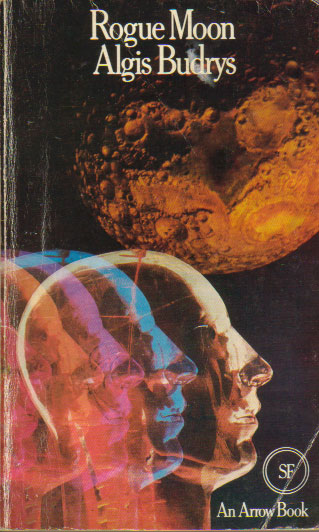
Sadly out of print it seems, this is a great science fiction book I read when I was still at school. I am a bit disillusioned with new fiction, and science fiction/fantasy has problems too I think. Every book in this genre seems to be at least 400 pages, and many are more like 700-1000. Sometimes I'd like an author to try and condense what he/she wants to say into a smaller and more managable chunk. At 178 pages, 'Rogue Moon' can be read in just a few short sittings, or even all at once.
This isn't really the book I remembered from over 20 years ago though, it's much more intense, much more people orientated than the hard science that I'd expected. I think I was mixing it up a bit in my head with another blast from the past I have just finished "The Stars My Destination" by Alfred Bester (also published under the title "Tiger, Tiger"). Both were first published in the early 1960s, though Rogue Moon is showing it's age a bit more.
The central premise of the story is gradually revealed, so explaining too much would spoil it. It involves a matter transmitter that can send a man to the moon, where a mysterious obelisk has been discovered. The big science idea that I rememembered was that if you transmitted a person, and actually ended up with two identical humans, how would their new experiences affect the way their minds developed. This isn't explored in quite as much depth as I hoped, but is considered enough to really get you thinking.
The thing that dates the book is the way the women are handled. One is just a beautiful parasite, living off her rich husband, and tormenting him by flirting with other men. The other is a pliant artist, who sits and waits by the phone for her man to maybe call when he gets a few minutes free from his busy, important life. There are Pinteresque scenes between these protagonists, some very long, but all seem to be trying to describe what it is to be a man. What makes a man strive to be the best? Why are successful men the way they are? How can some men face death doing dangerous tasks again and again? It's very intense, and never boring, though you do not quite feel that people like this could ever actually exist.
It's a very philosophical book about the nature of being, and the science fiction part, though really interesting, is a backdrop to this discussion between the two main strong-willed men. Well worth reading if you can get your hands on a copy, it shows that some science fiction really does tackle difficult problems.
[as an aside, I think Alistair Reynolds might well have read this - there are some distinct similarities to his short story Diamond Dogs)
Posted by se71 at 06:14 PM | Comments (0)
That Life
I watched the reunion episode of This Life with some pleasant anticipation, and being really disappointed with the result, started thinking of what I would say about it.
Then I went through my blogroll and found a review by Andrew Collins that says everything I wanted to say, and says it much better than I could have done.
So here it is, my review, written by someone else!
Posted by se71 at 09:03 AM | Comments (0)
January 03, 2007
Happy Feet
I finally made it to the cinema again, and it's so long since the last time I can't quite remember what I saw - probably a kids film though. And it was a kids film I saw this time too, Happy Feet.
This is a story of a little penguin called Mumble, who struggles to be accepted by his community. On the Antarctic ice shelf where he lives, penguins use singing from birth in order to find their true love. They have singing lessons, and all have a natural ability. As with the musical Moulin Rouge, we get to hear a lot of familiar songs, mixed together and remixed to sound very different sometimes from their originals.
But Mumble cannot sing, in fact, his singing is so bad it's painful to listen to. This makes him an embarassment to his family, and gives him no chance of being with Gloria, who he believes is is true soul mate. However, even though he cannot sing, can can tap dance, and loves doing it, losing himself in the beat. He believes that this will once day lead to acceptance by Gloria and the rest of the penguins.
So there is a love story, and some fantastic singing, what else would the movie need? How about some moral lessons on global warming, pollution, cruelty to zoo animals, and over-fishing of the oceans? Yes, we get all that too. Surprisingly though, it's handles quite sensitively, and resists too much sermonising.
Being a modern computer generated animated movie, we have come to expect high standards, and we are not disappointed here. The penguins look real; the flying through space to zoom in on the ice is amazing; the young penguins doing synchronised swimming in the ocean is mesmerising, and the avalanche fall is quite possibly the most exciting cinematic sequence I've ever witnessed.
Add this all together, with a heart warming ending which has masses of tap dancing, and what you get is a movie that is really very good indeed.
Posted by se71 at 05:03 PM | Comments (0)
December 12, 2006
Mark Lawson interviews Stephen King
Stephen King is doing the rounds with his new novel, and has recently been in the UK. This is a fairly unusual occurrence as far as I know. The BBC managed to get hold of him, and Mark Lawson did an interview which I saw last night and is repeated a couple of times at odd hours this week.
I thought I liked Lawson, having heard his show on Radio4 many times; he's pretty smart and covers a lot of ground. I am a huge Stephen King fan, and have never heard him speak before, never mind watched an interview, so was looking forward to it immensely.
Unfortunately, Lawson made a bit of a pig's ear of the interview, and it was only saved by King himself being a very friendly and accommodating guest. Lawson had a script of questions prepared, and every time an answer veered off into a different path, he ferociously brought it back on track. Interviewing isn't just about asking questions, it's about listening to the answers too. Sometimes you'll need to follow up a surprise answer to get to a more interesting place. King tried to take Lawson to other areas, he made jokes about something scary being behind his host, but Lawson couldn't even manage a smile and ploughed on regardless. When King asked Lawson why he'd asked a particular question, the only answer he could come up with was "because I wanted to know".
I have a feeling this was a wasted opportunity. Yes, we found out some facts about Kings early life and his struggle for acceptance, but the whole thing was done on a very clinical level, with no warmth or empathy. He even wound it up abruptly - was it live, against the clock?
Lawson looks like he is part of the literature establishment that doesn't appreciate populist fiction, the very people King is actively at war with, and I think he knows it. This should have been a job for Jonathan Ross.
Posted by se71 at 10:37 AM | Comments (0)
December 11, 2006
Cars
Lightning McQueen (a red car) plays the part of Michael J. Fox in what looks to me very much like an animated remake of the the old romantic comedy Doc Hollywood - but it's not anywhere near as charming or funny.
McQueen is a talking car, all speaking parts in this film are cars and trucks. He is very arrogant, don't forget that. On a trip across America for a very important race, he gets lost and winds up in a backwater town. He accidently ploughs up the main street, and is sentenced by a judge to stay there until he has fixed it.
While in town, he gets to know the characters who live there, and gradually loses his bad manners and becomes a more rounded individual - falling in love with a beautiful Porsche.
On the surface, it's a normal plot, and it should work as a film. But in the beginning McQueen is just too annoying, and it takes him far too long to get any better. By the time he has found his conscience, you don't really care any more.
The animation is to a very high standard, and some of the natural scenes look just like video, but who cares if there aren't any good jokes. Maybe I was expecting too much, and kids definitely like it, but it's not a film that is for adults too (like Toy Story, or The Incredibles), which is a shame.
Posted by se71 at 04:19 PM | Comments (0)
November 28, 2006
The Karate Kid
I saw this movie when it first came out in 1984 - it's a great coming of age story about the underdog taking on a big challenge. I seemed to remember it was fairly family friendly, so when my kids started pestering me to see it (the "Wax On/Wax Off" motto is famous still!) I popped into the local HMV to see if I could pick up a copy on DVD. To my surprise it's rated a '15'. I wracked my brains, and still couldn't think why this might be, so bought it anyway. I needn't have worried. This film definitely needs a reclassification - I can only think of the one occurrence of a fairly mild swear word as a reason it might conceivably miss out on a PG rating.
Ralph Maccio plays New York teenager Daniel who is uprooted by his single mother to California. As he tries to make friends, he falls for a girl called Ali (a very early role for Elizabeth Shue). She is an ex-girlfriend of the leader of a group of kids who attend the local karate school. This guy doesn't like Daniel muscling in on his girl, and soon Daniel is bullied, beaten up, and depressed with his new life.
In steps Mr Miyagi, the caretaker of his apartment block. Miyagi, played by the late Pat Morita in a career defining performance, turns out to be a karate expert. He says he will teach Daniel how to beat the bullies in a karate competition. His unorthodox tutoring methods are priceless and the centerpiece of the film.
This is classic '80s fodder, not to be missed. Did I mention it's pretty funny too.
Notes: Checking on IMDB I find that in 2005 this film was reclassified as a 12 in the UK. This is still too much.
I also see that Ralph Macchio was born in 1961 - this makes him probably aged 22 when the movie was shot - he definitely doesn't look that old.
Posted by se71 at 10:33 AM | Comments (0)
November 09, 2006
Muse - Unintended
Three minutes and fifty seven seconds of absolute perfection. Why aren't this band the biggest on the planet.
Amazingly, you can even listen to the whole track on the band's website Click the media link, select the CD 'Showbiz', it's track 7. And even better, you can also watch a video of the song there too. What a great site.
Also, you can buy it here
Posted by se71 at 01:43 PM | Comments (0)
November 06, 2006
Brick
Brick isn't half as smart as it thinks it is. It tries really hard, with lots of dialog you can barely hear, conversations between characters about things you can't know yet, flashbacks, anti-stereotyping and lots of other stuff to keep you confused. In this way I think the film makers think that you'll continually want to see what happens next, if only to finally understand what's happened already.
I was able to put up with this, I'm a bit of a machocist in this way: confuse me, mislead me, turn everything on it's head in the final reel, I'm happy. But I do want the game to be worth it in the end, and this film doesn't deliver.
Joseph Gordon-Levitt plays Brendan, a bit of a loner at a nameless American high school. His ex-girlfriend disappears, and he plunges into the criminal underworld to try and find her. His tenacity is a bit bizarre; he faces bullies and guns, endures beatings, and generally gets in a whole heap of trouble. Why would he do this?
The twist here is that all the criminals are also high school age. It doesn't quite work, they aren't menacing enough, and come across a bit like the gangsters in Bugsy Malone (the musical with kids). Unlike Gordon-Levitt, the supporting actors aren't as good, and some are actually quite poor.
And when we finally get to a conclusion, it isn't really very clever at all. Why he just didn't hand over the case to the police is beyond me.
Ties hard, but fails to impress. Some cool scenes.
Posted by se71 at 11:11 AM | Comments (0)
November 03, 2006
Click
Click has a very narrow range of target viewers - probably 13 to 17 year olds. Children under this are excluded by the 12A certificate, and anyone older will fail to find funny yet another dog humping a stuffed toy joke.
Adam Sandler is overworked by a dictator boss (David Hasslehoff, who is overacting his heart out). He longs for a way to get some more time, and when he is given a mysterious remote control thinks he has found the answer. This remote can pause, fast-forward, and replay time. The exact way this happens is a bit glossed over - in fast-forward mode for example, his body is there, and responds to people, but isn't really sentient. In some fast-forward episodes however, he manages not only to keep his job, but get promoted, hardly likely.
Of course, it all goes wrong, and the remote starts to do things on it's own, and Sandler starts missing big chunks of his life. It starts funny, and turns tragic and what we end up with, is a moral tale a bit like 'A Christmas Carol'. We are told to enjoy the time we have, put family first, and not work so hard. Laudable indeed, and not overcoated in sugar, it's a really hard-hitting lesson.
With a few alterations (the crude humour and the internal inconsistencies of the device mostly) this could have been a really charming story. It could have been a big event, a future clasic even. Sandler is a capable actor, his co-stars also perform well and it is very moving at the end. But the vision was just too small, the cheap laughs spoil it, and a fantastic opportunity was missed.
Posted by se71 at 11:03 AM | Comments (0)
November 02, 2006
Cast Away
I don't think I'm giving much away to say that this is about a man being stranded on a desert island for years. In a way, the first section of the film is a bit superfluous as we lead up to the inevitable plance crash. Slightly chubby Tom Hanks works out how to survive on the island; he grows a beard (see cover of DVD for this giveaway) and then loses his famous method actor paunch, along with a few of his marbles. During this time, he keeps his spirits up by thinking of his girlfriend Helen Hunt back home.
It all moves along in a bit of a formulaic manner, and would be boring apart from the spectacular camera work. We get a few scenes where the camera swivels around Hanks from all angles in continuous shot that look really amazing.
What we're all waiting for of course is to find out if he gets rescued. I'm not giving that away, but I will say I was a bit disappointed by it. There are two films here, and adventure story, and a love story, and I think the mixture of the two isn't handled quite right.
All in all, I'd say this was a good family film. It's not Forrest Gump , which Hanks and director Zemeckis worked on previously, but that was a true masterpiece.
***spoilers***
This bit complelety spoils the ending - you have been warned.
So, you have probably guessed that in Act 3, Hanks escapes the island and gets back home to see Hunt. When he was on the island he went almost completely nuts, talking to a volleyball as if it's a real person and seriously contemplating suicide. Once he escapes, he snaps back to being completely normal again - this is a bit unlikely I'd have thought. The most unlikely thing though is that when he finds Hunt is married now to someone else and has a child, he just walks away from her. In fact, the next day, he's chasing after the first girl in a pair of tight jeans that he meets. OK, there is a completely lame justification as to why she will be his next true love, but this intervention of fate, and also where the whale looks at him and practically saves his life, are unwelcome additions to what isn't supposed to be a fantasy film.
Posted by se71 at 01:54 PM | Comments (0)
October 09, 2006
CSI - Kiss Kiss Bang Bang
A fairly standard CSI episode. Grissome is a bit entranced and overwhelmed by the attentions of a glamorous woman who turns out to be a suspect in a murder. He lets her get away with a lot less questioning than he should do.
But this episode is interesting to me for two reasons - one good, one really bad.
1. I noticed the name Louise Lombard in the titles and it rang bells. I also sort of recognised her when she appeared as Sophia Curtis. Had to search online and then it clicked - she was Evangeline Eliot, the younger sister of Beatrice in the TV series "The House Of Eliot". This show aired in the early 1990s, and Louise is English, and is faking an American accent now as a regular in CSI.
I like it when we have British people masquerading as Americans - Tracey Ullman was one of the earliest I remember with her own show and then in Ally McBeal. Now we have Hugh Laurie as House and Ian McShane in Deadwood, both huge series. Go UK!
2. The second thing is CSI totally misrepresenting the power of technology. A grainy surveillance camera image is part of the crim vidence. A man reaches a card to another man in a car, at night, about 50 metres from the camera. It is actually difficult to see the man's face.
"Can we zoom in on the card"?
Of course we can. And let's just clean that image up a bit. Ah, it's a 2D barcode card. This is already stretching credibility, but, we now zoom in again, and resolve the image to see clearly the barcode on the card.
We're not living in Bladerunner times just yet, with holographic photographs and infinite zooms. This kind of thing is just plain dumb, and demeans the whole premise of the rest of the series.
Posted by se71 at 05:03 PM | Comments (0)
October 06, 2006
Who Am I
Who Am I is a Jackie Chan film, and it is wonderful. It is full of some terrible acting, both from Jackie, and from his female co-star Michell Ferre (who according to the IMDB page never worked again!). It has a car chase with appalling continuity errors. It has a fairly dodgy amnesia plot. And yet the sheer skill and exhuberence of Chan as a man fighting to live, and to find out his identity, is complete screen gold.
The thing that raises this film up so much from what could have been a disaster, is that it doesn't take itself too seriously. It's not actually a comedy, but the fight sequences and chases always have elements of humour thrown in. The best bit is where he has a leg kicking contest with a huge opponent, and afterwards they both sit down and rub their shins for a minute. Famously Jackie creates and performs all his own stunts. He runs down skyscrapers, he slides down gaps in walls, he inventively escapes being handcuffed to a chair.
The plot is completely incidential here, but this film is excellent, fun entertainment.
Posted by se71 at 10:54 AM | Comments (0)
October 03, 2006
The Talented Mr Ripley - Patricia Highsmith
The Talented Mr Ripley - Patricia Highsmith
This is a cold hearted thriller in the Hitchcock vein, Highsmith also penned "Strangers on a Train". It has a few twists that shouldn't be given away before reading, as Ripley's talents gradually get uncovered. It starts with a tense scene that reveals Ripley as a petty crook, a bit of a loser, in 1950s America. He is made an offer to go to Europe to try and persuade a young man called Dickie Greenleaf to come back to New York to visit his family. Dickie's father pays Ripley's passage and expenses.
Ripley finds Greenleaf, and insinuates himself into his life. He loves the lifestyle, the easy going Italian riviera; the trips to Rome and other towns; drinking wine and not worrying about money. He decides that this is the life for him, and that he will do anything to keep it.
The whole story is told through Ripleys point of view. We know how he thinks, what he feels, and we empathise with him. He has had a hard life, and wants better things. Then as events turn nasty, and we see his sociopathic side, we find it harder to like him, and yet still somehow hope he succeeds. It's very skillfully written, and the tension is unbearable at times.
Very highly recommended.
I saw the film of this a few years ago, and never really believed in Matt Damon in the part of Tom Ripley. Now I've read the book and have gotten a much better feel for the character, and I'm a bit more happy that he actually did quite a good job. Jude Law as Dickie is excellent, completely perfect as the rather lazy playboy.
Posted by se71 at 06:26 PM | Comments (0)
October 02, 2006
xXx
xXx was billed as an American answer to James Bond, and was supposed to herald a series of movies in this new franchise. There has in fact been another, but if it's anything like this one, then I'm not really going to hurry out to see it. I've actually had the DVD of this on my shelf for more than a year, but somehow the immediacy of having it on a normal TV channel usually prompts me more, so last night I stayed up late and watched it there.
The things that are wrong are easiest to explain. It has an idiotic plot and an annoying amount of loud hard rock/metal music, some of it sung in German. There are a lot of scenes with the evil anarchist yorgi - and his false Russian accent gets very wearing, very quickly.And calling yourself 'Triple X' or just 'X' for short, is a bit naff. They're going after the 007 James Bond link again. And it's just too long. In an spy adventure story like this you shouldn't be looking at your watch to see if this set-piece action stunt is the final one, and then sighing because you realise that there is another 20 minutes so there is plenty of time for another.
Gadgets, and there are a few, should be ambitionsly modern, but still believable. James Bond pushed the limits (went way past if you ask me) with his invisible car. But here we have something just as bad, binoculars that can see through brick walls and take full colour photographs. I think this technology is quite a way off.
Vin Diesel is a passable action hero, though he never manages to look as if he's taking anything seriously. His character is an irreverent internet prankster at the beginning, and the swift transition to freedom fighter for the US government is a bit unlikely. Unfortunately, the script is terrible, and he cannot manage to pull off the wise cracks to make them funny. His fellow cast members, unfortunately, are somewhat let down by this terribly cliched script too. I can't believe they are all terrible actors, but they really do come across like that here. It's like the new Star Wars films - you'd think from those that Ewan McGregor couldn't act for toffee, but it's just the derisory dialog.
The stunts are very polished; I looked carefully and wasn't able to spot the joins where the computer took over the action. Most of this action takes place in Prague in winter, which looks really dreary and I think that was a mistake. Bond always has some exotic locations, and we needed a bit of sunshine to brighten up what was quite dull looking scenery. But if you just like big explosions and car chases and snowboarding and parachuting stunts, then I think this is your film.
I was very disappointed really by xXx. I expected a little more, and the first 10 minutes were good enough to make me think I was going to get it. But it quickly degenrated into just a very expensive sequence of stunts divided up with bits of plots of other films into a very unsatisfying whole.
Posted by se71 at 11:15 AM | Comments (0)
September 25, 2006
The Sixth Sense
Writing a review of a film you've seen at least three times is actually more difficult than you'd think. Writing any review of this film is difficult anyway due to the chances of spoiling the story. So I'm going to skip most of the plot and stick to other things I can tell you about.
Bruce Willis gives a very measured performance as a child psychologist. He is very understated, and always believable. Toni Collette and Haley Joel Osment on the other hand get to act their hearts out, crying and screaming and being totally convincing as a single parent family that is falling apart.
This is a ghost story, and is chilling and scary in places. The music and cinematography are skillfully handled to create shocks in the right places.
The director Shyamalan kick-started his career here with what is still his best film, and one you'll want to watch again and again.
Posted by se71 at 11:06 AM | Comments (0)
September 21, 2006
Just Like Heaven
Reese Witherspoon is a very versatile and talented actress, and I really think it's time she stopped making films like this. This is a slightly above average romantic comedy, with only two, or maybe three real laughs. It will mostly be enjoyed by teenagers and younger children, who, of course, it is aimed at anyway.
Witherspoon plays a hard working doctor at a hospital. She has an accident, and turns up a few months later as a ghost in her own apartment. A man is living there now, and he is the only person who can see and hear her. Due to temporary memory loss, Witherspoon doesn't know who she is, and so they set out together to try and find out.
Of course, they fall in love.
It's likable enough, but too short on the comedy.
Posted by se71 at 01:57 PM | Comments (0)
September 11, 2006
Shallow Hal
I liked Jack Black in "School Of Rock", and even though I've been reluctant to watch another Farrely Brothers film, when I discovered he was in it, I thought I'd give this one a go. The Farrely's are well known for their apparent aim to insult just about any physically or mentally disabled minority they can think of, all wrapped up with generous doses of bad taste. This is only a '12' certificate, so they are more restrained. In my opinion, a few judicious cuts would make this a passable family movie, but occasionally the crudeness is annoying. It would be nice if film makers could really make up their minds who their intended audience is.
Anyway, Hal is a shallow man, who only wants relationships with girls who have supermodel looks. He is hypnotised (by real life motivational speaker Tony Robbins in a cameo role) into seeing women for their inner beauty instead. And so when he meets really overweight, ugly, or disfigured people, if they are good people inside, they appear beautiful to him. He meets a truely gargantuan woman called Rosemary who is a volunteer at a local hospital childrens ward, and also does charity work for the peace corps. Obviously she appears to Hal as the lovely Gwyneth Paltrow and they begin a relationship.
In a gross misrepresentation of reality every ugly, fat person Hal meets has a heart of gold, and most of the pretty ones are mean and nasty people. I guess this simplification is needed to make the point. Unfortunately they haven't bothered to play the trick with every character, and I'm a stickler for detail like that. Rosemary's father is really quite an unattractive looking man, and stays like that even though he is a obviously a good person.
It's quite an interesting premise for a film, and there are a few laughs, though you always feel a bit guilty for it. Jack Black carries the film throughout - it really wouldn't be worth watching without him.
[trivia - I'm a big fan of the group Kings of Convenience, and was very pleasantly surprised to hear their song "Toxic Girl" during the film. It's not on the soundtrack CD though. I also felt that some of the incidental music had a real KoC feel to it.]
Posted by se71 at 10:14 AM | Comments (0)
September 08, 2006
Cloud Atlas - David Mitchell
"Cloud Atlas" is a bold experiment. There are sections of complete genius which you will never want to stop reading; these make it all worthwhile. However, there are also parts that will frustrate and make you wish they would end right away. I think that for different readers, the 'good' bits and the 'bad' bits will actually be swapped. Let me explain.
There are actually six short stories in this volume, all connected in different ways and with recurring themes. They start with a long sea voyage in the 19th century, and move forwards in time into the distant post apocalyptic future. The narrators have very different styles, with stories in the form of diaries/letters/interviews and first person narrative. The structure is that we get the first half of five stories, the whole sixth story, then the second halves in reverse order, like this - a-b-c-d-e-f-e-d-c-b-a. I really like the idea, but I remain unconvinced that it was successful. The links were very slight between the stories. I'm not sure that the whole was greater than the sum of it's parts, and I'm struggling to persuade myself that this is realistically a novel at all, and not just a collection of short stories.
In the beginning, it's very archaic and formal writing and I found this very hard going, in fact, I almost gave up. The more recent sections were an improvement. For me though, the tales from the future were completely compelling. However, the final story is told in a made-up dialect language. I know some people were completely turned off this, but I found it simple having already been through similar reading exercises with Riddley Walker and Feersun Ennjin. I also of course love science fiction, and this was good science fiction, as was the penultimate story of the clone Somni 451. The same people who dislike the future stories, will probably be much more interested than I was by the sea voyage.
There is an overall message about mankind's inhumanity to man, and his disregard of the planet, and this is somewhat satisfying. But like eating a meal made of many different small courses - you may be full by the end, but there will be some dishes you'd like to have had more of, and some you will want to have done without.
So what we have is a very mixed bag, and an ending that is actually in the middle of the book. This novel will amaze you with it's dexterity and scope, and the sheer quality of the narratives. Recommended reading, but be prepared for a challenge.
Posted by se71 at 01:30 PM | Comments (0)
A Short History Of Tractors In Ukrainian - Marina Lewycka
There are passages in this novel of a ficticious non-ficton book on the history of the tractor. Oddly enough, these sections are by far the most interesting bits of Marina Lewycka's overhyped first book.
I'm a sucker for best sellers and prize winners. I got suckered into reading "The Da Vinci Code", "The Shadow of the Wind", "An American Boy" and many others - all truely terrible books. And now I've succumbed yet again and am living to regret it. Maybe there just aren't that many good books around.
This is touted as being a comedy, but I found it distasteful and pathetic. It's the story of an 84 year old widower, who gets involved with a Ukrainian refugee in her thirties. His two daughters try to protect him from what they see as an attempt to part him with his money, and a tedious drawn out battle ensues. Each new disaster is supposed to be amusing, but since when was an partly senile old man soiling himself funny?
The story has many flashbacks to periods during the Second World War. We are told how hard it was for families in the Ukraine, and the trials this particular family went to to survive, and ultimately escape. This was more sensitively written, and provided a bit more insight into a somewhat overlooked tragedy; the loss of as much as 20% of the population of that country - 8 million people. Unfortunately juxtaposing this with the farce occurring in the rest of the story didn't really work.
I found the writing style juvenile and annoying also, and there were long paragraphs that were completely gratuitous (a list for example of every vegetable growing in the garden, closely followed by another list of all the flowers). This is just desperate page filler and should have been cut. Constantly reminding us how Ukrainian people pronounce English words got very tiresome too.
I am at a complete loss as to why this book is so successful, and I'm afraid to say that I think a few loose ends will mean an inevitable sequel will follow in due course.
Posted by se71 at 12:55 PM | Comments (0)
August 07, 2006
Madagascar
Just like "A Bug's Bugs" and "Antz" a few years back, we now have two films on very similar themes being released close together. The other is "The Wild", and I haven't seen it yet unfortunately, so can't yet do a comparison.
Some animals, well, the zebra, giraffe, lion, hippo and penguins, in New York's Central Park Zoo, manage to escape and hitch a ride on a boat that eventually winds up with them landing on a remote part of the tropical island of Madagascar. This is the first time they have encountered lving in the wild. They don't know how to deal with the native animals, or get food, and the lion soon starts daydreaming of juicy zebra steaks (who is his his best friend of course). The story zips along to a predictable conclusion, as they all stick together to overcome the dangers and there are some mild scary bits.
It's a big name cast, with Friend's star David Schwimmer voicing the giraffe with exactly the same timidity as his Ross character. Ben Stiller isn't much better as the lion, Jada Pinkett Smith is unremarkable as the hippo, and it's left to Chris Rock to steal the show as the fast talking zebra. Incidentally, Sacha Baron Cohen (Ali G) is in this too as king of the island lemurs, and was nearly unrecognisable, in a good way.
There's not much to say about this, it's quite amusing and colourful to look at, but it's just a light weight cartoon that will be enjoyed mostly by the very young members of the audience.
Madagascar 2 is already in production.
Posted by se71 at 11:52 AM | Comments (0)
School Of Rock
Jack Black has had the role of his life written for him in this feel good movie. In fact, you almost feel he isn't acting at all, and that everything he says and does is really just him. Perhaps that's the power of a good actor, but knowing that Black is in a rock band, and has made music very much like the character here, makes me hesitate to praise him too much.
One of the major movie templates is the one where an unconventional coach takes an underdog and trains them to be a winner. This is such a movie. Failed musucian Black gets kicked out of his rock band. To pay the rent he tricks his way into a job as a substitute teacher for uptight ten year old kids at a posh private school. He realises they can play music, and he needs a new band to help him win a big rock contest. And so 'School Of Rock' is born, as Black secretly educates the kids in the ways of Led Zeppelin, AC/DC, Rush and other great rock acts. We know they will get to the competition, we know they will be great, we know Black will get caught.
But knowing the plot and probable ending of a film doesn't mean it can't be a fun journey. And this is a thoroughly enjoyable adventure. It's a virtuoso performance from Black, who is in practically every scene giving us every ounce of his enthuasism for ROCK MUSIC! And they managed to make it a PG certificate too, so that the whole family can watch. It's also of course really very funny.
Posted by se71 at 11:20 AM | Comments (0)
July 12, 2006
Sony Cybershot DSC-T9
I have a new camera, finally.
My reasons for buying it were not as scientific as they might have been, but as usual I just gave up trying to find the perfect beastie, and went with my instincts. A personal recommendation from Leon Brocard also helped.
My first digital camera was a Cybershot DSC-F55 2MPixel - a fairly early model I bought in 2000. It's still going strong, though I appear to have misplaced it a few weeks ago. It cost over £500 at that time and was pretty cutting edge. I have taken some great photos with it. Here is one I like:

This model has 6Mpixels, and a much better quality movie mode. It's a lot smaller too, and comes with 56Mb memory on board for photos. I got it on Amazon for £201 and bought a case (£11) and 1Gb Sandisk memory card (£44) from Jessops.
I like it of course, it has a nice 3X optical zoom and a really fast startup time. The battery meter, being Sony, tells you how long you've got before a recharge which is great. Being really small though, makes it an awkward camera to handle, and easy to drop. The lens cover slides up, which looks and feels really cool, but means you have to be careful not to touch the lens. There is already a fingerprint on it actually which I've tried to carefully remove.
The memory card is Memory Stick Pro Duo, the same as the PSP, and I've tested and you can look at the photos on the PSP screen if you swap the card over. This isn't really necessary, as the T9 has quite a nice screen anyway, and it comes with a cable to connect to the TV. There is a built in funky slideshow feature, with music, which is fun.
It has a burst mode feature to take several photos in a short period, which I haven't tried, but sounds useful for sporting events like triathlons. The main thing I'm missing is manual exposure times - my dream of using a tripod to take long exposures in the dark will have to wait until I can afford the Canon EOS-350D.
I've enjoyed taking recent photos on my Nokia 6230i mobile phone (1.3MPixel), but am feeling the limitations, and hope to take a few much better photos now, especially when the lighting is poor. Red-eye is still a problem though with this camera.
I've got the T9 reduced to 3MPixel mode for now, but will have a play and see just what difference 6MPixels makes. Here's one I took earlier, I used the zoom to frame the shot.

Posted by se71 at 03:48 PM | Comments (0)
Evolution
This is really a pretty terrible film. It is glossy, and has the big star names of Julianne Moore and David Duchovny, and the pace doesn't falter. This might lead you to think you've had an enjoyable experience, but really, when you think about it, you've just wasted your time on rubbish.
It's main problem is that it is trying to be an alien disaster movie, and also trying to be a goofy comedy. In some rare cases, this actually works, think of Mars Attacks, and The Fifth Element. But here, both styles sabotage each other.
The story is actually pretty good. It's about a discovery of a meteor which contains an alien life form that starts evolving very quickly. From single celled organisms, it reaches much larger creatures in a matter of days. Duchovny is a scientist who makes the discovery, but the military take over, and he has to struggle to remain involved, and eventually to try and stop the destruction of the human race. It's predictable hokum, and if handled properly it could have been a big hit. Think Independence Day.
But when Duchovny is turned away from the meteor by the military, what does he do? He moons them from his car. When his partner is breaking back in disguised in a biohazard suit, what does he do? He breakdances in the elevator giving them away as imposters. This stupidity, and the way Julianne Moore's scientist is always tripping and falling over, just isn't funny, and spoils what could be an interesting story.
If you want to make a goofy comedy, then put some actual good jokes in there, or some proper slapstick situation, not this halfhearted imitation of it. If you want to make a thriller that's also amusing, then make your characters real, and make funny things happen around them, and to them. Don't make them dopey idiots too.
I was really disappointed, as I wanted to like this film. I liked the creatures I guess, but that's about it.
Posted by se71 at 09:49 AM | Comments (0)
June 22, 2006
Sin City
This is primarily a review of the movie, though some references to the graphic novels is inevitable. Why? Well, becasue they are practically identical. Never before has a live action film crossed over from the printed page with such complete accuracy. In fact, I'd even go so far as to say that if you've seen/read one of them, you can honestly claim to have read/seen the other too. My previous short review of "The Hard Goodbye" is here.
This movie is based on three separate graphic novels, with short, interconnected introduction and conclusion sections. Unfortunately the lack of continuity shows. There is an attempt to get all the characters together near the end, to make it look like one story, but it doesn't really fool anyone. And one of the stories starts and ends the film - well, actually, it sort of goes A B C D B A. (B - That Yellow Bastard, C - The Hard Goodbye, D - The Big Fat Kill, A - bookend sections). I guess as director I'd have done the same thing, rather than just show the stories consecutively.
However everything does take place in one city, Sin City, where the laws of physics don't seem to work the same way. People can survive falling from tall buildings, and live through appalling gunshot wounds, and even biology is different, with one character turning a luminous yellow after drug treatments. Each of the stories has a main hard man, nothing stops him getting justice, that is, his personal brand of justice. He doesn't mind a bit of maiming, torture and killing, to get revenge. Each of the stories has a tough woman too, though not so tough she doesn't need rescuing by the hard man. Oh, and she is always very attractive, and quite often wears very little or no clothing.
So we are safely in 18 certificate territory. You have been warned.
What we get are detective stories in the Philip Marlow vein, but with a lot more oomph to appeal to a jaded generation that has seen it all and can take it. Bruce Willis is a cop nearing retirement who saves a young girl from a violent rapist, but gets sent to prison becasuse the man he catches is actually the son of the corrupt governer. Mickey Rourke is an ugly man with mental problems, and he scours the city trying to avenge the murder of a prostitute who was kind to him. Finally, Clive Owen is the third tough guy, protecting a group of prostitutes from the corrupt police force. Owen doesn't quite have the meanness of the other two, he doesn't quite convince us that he could take the punishment Willis and Rourke take and keep going, but he comes very close.
The women, as secondary characters, are all the whore with a heart of gold type. They trust their man to help them, but are tough when needed. The film has been branded as sexist, as the women all appeal to male fantasies and need protection from the men. To a large extent this is true, but it's not the whole story. Jessica Alba plays a smart, tough woman, who is self reliant and resourceful. Carla Gugino as Rourke's parole officer only really has one flaw, she believes that the cops are the good guys.
I loved this film - it's fast and furious, violent but darkly funny. It has a magnificent 'look', black and white computer generated backgrounds, with only some bright splashes of colour, maybe in someone's eyes, or their red lipstick. It's not for the faint-hearted, but if you like this kind of thing, then it's one for the DVD collection, as you can easily enjoy it again and again.
Posted by se71 at 10:05 AM | Comments (0)
June 20, 2006
JPod - Douglas Coupland
It's a really long time since I read Generation X

Having just completed JPod, I'm reasonably sure that it's pretty much the same stuff, slightly repackaged to include the new internet themes and memes.
Ethan works in an office for a computer game company. We're supposed to think he's a pretty normal geek in the beginning. He has the stereotypical cubicle life. He gets great company perks like free food and drinks, and very flexible hours. He calls his block of cubicles JPod, as everyone's surname begins with J. There are 5 main colleagues, all with odd quirks.
But Ethan's life is weird. All his family and friends are weird, and he happily gets caught up in all their illegal activities. I think we're supposed to find this amusing, like the way John Travolta and Samuel L. Jackson are funny hitmen in Pulp Fiction. But I just found the weirdness distastful and not very original. It goes on a bit too long as well, and like a soap opera, you can see the set-ups coming for miles.
It's written in an easy style which will have you moving through at 100 pages an hour if you're not careful. Of course, having pages and pages of prime numbers and digits of pi adds a lot to the thickness of the book, and very little to the interestingness.
Geeks will love all the overt references to Google, Nigerian spam, Blackberries and the multitude of other things they are daily exposed to. You get the feeling that Coupland really understands this world. He knows that dissecting a geek's laptop will expose just about everything you need to know about his life. I'm a card carrying geek myself and enjoyed that I understood most of the archane 8 bit computer talk, that I knew Belgian keyboards are hell to use, that I know what a rendering farm is. A few years back I was reading a Scott Adams Dilbert book, and was laughing my head off. My mum was there, and I showed her the passage - she has never worked in an office and the humour just didn't work on her. I think JPod is the same.
If you're not into the whole eBay, Quake, C++ world, if you think a computer is just a tool, and not a life choice, then I think you'll be turned off fairly quickly by this book. If like me you spend the day wondering what piece of software you could upgrade or reconfigure instead of doing any real work, then you'll find it a fun read, but you will be unconvinced by the actual story, and you won't care at all about the characters or what happens to them.
I even bought the limited edition, which comes signed by the author, and has a little JPod plastic figure. Nice marketing.
Posted by se71 at 10:37 AM | Comments (0)
June 05, 2006
Never Let Me Go - Kazuo Ishiguro
Sometimes it takes a few days for a novel to sink in after you've read it. This story seeps into your consciousness, and you find yourself thinking about it long after it's finished. Is this a defintion of a good book? Yes, I think it probably is.
There is very little that can be written in a review of "Never Let Me Go" without giving away key elements of the plot. If you like thought provoking themes set in a world much like ours, but subtly different you might like this book. If you want to see this world through the painfully honest eyes of a girl as she grows up, you might like this book. If you enjoy watching something gradually unfolding, with clues to what is really going on revealing the horrible truth....well, I think you'll like this.
Basically, I really think you should read this, but I can't actually tell you why without spoiling it for you.
It is completely heartbreaking though.
Posted by se71 at 10:36 AM | Comments (0)
May 23, 2006
Dogma
Am I allowed to review a film that I've only seen about half of. I guess so, as long as I make it clear it's not a proper review. I started watching this last night at 10pm, thinking it would finish in about 90 minutes. Unfortunately I then discovered that it wouldn't finish until a quarter past midnight, and maybe I'm getting old, but with a 6.15am start I decided to quit at 11pm. There was a time that I would stay till the bitter end once I'd started watching any film. I've been up till the small hours watching Jean-Claud Van Damme so that will let you judge my standards. Maybe I'm just getting sensible. Maybe I wasn't quite enjoying this enough. Maybe it's not as good as 'Timecop'.
Matt Damon and Ben Affleck are angels exiled to earth. They find a loophole in god's law which means that if they get to a certain church and walk through the door they can return to heaven. So they start travelling across America to this church, randomly judging sinners on the way and blowing them away with a big gun. I think this is supposed to be funny - but Matt Damon in particular doesn't pull it off.
Linda Fiorentino is a woman who gets visited by god's messenger and told to go to the church and stop the angels entering it. She keeps saying "Why me?", and I'm sure there must be a reason, but of course, I didn't make it to the end to find out. So she also starts on a road trip, after meeting sex starved Jay and Silent Bob (Kevin Smith, the writer/director again plays Silent Bob, a recurring character through many of his films). Jay never stops talking, and is quite amusing in the beginning, but his constant whining and requests for sex, and his swearing get a bit wearing after a while.
On the way they meet Chris Rock, who seems to be a reincarnated black 13th apostle. Oh, and Jason Lee plays the devil, and he sends three demon hockey players to try and stop Fiorentino. And Salma Hayek was dancing in a strip club for some reason.
And that's pretty much where I left it.
The movie seems to be a bit too jumbled to really work properly. If it's a normal comedy, then why have all the random violence. If it's a black comedy, why have the goofy stuff with Jay and Silent Bob. If it's a serious dig at the dogma of organised religion, why have so much swearing and violence that the target audience will never watch it.
I may watch the rest sometime, maybe it all comes together in the end. But it really hasn't grabbed me that much, so I'm not going to make any special effort.
Posted by se71 at 10:21 AM | Comments (0)
May 22, 2006
Magician - Raymond E. Feist
Another of the BBC Big Read Top 100 books, and one I have wanted to read for about twenty years anyway, so picking it up at last wasn't a chore. What was a chore however was wading through the almost 700 pages of battles and magic in the worlds of Kelawan and Midkemia in which the characters live. I did enjoy the story, it is a typical sword and scorcery adventure in the "Lord of the Rings" vein. The action scenes are well executed, the mysteries are revealed as slowly but surely the heroes fulfil their unlikely destinies.
The problem I did have however was the immense amount of politics and the seemingly neverending descriptions of the colours of peoples robes. Some of this is of course required to give the story substance, and to add human details to scenes to help us to picture them in our mind's eye. I think perhaps the edition I have read, which is a tenth year anniversary of first publication and contains 15,000 more words than the original, may be the reason for the verbosity. It is always tempting to include scenes you've written I'm sure, but sometimes the editor who cut them out is right. Slowing down the forward narrative to spend time on background details in an adventure yarn should be handled with great care.
It's the tale of a orphan boy called Pug who lives on the outskirts of a large kingdom. As usual, they have only a medieval level of technology; bows and arrows, but no guns; horses and carts, but no internal combustion engine. There are magicians, but there power is a bit difficukt to quantify - most are fairly ineffectual. He has a friend called Tomas, and lives with his family as an adopted son to the cook at a Duke's castle. The boys dream of a future in which Tomas will be a great warrior, and Pug a master magician. Of course, in fantasies such as this, dreams really can come true.
Suddenly the relative peacefulness of the kingdom is shattered by the arrival of a strange army. They appear from nowhere, and start to encroach upon the land, building up a territory of their own and fighting local people to enlarge it. Pug and Tomas are thrown into the middle of this and travel across the whole known world, and even to other worlds. They meet dwarves and elves, goblins and very powerful magicians who seem to predict the future.
There are a host of major and minor characters, and there are even some women, though they are only really standard love interest, and never get to take place in any real position of power.
I didn't really realise that this is the first in a trilogy called "The Riftworld Saga". I'm not sure if I'm sufficiently interested to read any more. There are some unexplained loose ends, but I'm quite satisfied I think with where this first volume closes. In fact, further investigation reveals there are loads more Riftworld books. I think it's best I stop now.
Posted by se71 at 02:57 PM | Comments (0)
May 18, 2006
Stars of CCTV - Hard-Fi
I appoached this CD thinking it would be just another collection of songs about girls and having no money, and fighting on a Saturday night; to a large extent I was right.
The Streets debuted with a collection of songs much on similar topics, and made a pretty good job of sounding original, and avoiding cliche. Hard-Fi have also managed to come up with some very good material, and along with the poor kid from the streets tracks, have also had a go at the Iraq war in "Middle Eastern Holiday".
The main influences for this music, whether conscious or unconscious, come from the late seventies. There is a lot early Jam in "Gotta Reason", the background singing on "Middle Eastern Holiday" and others is as tuneless (in a good way) as it was with the Undertones, and "Living for the Weekend" echoes Bruce Springsteen's "Born to Run". "Better Do Better" is a Two-Tone ska record reminiscent of The Beat in places.
The lead singer belts out most of the tracks with gusto, but isn't afraid to show a more tender side on "Move On Now". The band seem to be capable of using any sound they need, whether thrashing guitars, quirky synths, or clasical piano. It means the CD is never boring, but the lead vocal holds it together so that it forms a coherent whole.
All the songs are good, but some are very good, and there is an absolutely fantastic standout track. "Cash Machine" and "Stars of CCTV" give a real up-to-date cultural aspect to proceedings, and "Feltham is Singing Out" concretes this west London suburb angst with a young offender hanging himself in the prison there.
If you only get to hear one song however, listen to "Tied Up To Tight". This is of course another song about trying to leave the slums for the bright lights. I am finding it very hard indeed to describe just what it is about this song that makes it so great. Every listen makes the hair stand up on the back of my neck - it just works on some base level that I can't figure out. Is it the edginess of the music, the distorted guitars building up a tension that matches the lyrics? Perhaps, and that's the best I can come up with. The lyrics tend towards cliche in places "Your eyes are burning so bright", but any song with the word cognoscenti in it has got to be good.
A new band, if they are any good, only really get one chance at the angst-ridden angry young man album before they get rich and cannot do it any more - Hard-Fi haven't wasted theirs.
Posted by se71 at 12:03 PM | Comments (0)
May 11, 2006
'48 - James Herbert
There is something about an author whose work you have grown up with.
I've been reading James Herbert's novels since I was a young teenager: The Rats, The Fog, The Survivor, formative stuff. I enjoyed them at the time, and he became Britain's most popular writer in the horror genre.
He still writes, and I seem to have gotten a bit behind, as I have with Stephen King. So I picked up '48 and decided to give it a go. I sort of wish I hadn't.
The only skill present in this novel is that of spinning out a chase for quite so many pages. Characterisation is zero. It's just a seemingly unending set of fights between the hero, Hoke, and a group of zombie-like people. There are serious echoes of "I am Legend", the book by Richard Matheson filmed as "The Omega Man".
The backstory is quite interesting; it's an alternate history plot where Hitler infects the world with a deadly virus near the end of the Second World War. This wipes out all people except those with a fairly rare blood group. Hoke is an American airman in London, married to an English woman. When disaster strikes, he survives alone, and wanders the streets of the city. Some survivors have symptoms which mean they can live for years, but they are driven mad and band together in groups hunting the normal people. Hoke calls then Blackshirts, as for some reason they have all appropriated this mode of dress.
The novel's action takes place in 1948, three years after the atrocity. Hoke wakes up and is chased by the Blackshirts. He meets a few other normal people, and together they flee across London. That's about it. Fight, flee. Fight, flee. Hoke is the narrator throughout, and his American turn of phrase feels unnatural, and jars every time some obviously un-English word like "heck", or "darned" is thrown in. His reason for remaining in London, his secret task, is easily guessable and untimately unbelievable.
All in all, this is one of those books solely for the Herbert completist. The descriptions of London are intersting if you know the city well. Might make a good first person shooter video game.
Posted by se71 at 11:12 AM | Comments (0)
April 07, 2006
Grey's Anatomy
Grey's Anatomy
I wonder what came first? The idea to do yet another medical drama, or the rather poor pun that is the name of this series.
The main star is of course called Grey - Meredith Grey. In the opening episode she starts her first day along with another selection of newly qualified doctors in a busy hospital. They is the usual cultural and personality mix required by US serials; token black, asian and female characters. If we need a poor sap who is a bit useless, well let's make it a white male, wouldn't want to antagonise anyone would we? Grey is of course pretty, vulnerable but strong willed, and intelligent. When a patient is misdiagnosed, she is the only one around who has read the manual properly on that illness.
One of the bosses is a tyrant, though with a heart of gold obviously. Amusingly Grey has had a drunken one night stand with another of the senior doctors there. It's all a bit Scrubbs really, but twice the length with slightly fewer laughs. Everyone is good looking, and the cases are tragic, but it's not about the patients, it's about the doctor's relationships.
I've never seen E.R. which means I cannot do much of a comparison, but I think it will be a bit lighter in tone, with less blood.
Channel 5 are showing it directly after House which is an altogether more serious program. I found myself laughing more however at Hugh Laurie's anti-hero, he is just so fantastic in that role. The laughter is the cynical kind though, Grey's anatomy is much jollier.
Apart from all this falseness and predictability, or maybe even because of it, I found myself liking 'Grey's Anatomy' quite a lot. I like it's PG rating, I feel comfortable wasting an hour being entertained, but not challenged too much. It's not essential viewing, but I have a feeling I'll end up watching it quite a lot, especially if it's always on after 'House'.
Update: Just found out that there is a new TV show viral marketing technique - blogging. So while this show was first going out in the U.S., someone pretending to be a nurse at the hospital wrote a blog about what was going on. Clever. Here it is, it's called seattlegracegossip.
Now all we need is someone with better programming skills and more time than me to grab that data, and repost it to a new blog at the right stage in the show for us watching in the UK.
(see also the blog from the barman across the street, and also a blog by the writers of the show. They have more blogs than I do! )
Posted by se71 at 02:14 PM | Comments (0)
March 30, 2006
Up The Line - Robert Silverberg
It seems a great idea - have a time travel story where the hero goes back to Byzantium about one thousand years ago and falls in love with his great, great, multi great, grandmother. Robert Silverberg is a renowned science fiction writer, so I wondered why I hadn't seen this one on the shelf any time. I picked it up in the local second-hand store however, and soon discovered why it's out of print.
Although this novel does explore the interesting concepts of the paradoxes of time travel, it was written at a time, the early 1970s, when there was far too much graphic sex in science fiction. The writers of the day all seemed to assume that the future would be full of liberated women, walking around practically naked, and under the influence of new recreational drugs that made them open to advances from any man around. Maybe that's the way society looked like it was going in a world before AIDS. LSD was hip, the psychedelic scene and the popstar lifestyles of people like the Beatles encouraged this freedom of expression. Perhaps people thought this future was inevitable, like flying cars and three course meals in a pill. But now we can look back and see how it all panned out, and it just hasn't happened that way. A lot of the fiction therefore looks outdated and embarassing at best, but this one is also quite unpleasant. Either it's that, or someone must have hit me with the politically correct stick, because in the book I found that the casual attitute to incest, under age sex, and rape, was so unpleasant that I had problems enjoying the rest of the story. It's for this reason I think it must have fallen out of favour with publishers.
It's a shame about the X rated nature of this book, because there is actually a good story hidden inside. Judson Elliot gets a job as a Time Courier. He takes groups of tourists back in time to witness famous events in history - and specialises in Byzantium. Whilst on a trip one of his party escapes into time and starts changing history. Judd and the other couriers have to do a lot of hopping around the centuries to try and find him and put things right. Of course, there is a Time Police force they have to try and keep all this activity hidden from. It's quite fun, and completely impossible, to try and keep track of all inconsistencies that time travel would create.
"The grandfater paradox" is very famous - what would happen if you killed your own grandfather before he had met your grandmother? You would therefore not be born. But if you weren't born, then you couldn't go back and kill your grandfather. So you'd be born again. Would this create some kind of loop? In this book the added complication of going back in time and actually being your own grandfather is explored.
If people really could go back and see Byzantium, surely all these tourists would eventually fill up all the available viewing spots.
If you could travel anywhere in time, why not go back and buy a nice property and some slaves and spend your vacations there. These issues are examined, but of course no conclusion is reached. The chances for disaster are so great that even supposing Time Couriers and Time Police really existed, I do not believe they would be able to control things at all.
So the time travel bits are good, the Byzantium history lessons are a bit too detailed and overlong, and the morals are disturbing. Overall, I wouldn't really recommend this to anyone but a stereotypical frustrated teenage boy - he could read this on the bus-ride to rent "American Pie" or "Porky's".
Posted by se71 at 05:21 PM | Comments (0)
March 27, 2006
The Flintstones
This is the 1994 movie of the favourite children's cartoon TV series. John Goodman plays Fred Flintstone, in a curious stone age world where all our modern inventions exist, but are mostly made of rocks, and are either man - or dinosaur - powered.
Everyone knows and loves the Flintstones, so it must have been a brave decision to make a live action movie. People could really hate it if it spoiled their memories. But with executive producers Stephen Spielberg, and the original series producers William Hanna and Joseph Barbera on board, they had as good a chance of success as it was possible to get. It should be noted however that one of the writers, Stephen E. De Sousa, had another go the following year with a movie adaptation of the comic book character Judge Dredd; this was a bit of a critical and commercial disaster. Success at these things is not guaranteed.
But they did succeeded, and made a fun movie that is faithful to the original series, and made a lot of money. Fred uses his feet to propel his car. The waste disposal is an odd looking creature sitting under the sink eating the garbage. They even included the opening and closing titles from that program, with a huge dinosaur ribs dinner toppling the car over, and a computer generated pet sabre-toothed tiger being put out on the doorstep for the night.
The plot is very poor however. It's much too complicated, and actually very dark for a kids film. Fred causes his best friend Barney to lose his job and get evicted from his home, and the pair of them almost get lynched from a tree - they even have nooses round their necks at this point. The dark tones though are easily missed by children as the action is non-stop, and there is always another funny invention, or great special effect to see.
The supporting cast are all really good. Elizabeth Taylor is great as the mother-in-law, and it's a shame she hasn't been in any big movies since (just the TV movie "Those Old Broads"). Rick Moranis as nerdy Barney, and Rosie O'Donnell and Elizabeth Perkins are Betty and Wilma all emulate their two dimensional namesakes to perfection. The most amusing character is Halle Berry vamping it up as Fred's devious secretary. It's always fun to watch a major star in an early embarassing role.
So don't worry if you loved the cartoon and think you'll hate this. The characters are just the same, the crazy stone-age inventions are all there. Ignore the dopey plot, and you'll enjoy this movie a lot.
Posted by se71 at 12:12 PM | Comments (0)
The Traveller - John Twelve Hawks
This is a great book, and I didn't realise until very near the end that the story had a long way to go and couldn't possibly finish properly before the back cover arrived. Happily, it's revealed in a postscript that there are another two in the proposed trilogy on the way.
If you feel paranoid about personal privacy, as I do, then you will love the vindication this novel provides that we're all headed for a hellish time in a few short years. It is set in a near future world, where the agents of The Vast Machine are using computers to monitor us and control us. If we think we are being watched all the time, then we will behave. There are a lot of methods to do this, like tracking our cell phones to see where we go, also our credit card purchases, and face recognition systems attached to CCTV cameras. Most authors would make a good novel out of this, but Hawks goes a bit further, and turns a future thriller into a science fiction story too.
In this world, there are people who can project their essence, their 'Light' to other dimensions. These people are called Travellers. The Vast Machine are a shadowy intelligence organisation. They want to control the world, and think these people can help them. I'll not give away the 'how' here, but it's an even more outrageous concept. Maya is a person who has tried to live 'off the grid', out of sight of the Vast Machine. She is a Harlequin, one of another group of people, but these ones are dedicated protectors of Travellers. They are conditioned from birth to be experts in fighting and other skills necessary to survive in a hostile world and keep the Travellers safe.
Maya finds out about pair of brothers who might be Travellers. Gabriel and Michael are sons of a known Traveller, and the gift is sometimes passed down to children. She disguises herself and heads to America from her home in England to try and find them to protect them.
There are hints of other recent media in here - 'The Matrix' and 'The Da Vinci Code' being the most prominent, and the combination of real life privacy concerns in a post 9/11 world, along with the mysticism of the Traveller idea, is an uneasy mix. It just about works however, and is an exciting and stimulating thriller.
I recommend this to anyone who thinks that removal of privacy by the government to help stop terrorism is fine. If you have nothing to hide, why should you worry? Well, you might worry when all this information gets into the wrong hands.
I'm very much looking forward to the next installments.
Posted by se71 at 10:56 AM | Comments (1)
March 24, 2006
War of the Worlds
*** Spoilers ***
This is quite a good film, but misses the mark in several ways to stop it being great.
First, it's a science fiction story, and yet the science just isn't explained at all. Even some fanciful hocus pocus would be enough, but there isn't a character smart enough, or with enough imagination, to even make up a reason why the aliens would stay buried underground for millions of years.
Next, though some of the special effects are good, some look really low-tech to me. The scene where Ray is captured by a tripod looks like it was made as the money was running out. And the red weed didn't look biological at all. Maybe this was a deliberate ploy - I've read that this might be the case - less glossy, more real. It doesn't work.
The worst thing though is the pace. There are a few long scenes - the arrival of the marticns, the drive out of the city, the boat, hiding in the cellar. The links between them happen sometimes with no build up, and no warning. Suddenly things are different, and everyone accepts the new situation far too readily. This is particularly true near the end - the final scenes were just too abrupt. We could have done without some of the character buildup earlier on to make way for a bit better plot development.
Actually, the really, really, worst thing is Tom Cruise trying to sing a lullaby. What editor let that one though? I nearly cried, it was so painful.
There were some good points though. It is genuinely scary in places. This has turned out to be a better horror film than science fiction, with some sustained suspense. The mobs look real and menacing. People die, lots of people, and the army are powerless. All this comes across as real; a powerful enemy would not be overcome easily, or at all, by the conventional weapons we have. Tom Cruise is not bad in the role of Ray, but I was never really convinced by him. There is a lot made of his character progression from absent father, to hero, but I don't see it. He just reacts to situations, and is the same person at the end as at the start. He's just a normal father who loves his children but can't relate to them, and hates his ex-wife. If any character changes during the movie, it's his son, who finally grows up a bit and shows his dad some respect. Dakota Fanning as the daughter looks scared and screams a lot - she's a better actress than this film allowed her to be. Go and watch 'Dark Skies, the TV series, she is much younger there, but much better.
As a long time fan of the Jeff Wayne musical version of this book, I was always hoping for Richard Burton to come on as narrator and let us know what was happening. I also wanted to hear Wayne's fantastic music. John Williams' score was forgettable, and the aliens made a noise that sounded just like the dinosaurs in Jurassic Park - odd that! And Morgan Freeman doesnt have a resonant enough voice to add the gravitas that was needed. Wasn't James Earl Jones available?
If you've read the book, you'll have fun working out which bits they have used, and what they changed. It's all set in the United States of course, and is present day instead of 19th century England. I guess that's understandable. But the artilleryman and the preacher are combined into the Tim Robbins role, and their madness and motives are not clearly conveyed in his character. The boat 'Thunderchild' is there, but Ray's dash across the country to find his ex-wife is implausable, whereas the hero's search for his missing Carrie in the book is really emotional. I have no idea why they decided to change the way the aliens arrived on Earth - what was wrong with a series of spaceships?
It's certainly not boring, it's a good length, and it'll have you on the edge of your seat in places. But it's a missed opportunity to tell the story clearly. Spielberg, once more, is far too busy trying to tell us about dysfunctional families. This is something that I think 'E.T.' and 'Close Encounters' both also suffered from, and it's a shame he's done it again here.
Posted by se71 at 05:58 PM | Comments (0)
David Gilmour - On An Island
Oh dear, where to start?
I really quite liked "The Division Bell"; was it really twelve years ago? It wasn't anywhere as good as a Pink Floyd album with Roger Waters on board, but it had it's moments. It was worthy of a sixty- eight city tour, and I went to see them in Earl's Court. They were big, loud, and very entertaining.
If you were expecting more stadium filling rock from Gilmour on this release, then you will be sorely disappointed. Only one track, "Take a Breath", actually gets the BPM count above comatose. It's the only one that shows any real sign of life, but even it isn't very exciting.
"Red Sky At Night" sounds like some kind of mini "Shine on you Crazy Diamond" reprise. "This Heaven' has it's moments, a bit smokey jazz club maybe. "The Blue", and in fact a lot of the work here, harks back to a very early album Pink Floyd did in 1972 called "Obscured By Clouds". This track sounds especially like 'Mudmen' from that CD.
The title track "On An Island" is the best song. We all want to hear Gilmour playing his trademark electric guitar sound, and it has a fairly decent bit in the middle here, and an extended solo at the end. The guitar is always there on the album, but he is just strumming with no real passion. All the other tracks are very slight, flimsy. I can hum the complete solo at the end of "Comfortably Numb" from memory - that's not going to happen with any of the work on display here.
Nearly every track make you feel as if you've stumbled upon a small band having a private jamming session in their back garden on a summer's afternoon. The music floats over you, not unpleasantly of course, it sounds nice. I think it might work well as the soundtrack to one of those nature documentaries that are so popular right now. After such a long wait for new material however, I think we deserved a bit more. "Obscured By Clouds" incidentally was a soundtrack album.
The thing that is really lacking however, the one thing that might lift the music out of this torpor and turn it into something meaningful, is the lyrics. There are words of course, well, except on the three forgettable instrumental tracks. The problem is that they are meaningless sentimentalities about how it's nice to sit by the sea, or drink some wine, or look into a child's eyes. Chris de Burgh would have thrown these lyrics out as being too syrupy and cliched. This is about as far away from "The Wall" or "Dark Side of the Moon" as it's possible to get.
A great vocalist could probably do something with the material, but Gilmour, and Waters for that matter, were never good singers. Pink Floyd had fantastic thought provoking lyrics. They practically invented the concept album. They sneered, and shouted, and screamed - they didn't actually do any singing at all really. But Gilmour thinks he can get away with it now, and his voice is just not up to it.
I think the problem is that Gilmour is just to rich and too happy. Hhe doesn't need the money, doesn't need the adulation of the fans. He has nothing left to prove. Stop being so damned nice Dave! Get some decent drums back, where was Nick Mason for this one? In fact, now you've made friends with Waters again after Live8 (that was a great performance), why don't you all go back into the studio and have one more go at a real Pink Floyd album. Waters is a bit of an egomaniac, too political sometimes, too outrageous, but together you are a perfect complementary team. You can reign him in, and he can push you to new musical heights. Get back into the studio, fight a bit, argue with each other and swear once more you'll never work together again, but don't actually split till the music is recorded.
I'd hate for you to keep on making this kind of material, so please make more effort, and I'm sure you can still rock us properly at least one more time.
Posted by se71 at 10:53 AM | Comments (0)
March 15, 2006
Critical Mass
Sometimes, someone opens your eyes to a new way of thinking about things. This article for example, is not about blogging or writing primarily, but there is a remark that I've very much taken to heart over the last week:
"...the great thing about having a website is that no matter how slowly you add items, all the old stuff is still there. No matter how slowly you build it, as long as it's getting built it's okay"
I really love writing book/film/TV show/music reviews. I started doing it for fun really, and also, for my future self. There are movies I cannot even remember watching, which is a great shame. If I write a quick review then I can check back to see what I thought of something the first time around, and maybe avoid wasting a couple of hours.
I'd like other people to read them too, and hopefully find them helpful. But my website is small, so how are people going to find them. The site is however slowly growing towards what I hope will be a critical mass of reviews and articles. Already I can see some hits coming through from the search engines.
The great thing about the above quote is that I'm now feeling more encouraged to add new ones every day, working towards the time when this might actually become a useful resource as well as just a personal site. Even though the progress seems slow, I'll get there eventually if I just keep at it. And whan this happens, I'll do a bit of a redesign I think to make it easier to browse around.
There are already nearly 100 reviews, and over 200 posts on this blog, the time might be soon.
Posted by se71 at 11:16 AM | Comments (1)
I Still Know What You Did Last Summer
*** Spoilers for both this film and 'I Know What You Did Last Summer' ***
I Still Know What You Did Last Summer
Jennifer Love Hewitt is back, accompanied once more by her on-screen on-off boyfriend, Freddie Prinz Jr, as hapless teenagers Julie and Ray. You do not want to be friends with these people, you're likely to wind up dead.
The action takes place one year exactly following the first film. It should therefore really be called 'I Still Know What You Did The Summer Before Last Summer", but I guess even though it's more accurate, it's a bit of a mouthful.
Recapping that original film, you'll remember that a group of kids are driving home from the prom and knock down a man on a deserted road. They stop, put him in the boot of their car, and then dump him in the sea. But he's not dead, and one year later, on the anniversary of prom night, he starts leaving them ominous notes saying "I Know What You Did Last Summer". Death and mayhem ensue, Julie and Ray however manage to survive, and 'kill' this man. He's easy to spot by the way, he has a hook which he uses to dispatch his victims with, and wears a fisherman's slicker (that's a coat) and waterproof hat even when it's not raining.
Julie is now still having nightmares about this. But she helps her friend Karla win a radio competition for her and three friends to go to a remote island in the Bahamas, and jumps at this as a chance to get away from it all. Ray can't go, so she takes Ben instead, a boy from school who really fancies her. Brandy takes her boyfriend Tyrell, who appears to be there just to keep the swearword count unreasonably high. Meanwhile, back on the mainland, Ray is attacked by Slicker Man and only just escapes with his life. Somehow he realises that Julie will be in danger, so he makes his way to the Bahamas alone, by boat (he's a fisherman too, in case we'd forgotten).
The usual slasher film things start happening on the island, and a storm starts for good measure too. Will Julie survive? Will any of her friends survive? And will Ray get there in time to save them?
There is a bit of misdirection, and a couple of neat twists near the end, but this is really just an excuse to make a bit of sequel cash. The performances are good, lots of screaming of course. The murders are grizzly, but get a bit repetitive; there are only so many ways you can use a hook to kill people I suppose. It's not anywhere near as good as the original, but it you liked that one, then this is also quite fun and not overly long or pretentious. Worth a viewing.
Posted by se71 at 09:27 AM | Comments (0)
March 14, 2006
Chicken Little
When a computer generated animated movie used to come out it was a big deal. Does anyone else remember examining the dust blowing around in Toy Story 2, or Sully's fur in Monsters Inc? Now, only a few years later, they seem to be ten-a-penny. I can't imagine a big Hollywood release getting away with being just old style flat images any more.
Chicken Little is the latest effort from Disney, and it does look good. They haven't gone overboard on the CGI tricks however, and have produced a more rounded, less textured world, which will appeal to the younger target audience. It's pretty obvious that many Pixar films unashamedly target adults, especially computer geeks, as well as the kids This one only has a few in-jokes for the grown-ups, like a scene from an Indiana Jones film, and some obvious War of the Worlds imagery.
The story starts out as fairly standard fare. Young Chicken Little lives with his dad in a single parent family - mother is missing, presumed dead from the way dad still has her photo on the wall. What's going on these days with families - Nemo had no mother, and Lilo had no parents at all!
He causes a panic in the streets when he tells everyone the sky is falling, and his dad makes him feel bad by not believing him. The rest of the film is an attempt by Chicken Little to prove to his dad that he was right, and to get him to realise he should be a better father. This is really handled quite badly in my opinion, over sentimental, with kids acting far older than their age. One of Chicken's friends, Abby Mallard, is even some kind of psychology expert.
None of these complaints will really bother the children watching however. Chicken's friends are a lovable bunch of misfits. There is some mild peril to keep it exciting, and it all works out for the best in the end.
There are a lot of songs in this movie, and it's mostly all feel-good stuff. Even depressing sounding titles like "The End of The World As We Know It" by R.E.M have a bouncy melody. Some are by original artists, and some are voiced by the characters, but interestingly there are no brand new titles, it's all old songs, or cover versions. I kept expecting Chicken to speak with a Woody Allen voice, and his dad really ought to have been Dan Goodman. If you like playing 'spot the voice' in animated films then you'll have a bit of a struggle as none of these are instantly recognisable, except perhaps a certain starship captain.
Overall, a fun kids film, though a bit annoyingly sentimental for adults.
Posted by se71 at 11:17 AM | Comments (0)
March 10, 2006
Longitude - Dava Sobel
On the cover of this book, it says boldly "The true story of a lone genius who solved the greatest scientific problem of his time". Having now finished reading, I think this hyperbole over-eggs the pudding somewhat in an attempt to lure readers in. Of course, it worked! This short popular science book has sold an amazing number of copies since it's first release in 1996. It's great success is down to the fact that it is short, and sticks pretty much to the point. People could see themselves finishing it, understanding the problem, and even the solution. Those readers who completely lost the plot with Stephen Hawkins' "Brief History of Time" (and that probably included just about everyone), could feel good about themselves a bit more. We have Sobel and her success to thank for allowing many other great popular science books to find publishers too I think.
But, unfortunately, it's not really a great science book.
The problem itself isn't quite as esoteric or interesting as you might think. John Harrison was a clockmaker, and he knew what he needed to do right from the start. It wasn't really a struggle to find the answer to a difficult intellectual problem. All he needed to do was build a clock that would be accurate even when positioned on a ship sailing across the Atlantic ocean. It was just a mechanical trial and error procedure, performed over years of painstaking work I admit, but not really that interesting from the outside. And he wasn't really alone, his son helped him a lot in his efforts. I'm not saying he wasn't a genius clockmaker, he did invent new methods for controlling mechanisms to measure time, but in this book the science of those discoveries is hardly covered at all.
The Longitude problem, briefly stated is this: when a ship is at sea, it is simple to measure the latitude from the positions of the stars and the sun. However, no good method existed in the 17th century for measuring the longitude. So a ship sailing across an ocean had very little idea how far towards the east or the west it had travelled. This could be disasterous and was the cause of many shipwrecks. The simple answer is to have an accurate clock on board your ship. Set it on leaving port, and each day at noon (which you can tell from the sun) check the 'real' time on the clock. From the difference in the times you can easily calculate your longitude. The difficulty with this method at the time was that no clock could be relied upon. Differences in humidity, temperature and air pressure always made the clocks of the day run fast or slow. This is the problem that Harrison solved.
There were a couple of competing theories. They involved studying the positions of the moons of Jupiter, or the transit of the moon across the sky. Both these involved lengthy comnputations (over four hours, by a clever human 'computer'). They also relied upon clear skies, and in the case of the moon, were not even possible on some days of the month when the monn didn't appear.
This is all the science you really learn in 'Longitude'. The bulk of the story is the human interest side. The British Government of the day encouraged this problem to be solved by offering up a prize of £20,000 to whoever managed it to their specification. Harrison spent nearly 50 years of his life working towards this, and only finally won three years before his death at the age of 83 (on his birthday in fact)
There were many feuds with competitors who wanted Harrison to fail. Once of these, Nevil Maskelyne, was even appointed Royal Astronomer and made a member of the Board of Longitude during his struggle. It took intervention from King George III to finally force the full prize to be rewarded. This human story is of course interesting, but it takes up far too large a portion of what is anyway a very slim volume.
So, 10/10 Dava Sobel for making popular science more popular, but only about 3/10 for actually describing the science. There aren't even any good diagrams, or schematics of the clocks themselves, which I would have thought should be a prerequisite for a book of this sort.
Posted by se71 at 10:27 AM | Comments (0)
March 09, 2006
The Cave
Disaster movies and horror movies are very similar. You get a cast of characters at the beginning, and you get the fun of trying to guess which ones will live, and which will die a horrible death. The only real difference with the horror film is that it's not some natural disaster, there is usually a boogieman somewhere waiting to pounce.
The premise this film starts with a huge cave system being discovered in a Romanian forest. It's mostly flooded, and so a team of crack divers are called in to explore it. This is a place where no one has ever been before they think; except we know from the opening of the film that a group of soldiers were trapped in the cave 30 years previously and never escaped.
*** Spoilers ***
So far so good. Obviously, there is at least one monster unknown to man lurking in there. It will pick them off one by one, until there is a final showdown, leaving a select few survivors.
But this team of expert divers are idiots. The first thing they do is send one man in by himself 2.5 miles into the cave. When they lose communication with him, they aren't alarmed, they just all follow him in anyway. Then they manage to blow up some of their equipment, causing a rock fall that traps them all.
I could forgive this, it moves the plot to where they need it to be after all. But what I cannot forgive is the way the characters react to the bizarre situation they've found themselves in. One minute they are being attacked by creatures under the water - the next they are calmly going right back into that water without a care. They readily accept the scientist's view that this is an uncontaminated ecosystem that has produced new lifeforms that want to eat people, but they completely fail to protect each other properly. I think the editors must have spliced some of the scenes together in the wrong order too, or left out some important ones, as it gets very confusing indeed. There are icy passages, and right next to them hot caves filled with burning methane. All the men look the same with their short black hair and black T-shirts, and as they are in the dark most of the time, or wearing masks, this can be a bit of a problem. And sometimes you think someone has been taken by a monster, but then they're right back with the group. It's all very confusing.
To make a successful horror film, you have to get the pace right. You have to care about your characters, understand their uncertainty and empathise with their mounting fear. You need the to know that they have based their motives on the information they have to hand, and therefore their actions make sense. None of this was done in "The Cave". Sometimes they are diving into deep water, the next they are climbing rock faces. I'm sure this could easily have been explained, but it never is.
To it's credit, it has some nice underwater photography. The acting is competent, and the story actually holds together internally. The only thing that scares me really about it though is the obvious setup at the end for a sequel!
Posted by se71 at 11:10 AM | Comments (0)
March 07, 2006
Revelation Space - Alistair Reynolds
**Contains Big Spoilers**
Space Opera with big ideas
This will make your head hurt if you read too much. Hardly a sentence is left untouched by some description of a technological marvel. It all gets a bit much after a while and you'll be turning to "War and Peace" for a little light relief. This is not to say that the book is boring, in fact, it's so interesting and full of ideas you won't want to put it down at all.
Getting a niggly complaint out of the way, the chapter headings are useless. They tell the date and place of the action, which would be fine, except that this changes many times during the chapter. So in the middle of the chapter the action can jump 20 years into the future, but sometimes the chapter changes and it's exactly the same time and place. No logic in a very logical book, bad.
Main characters are:
Sylveste, genius archeologist, investigating why life on the planet Resurgam was destroyed 99 thousand years previously by it's sun.
Volyova, one of the crew of a lighthugger spacecraft. This spacecraft has some hefty planet destroying weapons.
Kouri, soldier and assassin, recruited to operate weapon cache on Volyova's spacecraft, and to kill Sylveste.
There are lots of other characters, it's a big book, we'll see some of them in a minute.
The structure of the book keeps the main characters apart for the first half. A lot is hidden from us, and doesn't get revealed till the end. This keeps us reading of course, to solve the mystery.
The Shrouders are an alien race hidden in an unapproachable area of space. Sylveste finds a way to get close, and enters their 'Revelation Space'. In the same mission his assistant is killed. He goes to Resurgam to investigate why something called the Event killed all the life there thousands of years previously. Kouri is recruited by the mysterious Madamoiselle, to infiltrate the crew on Volyova's ship, and go with them to Resurgam and kill Sylveste. Volyova's captain is dying of an advanced plague, and her colleague Sajaki is taking them to Resurgam to get Sylveste. Sylveste's father Calvin, is dead, but his personality has been stored and can be implanted temporarily inside Sylvestes head. In this way he will be able to operate on Volyova's captain as Calvin is a super genius.
Are you keeping up with this...?
Once they all get to Resurgam, which is in civil war, the action shifts to a nearby neutron star and a planet orbiting it. This planet turns out to be artificial, hiding what Sylveste has come to find, and the star is not what it appears either.
There are lots of double crosses, and some minor characters get killed, and an entity called Sun Stealer takes over the ship. The revelation at the end is very good, and sets up the universe for what I expect will be a good conflict in the sequels. Look away now if you don't want to know....that the Inhibitors were a race who set up machines to kill life wherever it developed. The race on Resurgam were nearly wiped out by one of these machines, but they managed to hide it inside the planet orbiting the neatron star near Resurgam. Then they became the Shrouders. They waited hidden from the rest of the universe. When Sylveste insiltrated Revelation Space, the Shrouders entered his mind. The plan was to use him to get to the Inhibitors machine to see if it was still working. If it was of course mankind would get wiped out. If not, then the Shrouders could come back to normal space. The Madamoiselle was the other person on Sylveste's trip to the Shrouders and didn't die. She realised this plan, though Sylveste was unaware of what he was doing. She decided he had to be killed, to save the rest of humanity.
It's a very thought-provoking book, very intense, and it nearly all makes sense. Sajaki is not dealt with very well though. He is feared immensely, and when he tries to scan Kouri's mind, a precedure likely to kill her, she hardly complains. volyova is mortally afraid of him too. And yet, all it takes in the end is a bracelet with knives that dig into his wrist to totally disable him. He is a synthetically enhanced human, with nano healers in his blood, and the hand is back to normal in hours, so why didn't he fight. He also gets disposed of unceremoniously by Sun Stealer soon afterwards. By the way, Sun Stealer is a Shrouder entity, passed into the ships computer by a mind interface with Sylveste.
Thinking about it, perhaps as Volyova and Kouri travel towards Resurgam, it seems that they are 20 years behind in time, but perhaps they occupy the same time, and the sub-light speed relativity effects bring them forward. So the whole book's action really is chronological.
There is so much to say, I've left out loads of important stuff, but I'd advise you to read this one if you like hard science fiction novels in the Arthur C Clark, Peter F Hamilton vein.
[note: this review was written over two years ago. I've now finished the trilogy and hope to put up reviews of the other books soon. The review I'm not that happy with really, as rereading it now, even I am struggling to unnderstand what was going on. A more general description of the story would have been better.]
Posted by se71 at 01:34 PM | Comments (0)
March 03, 2006
Desperation - Stephen King
I always used to read my Stephen King books in order of publication. Somewhere along the line I started to get behind. Recently I've been tempted to read a few of the newer ones, and I've been a bit disappointed by them. But my plan was always to go back, and so last week I picked up Desperation off the shelf and dived in.
I love not knowing anything about a book before I start. I completely avoid reading the blurb on the back if I can. I think, in terms of suspense, thriller and horror books particularly, that when you know for example that this is a 'vampire' book, your experience is lessened. You start right away thinking that each odd occurrence is probably a vampire, or every strange person is a blood sucking beast. Your mind is already tunnelling towards a conclusion, and is not open to the other possibilities, dead ends, traps and red herrings that the author has worked hard sometimes to create. When I was at school I used to regularly check the US best-seller lists in Time magazine. Every time a new King novel was released, it went in there obviously, and I pre-ordered it at the library without knowing anything about it. Maybe six months would pass before a UK publication date, and I'd be first in town to get it. Everyone knows nowadays when the book 'Christine' is about, but I had no idea when I opened it. If you haven't heard about it, then go to a bookshop and read the first three pages; it's deliciously clever writing in my opinion.
So, Desperation was a surprise for me, just a picture of a black bird flying across the sky on the cover. No clues really at all. If you like your reading experiences that way, then go no further here.
Desperation is the name of a small mining town in the desert, miles from the main highway, almost competely cut off from normal civilisation. It's also the state of mind that our heros find themselves experiencing in a dramatic fight for their lives. The novel starts several days after things have started to go wrong in Desperation. A seemingly random collection of people are arrested while driving along the highway by a huge cop, and driven back to be put in jail. The violence is appalling, they think he is simply a serial killer, but he's not even normal enough for that to be true.
Realising that they are not likely to survive, the men, women, and a boy called David, manage to escape from the jail. They play a cat and mouse with their former captor, but he seems to be able to command the buzzards, jackals, scorpions and snakes. These creatures, and a mysterious storm, and a blocked road, keep them from leaving town. Obviously, it all builds up to a final showdown.
The writing is great, the characters are as usual very real and believable. Everyone reacts to the horrific things they see and experience as you might expect. If you like your gore there is plenty here to make you squirm, this is really X rated stuff. But as the story progresses, it all gets a bit mystical. David has ongoing conversations with God, who tells him what to do, and even performs miracles for him.
I like suspending my sense of disbelief to allow me to enjoy the kind of 'monsters in the dark' that horror gives us. Somehow though, putting the real biblical God into this story made me think of it as more like an old testament bible tale, rather than a modern piece of entertainment. God is a cruel God, this is the tenet on offer here, and allows horrible things to happen to nice people, often. And God moves in mysterious ways, which means that facts get revealed piecemeal. Why can't God just tell someone what to do right at the beginning, instead of revealing himself in confusing dreams, and giving people odd feelings. A strong character suddenly has a Road to Damascus moment when God pops into his head near the end of the story, and suddenly their whole character changes. I hated that.
So even though I enjoyed reading this a lot, and some of the passages make really compelling and memorable reading, I have to judge it as three quarters of a good book. I'm nearly always disappointed by the endings that King comes up with, and this one is really no different. What was the evil lurking in the quarry at Desperation? Well never really know for sure.
Update: So they've finally made a movie of this book, albeit a TV Movie. Still, it should be good and scary.
Posted by se71 at 10:58 AM | Comments (0)
March 01, 2006
Lyra's Oxford - Philip Pullman
(***Spoilers for His Dark Materials trilogy included***)
This is a complete travesty. It's a small hardbacked book, costing £9.99 in the shops - less on Amazon, but still a lot. I read it in approximately 25 minutes. What a complete rip-off, glad I borrowed it from the library.
Don't bother reading this unless you have already read the other books in the 'His Dark Materials' trilogy. It's not an introduction, you'll have no idea what's going on, and you'll just spoil your experience of of reading them.
If you have read the previous trilogy, then this is just a little coda taking place two years following the action in those books. It's barely a normal chapter's worth and adds so little to be almost worthless. You basically find out that Lyra is still living in Oxford (title gives that away a bit) and that she is missing Will. There is a bit of a small plot involving a witch and an alchemist, some excitement, and then it ends. I'd recommend you just pick it up in a bookshop and read it there in a single session. You'll enjoy meeting Lyra again, and you'll save yourself some money.
Posted by se71 at 09:49 AM | Comments (0)
February 12, 2006
Holes - Louis Sachar
I think a lot of adults are finally coming round to realising that they like reading books that are primarily aimed at children. The "Harry Potter Effect" as I'll call it, was kick-started with the publication of J.K. Rowling's books about the boy wizard. Phillip Pullman's "His Dark Materials" luckily came out at around the same time and tapped into this vein. And now that we have a whole series of Narnia films on the way adults are going back to the source and reading CS Lewis again. JRR Tolkien has never really gone away of course, and I'm not sure if you'd really put his "Lord of the Rings" trilogy in the childrens section anyway.
Recently another childrens book also did a crossover to the adult world; "The Curious Incident of the Dog in the Nighttime" by Mark Haddon went for both markets with different : covers for each. Terry Pratchett has been writing child friendly fiction for years, but only recently pitched some of his Discworld novels deliberately to younger readers, and won awards for "The Wee Free Men", a book that is really of no less complexity than recent adult titles like "Going Postal"
Some of my favourite reads of recent years have been kids books. The geek world embraced "The Princess Bride", a novel and also of course a fantastic film. It's about giants, and princesses, and magic, but somehow, the whole package of characters and situations transcends the fantasy genre to become a story that anyone can enjoy. Of course, it has dialogue that only William Goldman could write which helps a lot. Who can forget the immortal "Hello, my name is Inigo Montoya. You killed my father: prepare to die!" Inconceivable!
Living in a house of girls, I am surrounded of course by Barbie and now Bratz, by Disney and Pixar. But probably the most watched and read fiction is that produced by Jacqueline Wilson. Today the BBC is reporting that her books are the most borrowed from British libraries for the third year running. She beats any author of adult fiction. Kids love these books, and there are no princesses or fairies to be found. There are children in foster homes (Tracey Beaker is her most popular end enduring creation, with a long running TV series), children with abusive parents, disabled children. The book I read recently "Vicky Angel" about a girl whose best friend dies in a car crash. It's a heart-wrenching story, as the girl's mental state degenerates, and her parent's don't even know what is wrong. Children lap these stories up, and are being prepared for the world, and the emotional rollercoaster of life, much better than we ever were.
So, I finally come to Holes. This is another children's story that I think adults should also read. It tackles themes like racism, crime and punishment, homelessness and mental problem. It has really evil adults, malajusted kids, and takes place in a dried out lakebed in a desert. Perhaps this doesn't sound very promising, or even suitable kids fare, but it's also got hope, redemption and friendship. It's a fantastic story where all the strands gradually tie together into one perfect knot.
A brief glance at the amazon entry will tell you it's the story of Stanley Yelnats, a boy who is wrongly accused of stealing a pair of sneakers. He gets sent to Camp Greenlake juvenile detention center out in the desert. The psychotic guards there force each boy to dig a hole five feet deep and five feet wide every day, in the hot sun. They are told it will give them character, but it's fairly obvious that some kind of buried treasure is being sought.
Stanley is a likeable loser, from a long line of luckless Yelnats. Throughout the book, his family history is related, and gradually, we see that things are coming to a conclusion, where if Stanley can do the right thing, his family curse will be lifted.
This is a fairy tale with no fairies, a morality tale with no preaching. It's heart-warming and laugh-out-loud funny, sad and frightening, but mostly it's fiendishly clever. When you get to the end you'll be smacking your head that you didn't work out all the plot loose-ends Sachar builds up.
Read it, make your children read it, then get the recent DVD release of the film of the book. It's not as good, but it's still pretty fun.
Posted by se71 at 10:31 AM | Comments (0)
February 06, 2006
Saturday - Ian McEwan
Any new novel from Ian McEwan is eagerly awaited. Following on from the complex and satisfying "Atonement", surely his best novel yet, there were obviously high expectations for this. The previous work was an ambitious decade spanning family saga, set before, during and after the Second World War. This book is no less ambitious, but the challenge McEwan has set himself here is to contain the action within a single, contemporary, Saturday.
Henry Perowne is a successful neurosurgeon, living in central London, during the time in February 2003 just before the Iraq war. Weapons of mass destruction are still being hunted in Iraq, and protestors in England are crowding in Trafalgar Square for a mass demonstration against the war.
He wakes early, and walks to the window to survey the city from the window of his stately home. His wife Rosalind, another intelligent and professional person, sleeps on. He witnesses a strange incident with a plane in the sky, and his thoughts turn to the terrorist activities of 11th September 2001, 9/11. Going downstairs he meets up with his son Theo, just in from playing at a late night blues gig, and they listen for news of the plane. Perowne's other child, daughter Daisy, is also an artist, a poet, and she is due back from France for a family reunion that evening. The other main family member coming for dinner will be Rosalind's father Grammaticus, a famous poet, and gifted musician.
Perowne has a few plans for that Saturday, what he expects will be a normal domestic day. He has a squash game with someone from work, he needs to visit his mother who lives in an old people's home, and he has to get some food to cook for dinner. As this is a McEwan book, you know that something strange or sinister is bound to happen. It begins with a violent confrontation in the street, where Perowne narrowly escapes a severe beating from a lowlife called Baxter. Far from relieving any tension, this builds it up to bursting point, and later something really bad involving Baxter does happen.
The plot is merely backdrop though to what this novel is really about. It's about two things. Firstly it's about middle-aged man noticing his body getting older, and coping with the changing stages of the lives of both his children, and his wife's and his own parents. Secondly it's about war and violence, on a global and a local level. McEwan doesn't overuse the book as a soapbox for his own opinions, but he comes very close. The character Perowne argues about the Iraq war with his son and daughter, and makes a few barbed attacks on organised religion. McEwan is of course one of Englands most famous atheists.
The whole story is told through Perowne's thoughts and actions. He is very introspectful, he analyses every single emotion he has. Even when faced with real danger, panic is never an option, he thinks through each action, and the consequences. It's a bit superhuman and unbelievable at times. And at other times, like in detailed descriptions of surgical procedures, and squash games, it's all a bit too detailed to be interesting. But it keeps the story moving forward with a slow inevitability to the end of Saturday, when we know the book will also finish.
There is one scene of Pinterish seediness, frightening and disgusting. The whole pivots around this, and yet is diminished by it. It is unnecessarily unpleasant, though interestingly, echoes a central event in 'Atonement' which has none of these nasty connotations. It's an odd and incongruous episode in the story and should probably have been toned down a little, but then, McEwan devotees would probably be disappointed.
The conclusion leaves the reader not particularly much wiser than when they began. The plot loose ends are neatly tied up in a depressingly bleak midlife-crisis like view of the future, but if you like your politics one-sided and decisive, then this isn't the place to come.
'Atonement' remains a much more fulfilling novel. 'Saturday' will be talked about briefly, and in years to come might be cited as a good cultural reference to the way some people live in the early 21st century, but it's unlikely that people will buy it for their friends and force them to read it. If the dust jacket didn't say Ian McEwan, would the book be on quite so many awards shortlists?
(This is an attempt at a proper review, one that doesn't give away the ending or many of the main plot points. It's much more difficult and time consuming to write like that.)
Posted by se71 at 09:55 AM | Comments (2)
January 24, 2006
Books not reviewed
I'm way behind on my book reviews. So I don't completely forget what I've read - here are the ones I remember, with a few brief notes that I hope to expand on.
Nicole Krauss - The History Of Love - Bad
This year's 'Shadow of the Wind', all about a book and the writer of the book. Far too much Polish/Yiddish stuff in here - do we really need another post holocaust lost love novel. I hated that some foreign words were included with no translations so I have no idea what they meant.
There are passages of the 'book within the book', and they are tediously awful. No one would want to read it, and interestingly in this novel, not many people do.
The best thing about this book is that it's short - and some pages only have a few words on them.
Alistair Reynolds - Century Rain - Good
Raynolds does it again, nice cold hard science fiction, with a detective novel sort of thrown in.
Terry Pratchett - Going Postal - Funny
Funny stuuff, on Discworld as usual. You either like these books or you don't, and I like 'em.
Alistair Macall Smith - The No 1. Ladies Detective Agency - Goodish
It's a short book that needs to be read slowly. This perhaps reflect the easy tropical pace of life in Botswana that our lady detective enjoys. Several short detecting cases are threaded together with an unlikely love story. I enjoyed it a bit, it's not bad, just not that good either.
Neal Stephenson - Quicksilver
Never finished - 100 pages in and I give up - if I wanted to read an encyclopedia then I'd buy one.
James Patterson - Sam's Letters for Jennifer - really terribly bad
Not sure why I picked this one up - probably morbid curiousity as I read a similar book by Patterson and wondered if he would have the temerity to do it again - he has!
Nick Hornby - Long Way Down - Crap
Four characters, all either boring or unlikable, want to commit suicide on New Years Eve and climb up onto a roof. They persuade each other to go on living - but I rather wish thay had just made the leap and spared me from this dross. Nick Hornby wrote 'About a Boy', and 'High Fidelity' - both absolute classics. How can he write such terrible stuff as this (actually, 'How to be Good' was just as bad, I should have know better.)
Iain M Banks - The Algebraist - Good
Huge scale space opera, totally confusing in the middle third where I nearly gave up, but ultimately worth it as I gradually pulled together the different threads to understanding.
Andrew Taylor - The American Boy
Persuaded by the Richard and Judy Book Club, and by my interest in Edgar Allen Poe, I dived into this historical novel. What a mistake. Despite him being a near namesake of mine, I really struggled to empathise with the lead character Thomas Shields. He was so much motivated by the civilities of the age, that you could see him easily willing to die rather than offend a person of higher class. Poe only makes brief unsatisfactory appearances, and never does anything intersting.
Posted by se71 at 05:42 PM | Comments (1)
Dean Koontz - Odd Thomas
Some authors spend a years, even decades writing a novel, and it gets loads of publicity and reviews in the press and everyone talks about it for a while, and they go off again and start working on another piece of worthy fiction.
You don't get that with Dean Koontz - like Terry Pratchett, he seems to have the ability to write books faster than a normal person can read them. They don't win any literary prizes, particularly as they fall into the horror genre, but they are excellent page turners.
I have a fifty minute train journey, and I like to count the pages of a novel that I get through during the ride. My average is about a page a minute, and this lets me get through the average 300-400 book in under a week. Odd Thomas was more in the 70-80 pages region. There are no hard sentences to try and fathom, nothing you really need to go back and reread. As an amateur writer myself I've been studying the prose and wondering just how it works. How do you write such readable pages? Does it just flow out of him, surely he doesn't have time to make detailed plans? Some years he manages three novels, sometimes he even wrote under different pseudonymns, as if his public couldn't possbily believe one person could produce so much fiction and so he had to hide some of the books.
And I also wonder, if he just slowed down and spent a year or two thinking about it, could he write a truely great story (apologies to Dean if this has already happened, I have many many more of your novels still to read).
Stephen King is a household name - how has he managed this when Dean Koontz hasn't. It's probably the great movie adaptations of the novels that did it. But also, King has managed to make a few of his stories less horror and more mainstream. "Stand By Me" and "The Shawshank Redemption" both have horrific elements, but the supernatural doesn't make an appearance. The latter I feel, which is normally voted by the public in the top five favourite films of all time, was what legitimised King's work in a way that has never happened with Koontz.
Anyway, back to the novel, Odd Thomas. The eponymous hero is a twenty year old man living in the fictional medium sized town of Pico Mundo in the desert somewhere in California. In an obvious gentle dig at "The Sixth Sense", he claims "I see dead people, but then, by God, I do something about it". Odd can see and communicate with people who have died, but not moved on to the next plane of existence. They cannot talk, but can gesture to him, and though they cannot hurt him, he can feel their touch. Sometimes they have been murdered, and they help Odd to solve the crime and bring the bad guys to justice. Sometimes Odd gets hurt, and though he is scared of physical danger, he is courageous. He is resigned to doing the right thing, knowing he couldn't live with himself if he didn't follow his self imposed rule of righting wrongs.
Along with this gift for seeing the dead, he also has a sixth sense for bad things about to happen. And if he knows the name or physical appearance of someone about to commit a heinous crime, he can walk or drive around the town randomly and this talent will soon bring him to the person. He uses this skill quite a lot.
He can also see black shadowy creatures he calls bodachs, which skulk around always preceeding a great disaster or atrocity.
The story is written as a first person narrative by Odd, and we know that something terrible will happen, but not exactly what or how bad it will be. We do know it will be pretty bad. Many bodachs are abroad, and shadowing a new stranger in town called Bob Robertson. One of Odd's friends has a dream in which she dies with a gunshot to the head. The future is a murky place, and Odd knows that it can be changed, but it is difficult to know exactly what to do. He follows Robetson and breaks into his house when it is empty. There, he finds a calendar with Wednesday February 15th ominously marked; this is only the following day. Odd know that there will be a terrible bloodbath unless he can stop it.
Odd is a very likeble character, who hates violence and guns, but because of his gift is forced to confront them. He is from a really dysfunctional family, but by keeping his life as simple as possible (no car, no bank account, job as a short order cook) he is getting by. His soulmate girlfriend Stormy isn't the only girl who likes him, though he is completely blind to their clumsy advances, and this complete lack of self interest and his self-effacing humour makes him a really down to earth and straightforward man despite his weird life.
As he goes about the day, visiting the Sheriff, and his girlfriend Stormy, and trying to work out what is about to happen, the novel reads much like a detective story. A 400 pound six fingered man is featured, as is a blind man who is a DJ playing plays jazz all night on the local radio station, and a woman who thinks she might wake up and be invisible. These and other colourful characters are reminiscent of the kind of people who show up in Elmore Leonard's books. Koontz could easily write a straight detective book, maybe he has (I notice from searching the web that he is credited with writing an episode of Chips, the motorbike cop show from the 1970s.)
The events of the next 24 hours do involve dead bodies, and culminate in a frenzy of explosives and machine guns. I'm not going to spoil the ending, though you know that Odd survives already, and even as I write this I discover that a sequel has been published less than two months ago. This novel must have been popular, Koontz hasn't written many sequels I think.
All in all, a diverting read, great for commuting or travelling, and a 400 page book you could probably devour in a single sitting if you had a mind to. You will like Odd himself a lot, and want to find out how he gets on after the end. I'm looking forward to reading "Forever Odd"
[Actually if you do want to know the ending, I think I'll create a spoiler page for it. Watch this space]
Posted by se71 at 08:31 AM | Comments (0)
January 20, 2006
Eleventh Hour
Yet another TV review, and yet again I'm complaining.
To be honest I didn't watch the whole thing. I'm trying to waste less time watching rubbish and 25 minutes into this I just couldn't take any more.
Patrick Stewart was the reason I tuned in in the first place, but his character was too unsympathetic for me, too grim, no warmth or personailty to make him interesting. He plays a scientific investigator for the government. This first story concerned his hunt for a group of people performing illegal human cloning experiments across Europe. A cache of buried foetuses is found in a field in England, and he's on the case faster than you can say "Beam me up Scottie!" (err, I know, that was the other Star Trek, but anyway).
Cloning is a complex issue, but this was just "Cloning is Bad" propaganda. We had shadowy figures with dodgy codenames, paying dodgy doctors to impregnate gullable teenage girls. This scenario was too far fetched for a 'serious' show.
And Ashley Jenson as Stewart's tough bodyguard - don't make me laugh. Actually, she's funnier here than in Extras with Ricky Gervaise, but she's trying to be serious.
Maybe there was a point to it all. Maybe the grainy film and bad lighting were a good thing and not just a desperate attempt to give a weak story some character. But life's too short, I didn't stick around to find out.
Instead, I watched a show from earlier in the week that I'd recorded, part two of "Life on Mars". Click to see my review of that - once I write it of course.
Posted by se71 at 10:36 AM | Comments (0)
January 19, 2006
Desperate Housewives - Season Two
Maybe I'm not the target demographic for this show, but I did like the first series. A central mystery running through it made the weekly trip down Wisteria Lane something to look forward to, and the central characters performances were excellent.
Last night I watched the opener to Season Two, and was very disappointed. Nothing much has changed, and the cynic in me thinks they really should have stopped on a high. Instead they've introduced some token non-white characters to the neighbourhood, and tried to start up a new mystery. Unless they manage to tie this in with the original characters and storyline, the manufactured feel of this will make me care very little for the outcome. Of course, can you really sustain a secret for years on end? Desperate Houswives at least gave us a conclusion last time. (I think 'Lost' are going to try and keep their secrets for years, or at least until they can think of comething convincing).
Back to the episode then, and my main complaint, which was the sloppy, slapstick situations. How many times do we have to see a man in his boxer shorts being kicked out the front door of a house in broad daylight by a woman in a negligee. I'm pretty sure it doesn't happen much in my street, it's just a convenient cliche to let us see the stars in their underwear and to get a cheap laugh at the embarassment of the situation. But it's not even funny if there is no one there to witness it.
How many times do we have to see a woman forced to take her baby to a job interview, and then watch her get the job anyway while changing a nappy in middle of the office. And the biting insight that got her the job? She said that the company's website sucks. That's hardly a revelation in the corporate world, and she didn't even say why it was bad or offer suggestions to improve it. Sure, I'd defintiely give a job to someone smelling of babypoo who glibly tells me that the way my company does things is crap.
And in case we hadn't cringed enough at these antics, we also get the delight of a woman lifing up her husband's corpse at a funeral in front of hundreds of people in order to change his tie. Yes, after killing off a busybody mother-in-law last season, we now get a new one (or is it the same one in a different coat, can't be sure) to create a bit of family friction. She wants her son buried in his old school tie, and will risk everything to make it happen. Sure, I believe that. And she gives her dead son's dirty magazines to her grandson so that they can laugh together at them. Sorry, this isn't really working is it. Desperate Housewives! More like Desperate Scriptwriters.
(apolopgies for that last sentence, it's probably a very tired play on words, but I haven't the energy right now to think of anything more original!)
Posted by se71 at 10:47 AM | Comments (0)
December 17, 2005
Harry Potter and the Goblet of Fire
Harry Potter and the Goblet of Fire - ludicrous magic sequel.
The producers, being handed a terrible forth installment of the Harry Potter franchise by J.K. Rowling, rightly decided to spice it up a bit, and also make it more scary, to try and attract the cinema-going audience.
So we have death-eaters (a scary name for ordinary people who follow Voldemort, the bad wizard); we have a man cutting his own hand off; and far more girls than usual either strutting around, crying or giggling, and one even wears a swimsuit. The whole premise of this story is so fatally flawed, and the ending so predictable, that only these elements and big flashy effects can attempt to save it. By the way, they fail, and what you are left with is simply a filler. Like most music albums contain filler tracks, this film server the same purpose in the Potter pantheon. The story is just a transition piece.
Anyway, back to the story itself. If you had some really good trainee wizards, would you resurrect a contest in which one or all of them were likely to be killed horribly? Would you create a big arena and get all the younger students to sit and watch the massacre? And yet this is exactly what the Tri-Wizard contest is all about. And yes, one of the contestants does get killed. Pure nonsense, just a bad excuse to get Harry into some avoidable peril - to set up some bad challenges that can only be completed successfully through mostly luck, and also a good amount of cheating. There aren't even any good morality points for kids to pick up in this film.
Why girls still like the Harry Potter stories is also a complete mystery. Boys perhaps see an underdog hero always succeeding even though he has no idea why. But the felmale characters like Hermoine and Cho-Chin are either victims or hopeless love fools. They don't even get to wave a wand at all this time. One girl is actually in the Tri-Wizard contest, but she has to be rescued repeatedly by Harry, who even get's extra points for losing. The boys don't really do a whole lot better with Ron hating everyone and making you wonder why anyone would want to be his friend, never mind girlfriend. And yet we're supposed to think that the hyper-intelligent Hermoine is desperately in love with him. Well, maybe it does happen, but I prefer to believe in flying broomsticks.
As a stand-alone film this one is the worst of the bunch. It beggars belief that it has made so much money, but then, I suppose I did buy four tickets myself, having given in to pester power.
Posted by se71 at 01:50 PM | Comments (0)
October 12, 2005
PSP
PSP
What a little beauty, almost all good, with just a bit bad, and overall an essential purchase.
So you have a mobile phone and a PDA. Between them you probably already have a built in radio and MP3 player, appointments calendar, contacts and to-do lists, simple games and maybe even movie playback. You can view your digital photos and, browse the web and all sorts of fancy stuff. So why do you need yet another device that you can carry around in your pocket and forget to charge? The answer is simple, this has the best quality small screen you've ever seen!
The PSP with version 2.0 of the operating system allows you to do the following 5 things
1. Play games
2. Watch movies
3. Look at photos
4. Play MP3 file
5. Browse the interweb
With the understandable exception of the MP3 player, uses the little crystal clear screen to great effect
The games are fantastic - I have "Everyone's Golf" and "Burnout Legends" and hours of my life have disappeared inside these worlds. They come on disks similar but smaller than minidiscs, which have something like a 1.7Gb capacity. I'm not going to quote graphics throughput or polygon counts at you, but from a players perspective, it compares in speed and quality to a PS2/XBox. The games are massive and the controls feel good even for long periods. A fantastic feature you don't get on mains powered consoles is the suspend/resume. I was half way through a race, and my battery ran out. I put the PSP back on charge, started it up, and resumed the race from the precise spot.
The movie player is great, I registered on the Sony website and they sent me Spiderman2. It is totally watchable, but I think the £20 price tag for movies will mean not many people go for it. With a decent capacity Memory Stick Duo Pro though, and the right software, you can encode your own media. I haven't really studied the DRM issues for this, as the way I'm doing it is dumping programs and films onto the PSP from ones I've recorded off the TV using my DVD-Recorder. Admittedly, this is a slightly slow method, and I don't use it much yet. What I really need is some way to get last night's episode of 'Lost' or 'CSI' onto memory stick with a few mouse clicks, then I really think I'll feel the real benefit. I'd like to timeshift my TV viewing onto the train, so that I could spend time at home doing other things - some programs aren't appropriate for my children to watch, and as it's impossible to get them to go to bed anymore, I end up missing them now.
The photo viewer is simplicity itself, just stick in the USB cable and drag and drop the jpg files into the correct folder on the Memory Stick. I've subjected several relatives to slideshows of my holiday snaps already.
The MP3 player is OK, but hardly inspiring. I'd like them to do a lot more on this for future Firmware upgrades. For example, why can't I listen to MP3s whilst web browsing? Why is the MP3 artwork not shown full screen. Why can't I have playlists, and why can't folders be more than two levels deep. But, it plays music, which is nice if you'd rather read your book/paper on the train than smash up sportscars in Burnout or watch Spiderman2 for the Nth time.
The Internet browser is impressive and much better looking than you'd think. Connection to my home (and office, and Burger King) wireles network just works. Entering addresses on the software keyboard is painful, so I use my del.icio.us bookmark page as a homepage and that leads me to everywhere I generally like to go - like BBC News, Bloglines, Slashdot. Tabbed browsing is supported, and cookies get stored to reduce logging on pain. It's very nice, I'd love to do instant messaging on it, but this and other applications would be impossible without with an external keyboard/mouse (I think they are in development).
The MP3 player is OK, but hardly inspiring. I'd like them to do a lot more on this for future Firmware upgrades. For example, why can't I listen to MP3s whilst web browsing? Why is the MP£ artwork not shown full screen. Why can't I have playlists, and why can't folders be more than two levels deep. But, it plays music, which is nice if you'd rather read your book/paper on the train than smash up sportscars in Burnout or watch Spiderman2 for the Nth time.
I waited a long time before buying a handheld gaming device, having been tempted by Nintendo and N-Gage, but never quite being convinced I'd actually use them. I know I made the right choice with the PSP, which does so much more, and has upgrade possibilities that mean many uses we haven't even thought of yet will happen. And with it's wireless multiplayer gaming possibilities, I'm even tempted to get another one!
Posted by se71 at 03:51 PM | Comments (0)
October 11, 2005
Faerie Tale - Raymond E Feist
A book I've had on my shelf for absolutely years, and which I finally dusted down and gave up the daily paper and crossword to attempt a quick read. Nearly 500 pages in just over a week isn't bad, but it really was fairly light stuff.
At the heart, it's really very simple, but as with many books the truth is revealed backwards to keep you reading. The forwards abridged narrative might go like this:
There is a secret society called the Magi who pretty much control the world - not only ours, but also a Fairie world too which has many of the attributes that Irish folklore tells of. The Fairies are kept in check by a pot of gold, and it's hidden under a tree in a farm in New York state. Phil and his family (wife Gloria, attractive 18 year old daughter Gabby, and twin 8 year old sons Patrick and Sean) move to the farm. The fairies start bothering them, indecently assault Gabby, and when the gold is found and removed from the farm (breaking the compact that keeps them under control), kidnap Patrick and take him to their Fairie land under the Elf King Hill. Patrick gets help from a local Irish drunkard, goes and rescues his brother, killing the Fairie King (but not the good Fairie Queen). The Magi bring the gold back, the Fairies disappear to another hill, and they all live happily ever after.
This is more of a horror story than a fantasy - the sick things that are described, and described in far too much detail, shouldn't be on the same shelf as Anne McCaffrey and Tolkien. I particularly didn't like the eight year old changling boy who tried to rape a nurse whilst smearing her with his excrement!. If this was a James Herbert or Stephen King book then perhaps I'd have been ready for that, but I have a feeling that this aspect, and the bad language, will have turned off his main readers.
There is a whole family history for Phil and his extended family that adds very little to the narrative, but lots to the page count. The characters don't behave in a realistic fashion - a son who had a nightmare and screamed for several hours then went into a short coma state, is left alone in his bedroom the very next night. a father who believes a rapist is stalking his daughter, lets her wander about alone in the barn and local woods days after she was attacked.
The slow build up where creepy things begin to happen and gradually get worse provides some spine-tingling moments, but a good editor could easily lop about 1/3 of the book away and retain that but give the reader a much better experience. This is definitely a book for teenagers who want their fiction light and a bit spicy.
I've got 'Magician' on my list of books to read too, which I hope is proper fantasy.
Posted by se71 at 04:53 PM | Comments (0)
September 19, 2005
Angels & Demons - Dan Brown
Angels & Demons - Dan Brown
When I started reading this novel, I almost did a double-take, confused if maybe I'd accidently packed "The Da Vinci Code" again by accident for my two week holiday in the sun. A bizarre murder by a religious nut; Robert Langdon being called in as a symbology expert; it's all so familiar. And yet, this was the original book in which our hero appears, to try and unravel an ancient trail of clues with only his encyclopaedic memory for codes, architecture and art history to help him. Well, there is of course a pretty foreign sidekick too, this one being Italian.
The book races along amiably, the plot being that an ancient cult of scientists called the Illuminati have stolen an anti-matter bomb that will destroy Vatican City at midnight. Robert Langdon only has hours to solve the clues to try and save four kidnapped cardinals. They will be killed, one every hour, and the oocation of the next murder will be obliquely signposted by something at the site of the previous one. During this time, the other important cardinals in the Catholic church are trying to elect a new Pope, unaware of the drama unfolding.
Does Langdon save the cardinals? Does the bomb explode? Do we learn a lot of history of Bernini's architecture we didn't really care about? The answers are no, yes and maybe, but not necessarily in that order.
This is perfect holiday fiction. Short chapters, multiple cliff-hangers, enough to make your brain work a little, but not too much. The appalling prose is still here unfortunately, the almost stupidly complex clues, and an unbelievable helicopter stunt too. But you will inevitably steam through it between your snorkelling and sunbathing, and be happy to come back for more next year. Come on Mr Brown, where is the third in this series?
Posted by se71 at 03:51 PM | Comments (2)
September 13, 2005
Sin City - The Hard Goodbye - Frank Miller
This is a short review of the graphic novel, not the movie, which I haven't seen yet. (Note: Now I have)
It's a violent gangster story, drawn in stylised black and white. Marv is the hero, trying to avenge a murdered prostitute, by torturing and killing a trail of people in the fictional town of Sin City. This city is corrupt from the top down, and this giant of a man is it's natural inhabitant. He's not too bright, is on medication for mental problems, and often forgets to take it, has the strength of an elephant and loves his dear old mother.
This is a tale that has been told many times, and would probably not be as famous if not for the fantastic artwork. Evrything is dark and gritty, simple and bold, reflecting the story and the environment perfectly.
It seems a shame to devour something like this in a single sitting, but it takes less then an hour, and once you start you won't want to stop.
Posted by se71 at 02:55 PM | Comments (0)
August 15, 2005
Splash
Boy finds mermaid, boy loses mermaid, boy finds mermaid again.
Tom Hanks is a very young man in this film, yet instead of enjoying his freedom, he's already feeling that he's never going to find the right girl for him. Paraphrasing his his on-screen brother John Candy, "Get a life!". But this sadness and yearning is all because he actually met his life partner when he fell off a boat as a child. The only trouble is - she's a mermaid.
When he manages to fall in the water again, Darryl Hannah, the mermaid in question, finds him again and saves him. Then she comes into the city, naked except for some carefully positioned long blond hair, and they get together.
A mad scientist puts a spanner in the works when he exposes her, and she gets taken away to be experimented on. But it all works out in the end, and Tom and Darryl swim off to mermaid land together.
This is a pretty nice film; funny, silly, slapstick, with a good heart. Kids love it, and grownups can also enjoy it - especially John Candy, who plays his normal affable and hilarious character.
How on earth did it get an Oscar nomination for best original writing though!
Posted by se71 at 01:39 PM | Comments (1)
August 12, 2005
Lost
So, finally it begins. It's always fun to look at a big poster full of actors you don't know, and to know that you'll have the details of all their characters memorised in a few short weeks. Thus it is with Lost - there are several good looking men and women, some white, black, asian. There is a fat character, a boy, an oldish bald man, and a hobbit.
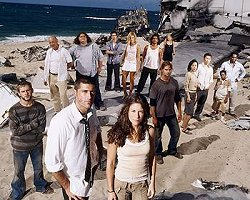
I have now seen the first two episodes, and I know that the hobbit is actually a rock musician with a drug habit. The boy has just lost his mother to cancer and is with his estranged father. The dark haired woman was a prisoner in hand-cuffs during the flight, but she's actually a pretty nice person. The tough-looking guy with the short hair and white shirt is a doctor and very good in a crisis indeed, and he has a big tattoo on his shoulder. There is an Iraq soldier who fought against the US in the Gulf War, but seems to have changed sides now. And the pregnant woman, is, well, still pregnant. There are about 14 major characters in all, we don't know many of them that well yet, some haven't even spoken any English.
Learning about the secret past lives of the people is a big part of this series. It's obvious that nobody will really be who they appear. It's also probable that the accident wasn't even that. But I'm getting ahead of myself here - just what is the plot?
We first see our characters escaping from a passenger airliner that has crashed on a remote island in the south Pacific. There are over fifty survivors, and at least one person is seriously injured. As they pull themselves together and wait for rescue, they hear weird sounds coming from the jungle, and the tress sway as if there is a big monster in there.
Some survivors go to look for the front section of the plane which has fallen some way away, to try and find a transceiver to radio for help. They find the pilot, still alive after 16 hours, and he tells them that they were completely off course, so potential rescuers will be looking for them in completely the wrong place. The weird noises start again, and then...well, I won't give too much away, but it isn't pretty.
Knowing that there are 25 episodes, and that a second series is in the pipeline, puts me in the notion that this band of people are going to be spending quite some time together on the island. Something really odd, and dangerous, is going on there with the wildlife. No one is quite what they seem, and factions will develop within the group with plenty of scope for tension.
All in all, it's a nicely acted piece of drama, with great potential, and essential Wednesday night viewing.
Posted by se71 at 02:33 PM | Comments (0)
July 04, 2005
Alice Munro - Dance Of The Happy Shades
Alice Munro - Dance Of The Happy Shades
Often described as the best short story writer in the world, I had really high hope for this collection. Happily, they weren't completely dashed, though I did start to get a little bored by the stories mostly being set in the same time and place, and by the pace.
This collection from 1974 seems to draw on the simpler post war days of small town America. A young girl has a new dress made for her by her mother to go to a dance. She is full of self doubt about whether any boy will ask her. She discovers something about herself and grows up a little that evening. An old woman dreams of seeing her son, but thousands of miles away in a small convenience store with her daughter and granddaughter on a seldom driven road. A mother copes with a tragic accident where her baby boy is scalded when he is left alone while she visits a neighbour.
There is a lot about young people coming of age. There is something about simple societies concealing individual's complex emotions. There are stories that don't really have much of a point at all, but just describe a small incident. They usually have some kind of transition, a moment when a person has an idea that changes them, or has a realisation of something they should have known all along.
The writing is very calm, measured and I can't fault the quality of these stories in isolation. I was hoping for a little more variety, and maybe a few more surprises - there are some though. Perhaps this collection is meant to feel like everything is taking place at once in the same town (it is mentioned by name a few times in different stories). Maybe other collections will show that the writer does have a larger canvas to paint on. I hope so.
Posted by se71 at 01:47 PM | Comments (0)
May 20, 2005
The Hitch-Hiker's Guide To The Galaxy
This is a movie I never expected to see. I've been reading the books since 1979. I joined the HHGTTG appreciation Society in 1983. I went to see Douglas Adams reading from "So Long and Thanks For All The Fish" and got him to sign not only my copy of that book, but the previous volumes too. Over the years I've reread the books, watched the TV series, listened to the radio series, and swapped Guide quotes with friends and family on a daily basis.
So when it comes to the wacky concepts, and the one liners, I seldom laugh out loud any more. I still appreciate them, but it's more a wry smile than a belly laugh.
This makes the job of impressing me with a film very difficult indeed. When a small piece of dialog is subtly altered or left out - I notice. When favourite scenes are completely forgotten (the desperate conversation with the Vogon guard to try and persuade him to not throw Ford and Arthur out of the airlock for example) - I notice. When a brand new subplot about Trillian being Arthur's soulmate and him rescuing her from certain death is inserted - I notice.
And yet I did find that an awful lot of the things I like were included. Mr Prosser was there to demolish the house; Arthur and Ford made good use of their towels, 'frood' was used as a word in context , and not explained; Marvin's voice was right, as was the one for Eddie, the shipboard computer; and the sperm whale got to give his whole monologue before smashing to smithereens on the planet of Magrathea.
There were even some new touches that embellished the humour and actually did make me laugh. The landlord and customers in the pub, just before the Earth is demolished, actually do lie on the floor with paper bags over their heads. The Vogons become even more administrative needing a form filled in to allow them to chase Zaphod Beeblebrox across the galaxy. And Deep Thought is depicted as a huge bronze statue not unlike Rodin's 'Thinker'.
I'm not going to say I liked everything. Zaphod was altogether too stupid and his head flipping routine tiresome. Ford was a bit on the homosexual side, something never hinted at in the books and probably just a politically correct attempt by the directors. The Arthur and Trillian love interest was also unnecessary - but I'm guessing Hollywood didn't want to bankroll a big movie without it, even the Star Wars franchise seem to think this is something a science fiction film needs.
Overall, it's a very good film - the special effects are stunning in places, and very good everywhere else. The Englisness of it is diluted a little, but mostly present. The 'Guide' is adequately read by Stephn Fry, though it will always be Peter Jones for me. I almost wish I was a Hitch-Hiker virgin so that I could watch it without all my previous baggage, as people in that position are the ones who will enjoy it the most.
Posted by se71 at 12:43 PM | Comments (0) | TrackBack
May 03, 2005
Diamond Dogs, Turquoise Days - Alastair Reynolds
*** SPOILERS ***
Two short and unsatisfying science fiction stories.
Readers of the epic space opera begun in Revelation Space will be a bit disappointed by these two tales. Both take place in the same universe, though are not connected in any other way. In the first a very rich, old, devious man (hmm, haven't we seen a few too many of these already Mr Raynolds) has found what appears to be an alien artifact on a distant planet. He has some recorded evidence that other humans found it first. It is a building with a series of rooms, and in each room is a puzzle. If the puzzle is solved a door opens to the next room, if not, then the room kills or maims those inside. All the previous explorers are dead.
He gets together a team of the best people he knows, intelligent, cunning, surgically enhanced. He brings along a mad scientist who can replace limbs cut off, even organs damaged. For a very large amount of money they are going to see how far they can get.
That's about it. The story is interesting, the characters real, but the journey never really gets resolved.
The second story takes place on a Juggler panet. This is an aquatic world, populated by a semi intelligent organism called a Juggler. Humans have settled there to study the creatures, and have been isolated from the rest of humanity for about 100 years.
The lead character is a woman whose sister went to swim with the Jugglers and never came back - they have the ability to assimilate people into their collective consciousness. There is a hint of something evil in the water, which never gets resolved. Then a team visit the planet, ostensibly to study too. This causes great consternation and upheaval. They have only
been on planet for a short time when one of their number goes on the rampage killing both his own people and the locals, and then attempts to throw something into the water to kill the jugglers too. But he is stopped.
That's about it.
Both stories are well told, but Reynolds hasn't been fair with us with this brief volume. He builds up an intriguing premise, then leaves it open ended. I guess a lot of science fiction stories do that, but after the novels I was expecting more. I'm very glad I didn'tpay full price for it.
If you have never read any of his other books, that is actually quite a good place to start. The novels are very large and also dense, so if this taster doesn't interest you, it would be best to give them a miss. However if you quite like the stories, and want to know a bit more - Revelation Space is the place to start.
AE1
Posted by se71 at 04:45 PM | Comments (0) | TrackBack
April 22, 2005
The Outsider
The Outsider - Albert Camus
*** SPOILERS ***
What is the correct length for a novel. Stephen King can churn out more than 1000 pages. He can dissect the lives of ten or twenty characters in that space. Camus gives us just one real character here in around 100 small pages, and yet somehow his novel is a great existential masterpiece, whereas King gets slated as a hack.
Meursault is the protagonist, and the whole story is told by him in the first person. He is a strangely detached individual, who seems to observe his own life rather than live it. He has an office job that he is happy with, he lives alone but has friends. He had sent his mother to an old peoples home, and at the beginning of the novel we find she has died. After attending the funeral, he gets back home and forms an attachment with a young woman called Marie. He doesn't really have any feelings for her, it's just quite nice and convenient When she asks if they should get married, he just says 'sure'. He'd be happy to marry any attractive girl.
Meursault's neighbour Raymond is a violent man who beats up his girlfriend, an Arab girl. The girl's brother follows Raymond to a beach where he has gone with Meursault and Marie for a day out. Somehow Meursault finds himself approaching the Arab, who draws a knife in self defence, and Meursault shoots him with a gun which he has actually taken from Raymond to try and avert it's use.
Mersault is arrested and tried for the crime. He answers truthfully to all questions, and his lack of emotion doesn't help his case. He is sentenced to death. Whilst awaiting the sentence to be carried out, he is visited by a priest, who tries to convince him to embrace God. Meursault does not believe in God, which exasperates the priest, who cannot believe how someone could face death without repenting their sins.
"Killing an Arab" was an early song by The Cure - here is the chorus
"I'm alive
I'm dead
I'm a stranger
Killing an arab"
If you've ever heard the song, then you will not be able to read this book without thinking about it. Like The Cure themselves, this book is bleak, dark, and unsettling. Meursault is obviously guilty of the crime, but he doesn't appear to have any moral view on it. If someone doesn't really understand why what they have done is wrong, should they be punished? Is this 'outsider' a part of society? What should we do with people who do not conform to normal types of behaviour?
The 'plot' is a simple one, the writing is dry and subdued, with little in the way of excitement. What the story is there for is just to illustrate these moral questions. It's certainly succeeded in creating an odd and memorable situation, but it's not really a novel. It's a 'one trick pony', a short story with only a single point. A novel should really have more than one strand.
AE0.5
Posted by se71 at 11:51 AM | Comments (0) | TrackBack
April 15, 2005
Blakes 7
*** SPOILERS ***
As a kid, I somehow missed out on Blakes 7 until well after the eponymous one had died in the series. Avon, who replaced him as leader of the rebels, was a great character. I don't seem to have felt the loss of Blake at all in those early episodes.
Getting the first series on DVD however was a bit of a thrill, and so I sat down to finally find out what happened in the beginning.
The title screen looked excellent, the Liberator spacecraft approached me in crystal clarity flying through space, and I thought to myself "Wow, they really did a good job on the graphics in those days, much better than Dr Who". Then the real intro come up, and I realised that the Blue Peter team had probably made it on one of their days off. These low tech effects continue throughout of course, you don't watch BBC SF shows for that kind of thing. Unfortunately the juxtaposition of the specially made one for the DVD with the old credits really emphasises how far we've come.
Blake lives on Earth of the future. The population are imprisoned in a huge dome and drugged to keep them docile. There are rebels, but they are small in number and have to meet outside the dome. A recent rebellion was quashed, with everyone except Blake deported to a prison planet and executed. Blake himself was brainwashed so that even he doesn't remember his past.
A new civil disobedience initiative is starting, and they want to use Blake as a figurehead. They lure him to a meeing and reveal to him who he really is, but then the meeeting is infiltrated and everyone is killed. Interestingly the government are still scared of making Blake a martyr, and so keep him alive. They do however try him in court for false child abuse charges, and put him on a ship to deport him to the prison colony. On the trip, he mets Jenna and Vila, and then it ends.
It's a familiar plot really. The sets and effects are really bad. A lot of the acting is really bad too. A 20 second dream sequence is replayed in it's entirety three times, and it's not really very convincing the first viewing. And the accents are hilarious; everyone has a clipped BBC voice, even Blake. Imagine Noel Coward playing every part, it feels a bit like that.
And yet, is it just the nostalgia talking, or has it remained really very gripping drama? I think Blakes 7 has aged really well. Science fiction can easily throw up laughable visions of the future, but this dystopia is still a possibility for us. I know Blake will get his memory back soon and start fighting the federation back properly. I'm really looking forward to Avon and Servalan reappearing for some much needed maliciousness and sarcasm. And I'm introducing a new generation to the show of course, my daughter will be forced to watch the whole lot whether she likes it or not :-)
Posted by se71 at 01:49 PM | Comments (0) | TrackBack
April 14, 2005
Iain Banks - Canal Dreams
 Canal Dreams - Iain Banks
** SPOILERS **
Brooding novel about war and violence with action packed finale.
Hisako Onoda is a Japanese woman who is a celebrated cellist. Afraid of flying, she is travelling by boat from Japan to Europe through the Panama Canal. This is a politically volatile time in Panama, and her boat is blocked in the canal along with two others as it is too dangerous to proceed. She spends the time practicing her cello, and having a relationship with one of the ships crew, Philippe, who also teaches her how to sub-aqua dive.
There are numerous flashbacks to Hisako's life growing up in Japan. She is a strong willed girl, clever with languages and excellent at the cello of course. She has dreams, which are full of blood. She is remembering back to a public demonstration that she attended which got violent, and where she actually killed a policeman with a baton and got away with it.
A group of rebels take over the ships and imprison everyone. They plan to launch a missile to bring down an American plane. Things are fairly civilised, until one man tries to fight back. This initiates a struggle which the gorillas quickly overcome. And it makes them mad. They kill everyone, except Hisako, the sole attractive woman. They keep her alive and rape and torture her.
Against overwhelming odds, Hisako escapes, and in action worthy of the finale of a James Bond film, manages to kill every gorilla and blow up two boats before swimming to safety.
This is a good book, with an interesting mix of history, and action. Hisako is a particularly good character, Banks seems to do heroines well. She is complex, with many motivations, and her fight back at the end is convincing. The secondary characters however are lightly drawn, and when they all die we're not overly bothered. Perhaps that was deliberate. I'm sure Banks is trying to say something about war, and he includes the atom bomb in Hiroshima as the cause of Hisako's father's death. I couldn't really work out what it was he was trying to say though. All the Panama political history was much fresher in the public mind at the end of the 1980s when this book came out, and maybe the book was a reaction to that.
There is a really nice touch where we are told that there is a fault with the diving equipment gauges. We assume that somehow this will be important later, and it isn't till the last page that it's mentioned again, and we see it was a deliberate red herring.
AE 2
Posted by se71 at 04:52 PM | Comments (0) | TrackBack
April 06, 2005
Ian McEwan - Amsterdam
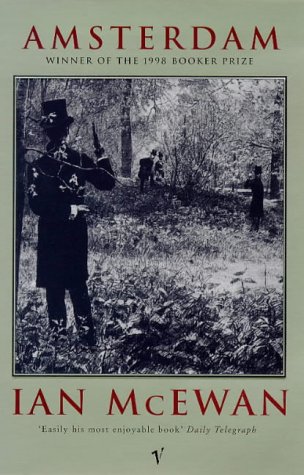 Amsterdam - Ian McEwan
** SPOILERS **
Tale Of The Unexpected!
Molly dies, and she's been very popular with men during her life. Four men in particular are involved in this tale - Vernon, a newspaper editor; Clive, a composer; Julian, an MP; and George, her eventual husband.
Vernon and Clive are best friends, both dislike Julian. When Molly dies they both sense their own mortality. They don't want to lose their faculties and die confused and cared for by others. The make a pact to arrange each other's euthanasia should this ever happen.
George finds a photograph of Julian that had been taken by Molly. In the photo Julian is wearing a dress and posing to the camera. This is dynamite, as Julian is now vying to become Prime Minister. He sells the photos to Vernon, who immediately decides they must be published. His colleagues aren't so sure, but he manages to persuade them.
Meanwhile Clive is composing a symphony, commissioned for the millennium. He is having some trouble with it, and goes to the
lake district to clear his head. Whilst there, he is witness to an attempted rape, but tells no one about it except Vernon.
So far, all is reasonable, this is a pretty good story, exept for a bit too much detailed description of the symphonic composition process. But then these two old frinds fall out. Julian comes clean about the photos on TV, and the public don't seem to mind too much. Vernon publishes anyway and in the backlash is asked to resign from the paper. Clive has always been against publication, and says so in a note to Vernon, but the tone is misleading and Vernon takes it the wrong way. Vernon tells the police about Clive's experiance in the lake district and has to go back to Manchester to answer questions. This completely shakes his mood, and stops him from completing the symphony properly, he just can't find the melody he needs.
So both 'friends', now mortal enemies, decide to pretend to make it up in Amsterdam, but really to kill each other. They both hire euthanasia vigilanties (it is Amsterdam after all), drug each other with champagne, and are both killed.
There isn't much else to say about this book. It's a tale that Roald Dahl would probably have put into one of his short story collections, being only about 100 pages of large type in length. The shock ending is fairly predictable, but the emnity between the foes isn't properly developed. If you like this, then move on to some of McEwan's better work, which includes any of his other novels in fact. If you don't like it, don't give up on McEwan though.
AE2
Posted by se71 at 04:34 PM | Comments (0) | TrackBack
March 31, 2005
Being Dead
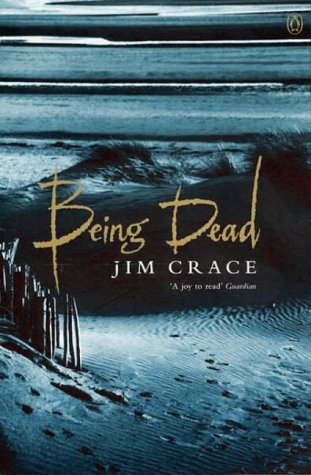 Being Dead - Jim Crace
**SPOILERS**
Mortuary textbook, love story?
A pair of young marine bioligists, Celice and Joseph, meet at Baritone Bay on a field trip from university. They are both a bit unconventional, and fall for each other almost immediately. There is a tragedy where one of the members of their trip gets killed, and this probably pushes the couple closer together. Skip to 25 years later, and they are both married with a grown up daughter and working together in academia.
Hearing that their meeting place is about to be redeveloped into luxury residences, they return one last time. As they sit semi-naked amongst the sand dunes, they are brutally murdered, heads smashed with a concrete block, by a nutter who only wants their cash. They lie there decomposing for days before they are missed. Once this happens their estranged daughter comes back home and starts searching the hospitals and morgue. Finally they are found.
This is a short novel, and the events are split up and told both backwards and forwards in time. This device isn't really much help; it 's only purpose seems to be to try and spice up a fairly mundane story. A huge proportion of the writing is about death and the processes of decay, so don't read this if you're a bit on the squeamish side.
It is interesting to see how a writer can take something so simple, and make a novel out of it. It is a diverting read, and the narrative actually starts with the death, so the spoiler warning wasn't really necessary as nearly everything is given away in the first few pages. The search for the bodsies does however have a certain amount of tension.
AE2
Posted by se71 at 01:52 PM | Comments (1) | TrackBack
March 03, 2005
The Shadow Of The Wind
The Shadow Of The Wind - Carlos Ruiz Zafon
Mystery story set in mid 20th Century Barcelona
This much hyped story doesn't really live up to the buzz surrounding it. Some have even gone so far as to claim the book will change your life - this is complete nonsense.
Daniel is a young boy growing up in Barcelona around the time of the Spanish Civil War. His father runs a bookshop, and when Daniel is 10 years old he takes him to the secret Cemetry of Lost Books. Here Daniel retrieves a novel called The Shadow of the Wind, by Julian Carax. The author is from Barcelona, but fled to Paris and is believed to have died there many years before.
Daniel is captivated by the book, and tries to find others by the author. He discovers that there is a shadowy character retrieving all copies of Carax's books and burning them. This man Coubert is hideously disfigured from a fire he got caught in, and only appears at night. Daniel digs deeper into Carax's life, and finds a murky history with a lost love called Penelope, a school friend called Fumero with a murderous past who has now risen to the rank of senior police officer
, and a mysterous woman called Montfort who knows more about Carax's life in Paris than she at first reveals.
Aided by Fermin, a vagrant and a former political prisoner, Daniel gradually discovers the truth. Fermin is being hunted by Fumero, who is also trying to find Carax who he believes is still alive. The two amateur detectives follow the trail around the streets of Barcelona gradually uncovering more of the truth. They narrowly avoid death themselves, and inadvertently lead Fumero to Carax himself for the final showdown.
--
There are many problems with this story, which should be in the fantasy section of the bookshop really it is so unbelievable. It is completely obvious that Coubert and Carax are the same person, yet this is a central mystery of the book. This sluggish revelation, and the relealation of the rest of Carax's past, is drawn out over hundreds of pages where much less would have been preferred. The reason is so that the author can flesh out his colourful cast of characters, but even here this is hardly worth it. Fermin, much liked by other critics, is an unreal person. He is constantly optimistic, resourceful, and almost indescructible, so why is he living on the streets as a beggar when Daniel meets him? Daniel pays the detective, but his motive is really very weak. Montfort, who turns out to be Carax/Coubert's lover, in anticipation of her own murder by Fumero writes outher version of what happened in a letter to Daniel, who she hardly knows. This letter forms about 50 pages of the novel, a lot more detail than is believable from a woman in hiding.
Leaving aside the melodramatic search for the truth portion, there is a coming of age story of Daniel falling in love first with a much older woman, and then his best friends sister, which is much more interesing. The parallels drawn between this and Carax's early life are nicely played out. Both young men are obsessive, and yet whether because of the changing Spanish times, or their own characters, the outcomes of their actions are different.
Also, there is much here about life in Spain, about the Civil War and the Second World War, about ordinary people coping with a changing world.
So read this for the history, and the humanity, and the colourful language, and give the author a bit of leeway on the rather fanciful and confusingly drawn-out plot.
AE2
Posted by se71 at 09:41 AM | Comments (0) | TrackBack
July 17, 2003
The Matrix Reloaded
Glossy effects, but sequel is too confusing, and lacks the wow factor. All the main cast return for this first sequel to the massive hit The Matrix. Keanu Reeves as Neo has lost none of his woodenness, and goes around with a permanent confused frown on his face. Trinity, played by Carrie Ann Moss, is little better, though she still looks good in that black one-piece suit. Laurence Fishbourne as Morpheus has almost lost the plot completely in his fanaticism that Neo is "The One" who will save Zion, the underground city which is the last refuge of the human race. As we open, Trinity is in action, much like in the original film. As she is chased, she jumps from a skyscraper, and is still firing bullets at the agents diving after her, when she hits the ground; and Neo wakes up! It's just the classic nightmare scene much loved of horror films, or is it a premonition? It is a strong opening, full of tension and showcasing the trademarked special effects. These effects really are excellent, especially later when Neo has to fight dozens of copies of Agent Smith all at the same time, and in the spectacular motorway chase, but somehow the awe we felt at seeing them in the first movie is a bit less now. Cinema audiences expect excellent quality in their special effects, it's innovation in their use that has to differentiate films. The original Matrix managed to innovate, and though Reloaded does push the boundaries, it doesn't make that same quantum shift. So, the story so far. Machines have enslaved the human race, and keep them as power generators in pods. To keep them from going mad their minds are plugged into the matrix, an artificial world, where they live their whole lives without realising it isn't real. Some humans have escaped, and live in a city called Zion, underground. Morpheus pilots a ship, Trinity is part of the crew, and they are looking for a saviour, someone with the power to destroy the matrix. They seem to have found him in Neo, who manages to kill the agent programs which police the matrix. As we open, the machines have found Zion, and are drilling through the earth to reach it. In a matter of days they will reach the city. Somehow they must be stopped, and the city council have two plans. The first plan is just to fight, as they have always done. The second plan is to allow Morpheus and Neo to infiltrate the matrix, but this plan relies on prophesy and faith, and has very little backing. It isn't really made clear how destroying the matrix will actually help, presumably it will free the millions of enslaved humans, but they will be unable to look after themselves as their muscles have never been used, will have no food, and will all quickly die. But this plan is put into action, and several teams plug into the matrix, trying to destroy the heavily protected core program. There is another meeting with the enigmatic Oracle, fights with rogue Agent Smith, and an odd meeting with characters in the matrix called Merovingian and Persephone, who have special powers, and have very powerful twin body guards, but in a shock ending, it looks like they have failed, and that Trinity has died. But Neo displays unknown powers, when outside the matrix, he manages to resurrect Trinity, this is definitely odd, and will have to be explained in the third film. This is a very confusing film, which has withheld information from the audience, presumably so that it can be revealed in the final instalment. Because of this many things make very little sense, such as the Keymaker and the multiple Agent Smiths, and so you'll leave feeling unsatisfied, having consumed the starter, but been denied a main course. Perhaps once everything has been revealed in Revolutions, the third instalment, it will be possible to return to Reloaded and enjoy it much more. AE 2Posted by se71 at 12:38 PM | Comments (0)
July 13, 2003
Highlander 3 - The Sorcerer
Disappointing Sequel, but better than Highlander 2 Highlander was a tremendous film, and at the end Conor McLeod was the final immortal on the planet. "There can be only One" was his catchphrase. But then a sequel was made, and it was terrible. It paid no attention to the story in Highlander, it was brash and over-the-top, and substituted intelligence and pathos with loud music and extreme violence. Fans around the world screamed "No!" It looks as if someone listened to the fans, and deciding the franchise could be resurrected, decided to make a real sequel that didn't ride roughshod over the original's story, but actually followed through. It's actually quite a poor story unfortunately, as it really doesn't add anything new to the idea of being immortal, and is just an excuse to show some swordfighting. 400 years ago, in ancient Japan, an immortal with sorcery skills is killed by another immortal called Kane. So Kane acquires the ability to create illusions, to trick his enemies into seeing things that aren't there. Before he can use his new skills however, McLeod manages to entomb him in an underground chamber, where he will remain forever, still alive, but trapped. Back to the current day, and an archaeological dig frees Kane, and he wants revenge. Kane is a one dimensional character, with a simple bloodlust to destroy everything in sight. Throughout the rest of the film he gets to use his illusionist skills to confuse his enemies, but this is really only an excuse to include some fancy special effects. The archaeologist is an attractive woman called Alex, and from an old piece of tartan she finds in Japan, she manages to track McLeod down. He still has his New York apartment, and is still managing to confuse the doctors by being shot and not dying, and the police by leaving headless corpses lying around. Kane kidnaps McLeod's adopted son, to lure him to a swordfight, which McLeod wins. He drives off into the sunset with Alex and his son, presumably to live happily ever after. Highlander 2 was an abomination, Highlander 3 is simply unnecessary. AE 1Posted by se71 at 01:29 PM | Comments (0)
July 05, 2003
Caught In The Light - Robert Goddard
Convoluted and unconvincing mystery, but a real page-turner Ian Jarrett is a photographer. He had an affair five years before the story starts that nearly wrecked his marriage. He got found out by his wife when he knocked down and killed a young woman as he was driving back from a liaison with his mistress. Somehow he managed to patch his marriage together. On assignment in Vienna, he meets and has a passionate affair with a woman calling herself Marian Esguard. Foolishly, and unbelievably, he leaves his wife and daughter upon returning to England, and heads off to meet the new woman. Marian doesn't show up, and sends a message for Jarrett not to try to contact him, ever. So far, the story seems fairly straightforward, but the author has already started to deceive us. It's all really about the car accident. The woman who was killed had a brother called Conrad Nyman, and a female lover called Daphne, who are both devastated by her death and want revenge. So they plot, and they decide that they want to ruin Jarrett's life. Marian is hired to seduce Jarrett, and make him leave his wife. She then disappears, but leaves clues for him to follow, and he is so desperate to find her, thinking that she is in danger, that he gives up work and all contact with his family to search. Daphne is a psychotherapist, and she helps Jarrett by pretending Marian was a patient called Eris Moberley. Jarrett searches for months, traversing Bath, Chichester, Somerset, Norfolk and Guernsey, and even gets caught up in a murder. The final part of the plan is when Nyman seduces Jarrett's estranged wife, and convinces her and her daughter that Jarrett is insane. It's all very bizarre, and at the climax, when Nyman is found out and kidnaps Jarrett's daughter, another desperate chase across England is started. But Nyman's business, and life, is ruined, and he kills the girl, and then himself, and Jarrett never finds Marian. This is a very unsatisfying downbeat conclusion The subplot to all this is a very complex story about Eris having flashbacks to a previous life. In these flashbacks she is a 19th century woman called Marian Esguard who was a pioneer in the science of photography. She took photos before anyone else, and some of these still exist and are worth a fortune. Jarretts search for Eris/Marian is also a search for these photos. Once again however, the photos don't ever materialise, giving more disappointments for the reader. If someone wanted to ruin another persons life, this plan has so many holes in it that it is incredulous, and something simpler would be much more likely to succeed. Nyman is supposed to be pathologically insane, but even that doesn't excuse this plot. Robert Goddard has gone too far this time and has tricked his readers into following a story which appears all along to be real, but turns into complete fantasy. The writing drags you on relentlessly, but once you finish this book you'll ask yourself "Well, What on earth was the point of that?" AE 1Posted by se71 at 12:04 PM | Comments (0)
June 13, 2003
Time's Arrow - Martin Amis
Clever tale of Nazi butcher's life Amis has a fairly straightforward tale to tell, of a German doctor who worked in the Nazi death camps of the Second World War. The man escaped with gold stolen from the murdered Jews, changed his identity and lived the rest of his life as a doctor helping the sick in America, and eventually died of old age. There are probably novels that cover this kind of life, and even if there aren't it would be possible to write a good novel with this plot synopsis. But there is a trick Amis wants to play on us - he writes the story completely backwards. The story begins with the man's death, lets call him Tod Friendly, though this is an alias. The details are related by someone who comes into consciousness at this point in time and lives inside the Tod's head. This unnamed narrator has access to the man's senses, and his feelings, but not to his thoughts. He begins by being pretty bewildered about what is going on, and never understands that his timeline is wrong; for example, he thinks that kind parents see their children crying, and slap them to make them feel better; he thinks taxis are always available, and that grateful passengers wave them goodbye upon exiting. Tod's life runs backwards, but the entity inside lives forwards, and so remembers the man's future as his past. This makes for many interesting and amusing misunderstandings like the ones just mentioned, and is also a clever and unorthodox way to raise the tension. Tod has nightmares, and we can see that this is a precursor to something terrible happening, but we have to guess what that might be. Tod is a very unpleasant man, who didn't need much persuasion to be corrupted by the Nazis, and who spends his whole life mistreating the women in his life. We don't hate him as much as we ought to though, because it's his miserable old age, and years of worry that we first discover, and this skew in our feelings is one of the most remarkable thing about the novel. It's quite a short book, so there isn't really time to get too irritated by the confusion it causes; conversations are particularly difficult, so sometimes you need to turn the page and actually read the novel backwards. The combined elements of this backwards storytelling, Tod's harrowing life, and the holocaust itself, make this an interesting and thought-provoking read. AE 2Posted by se71 at 04:20 PM | Comments (0)
June 09, 2003
Man And Wife - Tony Parsons
Midlife Angst Harry Silver repeats his performance from Man and Boy. This review could easily stop there, because if you've read the first book, then this sequel will hold no surprises. Harry is living with new wife Cyd, who is of course very beautiful, and her daughter Peggy. His son Pat, the most beautiful boy in the world, of course, is living with ex-wife Gina and her new beau Richard, and he does the normal weekend father stuff. He also has a good job as a TV producer. But is he happy, no. And then Gina takes their son to live in America. And then his mother gets breast cancer. And then his job starts to fall apart when his only client takes a bit too much cocaine. And then he suspects his wife of having an affair, and begins a mini platonic affair himself. Just what is it he wants from life; he seems to stumble from one disaster to another, wanting the perfect relationship, and then not being happy with it when he gets it. He idolises what he perceives his parent's marriage was, one long love affair with each other. And then things start to come together again; he stops the affair before it goes too far, his son comes back from America, his mother looks like she is recovering well from her mastectomy. And the final topping on the cake, Cyd becomes pregnant, which will make them a totally blended family. Harry appears to be a voyeur, looking at his life, but not being able to affect it. And as a reader, you feel that you are watching this with cotton wool in your ears. You feel detached, you know your emotions are being cleverly manipulated, and most of the time you easily resist, but occasionally Parsons manages to get through to you. The characters are one dimensional caricatures, and the situations manufactured for maximum effect. In fact, the whole thing screams "TV movie sequel", from the punch up in the posh restaurant, to the biker's wedding at a service station. And the book has a fairly unconvincing ending. Harry really is a pretty unpleasant person, selfish and self absorbed, and you just know that this latest attempt at happiness will be spoilt when he next spots a young pretty girl that takes his fancy. Perhaps there will be a trilogy - "Man and Mistress" anybody? AE 1Posted by se71 at 02:08 PM | Comments (0)
May 21, 2003
Entrapment
Heist thriller with unlikely romance included Little needs to be said about the plot of this star vehicle for Catherine Zeta Jones and Sean Connery. They play high tech thieves, who steal very expensive things, mostly for the challenge, but also looking for that big haul that will make them the top criminal, and allow them to retire forever. Jones is also an insurance investigator, and she is investigating Connery to try and catch him red-handed. In true double agent style, we never know whether she will betray Connery, or her firm, or both. Connery however knows he is being double crossed. We see them do a couple of stylish and clever heists. The training and execution of Jones' gymnastic feat of avoiding invisible laser beams is the highlight of the film; that skintight black catsuit probably doubled the boxoffice gross. But in the end Connery turns out to be working for the FBI, and betrays Jones to them. In a very unlikely finale, they both declare their love for each other, and escape with $1 billion. All in all, a fairly pleasant two hours. Sean Connery plays himself, Catherine Zeta Jones does a passable American accent and looks good, and the action is good, and the tension actually does feel real in places. The love story was unconvincing though, and the plot, especially the computer hacking, and FBI and insurance company ineptitude, meant that it should really be treated more as a romantic comedy rather than a thriller. AE 0Posted by se71 at 06:21 PM | Comments (0)
May 18, 2003
The Outlaw Josey Wales
Real western life at the end of the Civil War Clint spits his way through this film with his usual blend of grit and humour. During the American civil war Josey Wales is just a simple farmer, then one day 'Red Legs' come (soldiers on the side of the union) and kill his wife and son, and leave him for dead. He survives, and joins the rebels trying to avenge his family. Several years later, and he is one of the most feared outlaws in the south, when the rest of his gang decide to surrender, realising that the war is over. They are betrayed and massacred by the Unionists, but Wales gets his own back by killing many of them, and so a chase begins. Wales is pursued across the Indian nation; along the way he picks up a growing band of misfits including an old Indian man, a squaw, an old lady and her young beautiful granddaughter (Sondra Locke). Finally they reach a safe haven, a farmhouse, and decide to make their stand. A battle ensues, Wales wins. If you were to point to the epitome of '70s westerns, this would probably be it. It's a bit slow in places, but the pace gives you time to immerse yourself fully in the world. It's genuinely funny and tragic at the same time. The transition from earlier treatments on film of Red Indian savages to noble Native Americans in almost complete; in fact they are treated as normal human beings with good and bad sides. And just when you think it's getting a bit serious, Clint spits on the dog, which never fails to amuse. AE 0Posted by se71 at 10:53 AM | Comments (0)
May 02, 2003
Blade II
Stylish follow-up vampire action Wesley Snipes returns as Blade, accompanied by loyal sidekick Chris Kristofferson whom he rescues in the first 15 minutes. Didn't Chris die in the first one? No, he didn't. We thought he shot himself rather than be captured by the vampires, but he was kidnapped by them, turned into one, and kept alive chained in a vat of blood. A quick injection later and he's as good as new, inventing cool gadgets for Blade to kill vampires with. Back to the real plot though. A new kind of vampire is on the loose. His prey is not humans, but other vampires. He has an extendable jaw, an bit like a cross between Predator and Alien. He uses this to bite his victims and turns them into strange bald creatures that just seem to want to eat vampires, and bound around like chimps the rest of the time. The real vampires are scared, and recruit Blade to work with them to try and get rid of them. These new vampires are a bit hard to kill though, and eventually after silver bullets and swords have failed they discover that only UV light does the business. Many battles later, and we discover that the leader of the vampires created this new breed, and their leader is his disowned son. He kills his father, and Blade eventually kills him, and that's about it really. Everyone wears black leather. The music is pumping techno and rap. It's slick, it's stylish, it's fast. It has lots of Kung Fu type fighting, and vampires exploding in blazes of fire, and it's a lot of fun. It's Blade II, what else did you expect? AE 0Posted by se71 at 04:11 PM | Comments (1)
The Game
Dark thriller that almost works Michael Douglas is a successful businessman, very successful, very rich, and very bored. His brother buys him a birthday present, a very strange one, it's a part in a game designed for him personally. Reluctantly Douglas goes for the detailed personality testing required to enter the game, and then forgets about it. A few weeks later, he is caught up in a dangerous situation, and helps a woman escape from some bad people. A lot of this goes on, and Douglas isn't sure, and we're not sure whether what is happening is real, or is part of the game. Then the attempts on his life get even more serious, his brother gets involved and begs him to help him escape the game himself. Then all his wealth is moved out of his bank accounts, and finally he gets drugged and kidnapped and dropped in a foreign country with no identification and no money. Driven almost to madness, he makes his way back home to try and get his life back. He believes the game's original aim was to do this to him, and he wants revenge, and his life back. And this is where everything falls apart, and the film's twist in the tail spoils everything. What happens is that he finds the headquarters for the game's organisers, and goes there with a gun. Blinded by fury, he accidently shoots and kills his brother, then discovers that the whole game really was a game, and that all his money is fine. This is too much for him, so he walks to the edge of the tall building and throws himself off. And then he lands on a big balloon in the banquet hall on the ground floor, where all his friends have been gathered to give him a big party. It's just too neat, nothing could be planned so carefully. Driving a man to suicide as a game to spice up his life is too bizarre, and maybe he will never recover from the shock. And the game itself nearly killed him so many times they could have never been sure he would stay alive until the final denoument. It's a great idea, and very well made and enjoyable right up till the endfinale, but the double twist, and the way that you don't believe it could really ever happen like that, spoil an otherwise excellent film. AE 0Posted by se71 at 12:22 PM | Comments (0)
Terminal Velocity
Ludicrous action thriller, but fun too. Charlie Sheen plays a parachute trainer who takes on the job teaching a pretty girl how to take her first jump. In the plane she distracts him, and jumps, but very quickly he notices and jumps after her. He nearly catches her, but she plummets to her death. The authorities try to close his business down, but suspicious of the dead girls motives, he searches her bag and finds a photo proving she could already skydive. He then finds her address and goes to search her apartment, which is where it starts getting a bit silly. It all ends up that she is a Russian spy, who has tried to fake her own death. The body found on the ground was a decoy dropped by another plane. She is trying to recapture Russian gold, and Charlie finds her and they have many adventures involving skydiving and rocket powered cars and really bad people who want to kill them for the gold, including an early appearance by James Gandolfini. There is some good action, and a great stunt where he rescues the girl from the locked trunk of a car that is in freefall from a plane, but there is an unreal feeling about it all. It seems like a spoof action film, like Hot Shots, which Sheen starred in of course, and it's difficult not to think of that film while you watch this. It's quite enjoyable for all that, but I do wonder why I've actually watched it twice now, maybe Natassja Kinski as the mysterious Russian spy has something to do with it! EA 0Posted by se71 at 12:22 PM | Comments (0)
April 28, 2003
Madonna - American Life
Madonna does it right, yet again I'm confused. I look at the top selling singles chart and see mostly dross from new young artists. Is no one interested in buying music these days that has a little integrity? Pop Idol and their ilk have a large part to play, but the rot really set in with Steps and S Club a few years back. So why am I confused? Well, Madonna has been making top quality pop music for over 20 years and can still wipe the floor with everyone else around. So why aren't the record companies recognising this, why are they consistently pushing MTV friendly, clear faced, bland pap at us, instead of marketing real talent that may have a shelf life of more than 15 minutes. OK, rant over. This is a tremendous CD, and once you've finished listening to it for the first time, you'll immediately click the play button again and go round for another turn. In fact, like me, you may find that you play it six times on the trot and only stop because it's past your bedtime, oh, and then you'll stick it on the walkman for the journey to work. So what makes it so good? real lyrics about things that matter (if a bit self indulgent); a super cool combination of acoustic guitars and analogue synths sounds mixed up and produced to perfection with some great timing tricks that really get your toes tapping; Madonna's vocal, though never a really great voice, is a reliable one that you recognise in these homogenous days which is a big bonus; the sheer hummability of the melodies; and the overall feeling that this hasn't simply been produced just to make money, the people involved are interested in music, and in making the best damned CD they can. I do have a couple of complaints, just to prove I'm not just a dedicated sad Madonna fanboy. The vocal is pure on some tracks, but has had some serious electronic tricks played with it on others, and on some of these it is so distorted I had to check my stereo equipment to see if it was OK. If you've ever played a vinyl record, and had the needle get covered in dust, this is the way some tracks sound throughout. This is overdone, and some cheap speakers just won't be able to handle it. The second thing is the swearing on the title track, this was a bit unnecessary, and because of it I'll be keeping the CD away from my children. I'd like to do a track by track analysis, but haven't time now, so briefly I think that Love Infusion and Easy Ride are the most beautiful tracks to listen to, and Die Another Day is the best of the over-engineered synthpop ones. Madonna is still making interesting music, and other pop acts have quite a way to go to catch up. Radiohead and Coldplay haven't got much to worry about, that's a different market, but in pop terms, I'm struggling to think of anyone else in her league nowadays.Posted by se71 at 03:15 PM | Comments (0)
April 25, 2003
The Rugrats Movie
Animated adventure for children If you have ever seen an episode of The Rugrats on TV, then this film won't hold many surprises. It's just an extra long show, which bobs along quite nicely, and you would probably mistake it for a normal episode if you missed the titles at the beginning. The Pickles have a new baby boy, and Tommy's younger brother gets the unfortunate name Dylan (or Dill for short, gettit, Dill Pickles). Later, whilst the kids are all playing together, Grandpa Pickles falls asleep, and they all get accidently carted off in the back of a lorry, and end up stranded in a forest. Angelica is left in the house, but discovers that the babies and her doll Cynthia are missing, so sets off with the dog to search for them. When the parents return, a full scale police hunt is started; but after spending the night stranded out in the cold it is actually Mr. Pickles in an experimental toy flying dinosaur who finds and rescues them. If you've paid money for this, either at the cinema or on video/DVD, you might be a bit disappointed. Your kids will enjoy it, but they'd enjoy watching a couple of episodes on Nickelodeon better. There isn't really anything wrong with the film, but it's nothing special either. AE 0Posted by se71 at 04:19 PM | Comments (0)
April 09, 2003
Extreme Measures
Effective low budget thriller Hugh Grant plays a brilliant young English medical student. He is working in a New York hospital when he discovers a patient has died mysteriously. He tries to get the postmortem notes, and finds that they have disappeared. What's going on? Colleagues tell him to just let it go, but he is an idealist, and starts investigating. He finds other vagrants have also died in a similar way, and uses a contact to go underground to mee the community of tramps living under the city. This is the last straw for the shady characters in the background, who try to kill him, and though he escapes with a small wound, his career is over. He gets framed for drug abuse, and sacked. It's difficult to see why he kept on investigating earlier, but now he has nothing to lose and the pace and tension of the film really hots up as he discovers the truth. Gene Hackman is doing experimental spinal surgery on homeless people, and disposing of them when they die. His daughter is in a wheel-chair, and he has made it his life's work to try and find a cure for her disability. All the people helping him are either similarly disabled themselves, or have close relatives who are, and this is the sinister conspiracy alluded to earlier. There is a big dramatic showdown, and Grant eventually wins and gets his job back. A nice touch is that he also gets Hackman's notes, and so can continue the research on a more ethical basis. All in all, an overlooked gem, with a very watchable Hugh Grant and supporting cast (including Sarah Jessica Parker). You feel a real empathy for what Hackman is doing; he makes a very moving speech supporting his case, after all, it's only a few bums who get killed, and who cares about them, whereas thousands of useful disabled people will be given new lives. But of course, you know it's wrong, and you rightly root for the moral choice. AE 0Posted by se71 at 05:25 PM | Comments (0)
April 04, 2003
Gladiator
Big budget battle blockbuster Russell Crowe will probably never match the hights of this popular performance - His lines:"At my signal - unleash Hell!" and
"My name is Maximus Decimus Meridius. Commander of the armies of the North, general of the Felix Legions, loyal servant to the true emperor Marcus Aurelius, father to a murdered son, husband to a murdered wife..."
have entered the language, and have turned him into the megastar he is today. But does the film deserve the plaudits and popularity? Well, not entirely. Gladiator begins by setting the scene. Maximus (Crowe) is a general who leads from the front, and is loved by his army for this. He defeats the barbarian horde in Germania, a remote Roman province. The Roman emperor is there, and is dying, but offers the succession to the throne to Maximus. Before he can accept the offer, the emperor's son Commodus turns up and realises what is going on. He kills his father, takes control of the army, and tries to have Maximus killed. Maximus escapes, and heads for his home in Spain to his wife and son, but they have already been murdered by the Romans. The rest of the film writes itself. Maximus is captured and becomes a slave, and gets sold into a travelling gladiator show. He wants revenge, and sees his only chance is to be the best Gladiator in Rome, as that would grant him an audience with the emperor, and he could kill him there. Things are very bloody and gory, there is a political sub-plot as the Roman senate also want to get rid of Commodus. The climax is a battle where a wounded Maximus and Commodus fight to the death in the Colliseum. That would have been enough for a two hour film, but somehow another story got integrated involving Lucilla, Commodus's sister. This is all very messy and badly explained. She has a son, a dead husband, and has in the past had a relationship with Maximus. She is also involved in an incestuous relationship with Commodus. None of this is explained properly however, and it slows the action down too much; it must have been added in to try and attract the less bloodthirsty demographic, but they won't want to sit through the first 15 minutes battle so why bother. I suppose it all helps to show us how evil and depraved Commodus is. Notable is Hans Zimmer's score, which is very beautiful music in the main, with ethnic overtones. Something else you should know is that Oliver Reed died during the making of Gladiator, and some of his scenes were cleverly recreated using computer technology - see if you can spot which ones. Its a very impressive film, with great action sequences, massive sets and crowds. It has a powerful, broody performance from Crowe and an excellent devious slimy character in Joaquin Phoenix. If you like gladiator film, you can't get much better than this. AE 0
Posted by se71 at 12:22 PM | Comments (0)
March 07, 2003
From Dusk Till Dawn
Dark thriller, and comedy horror, all in one Usually it's easy to pigeon-hole a film into it's genre, and where genres are mixed, they are mixed throughout. Here is a film split into two very unequal halves, both extremely violent, but in very different ways. George Clooney and Quentin Tarantino have escaped from jail and robbed a bank. They are on their way to the Mexican border with a female hostage. At a liquor store they stop, and the cracks in Tarantino's character start to show when he opens fire unprovoked on the sherrif and store clerk who are in there. Clooney is a violent man too, but restrained, keeping the threat of violence as his main tool. Tarantino is left alone with the hostage, and rapes and murders her, so they need a new ones. They kidnap an ex-preacher (Harvey Keitel) and his two children, and in their motorhome manage to get across the border where they have planned to meet someone the next morning at a remote topless bar. The gear shifts here. Just after Salma Hayek does a very sensual dance, the doors are locked and all the staff turn into vampires and start killing everyone. We're in Evil Dead 2 territory now, as throats are ripped out, and vampires are staked through the heart, in the same sort of tongue in cheek grizzly horror. Everyone survives, except Tarantino who himself gets bitten and then turns into a vampire and has to be killed by Clooney. But then, a whole host of vampire bats get in through a broken window, and the battle is on again. Only two people survive the night, and at dawn the remaining vampires are burned to death by sunlight. The ending is probably the weakest part, as it just stops, and we have no idea what one of the survivors will do next. Clooney is excellent, is there any character he can't play convincingly? Tarantino is really creepy. There are some attempts at the kind of dialog that Tarantino is famous for, but only near the beginning. Robert Rodriguez really keeps the pace going; he is now famous for the hugely successful Spy Kids films, and you can see his touch in some of the camera tricks and over-the-top explosions. Some people cannot take the graphic violence violence of a full blown horror, others cannot take the psychological horror of real life violent situations, so a lot of people will be disappointed by one or other of the film's parts. If you like both however, it's a real treat. AE 1 -- /RobertPosted by se71 at 02:46 PM | Comments (0)
February 21, 2003
The Salmon Of Doubt - Douglas Adams
Brilliant postscript to the life of a genuis When Douglas Adams died suddenly, he left behind on his Apple Mac some chapters of an unfinished novel. There wasn't really enough to publish, but the work really needed to be seen by his fans. So various other pieces of writing, including essays on science, letters to film producers, columns from newspapers and magazines and other assorted extracts from his hard drive were collected into this volume. Loosly sorted into sections called life, the universe and everything are repectively general articles, pieces about science, and the unfinished novel. Starting at the end, the unfinished novel is another Dirk Gently outing, and is amusing and intriguing, and finishes just as it's getting really interesting. The Universe contains pieces written by Adams mostly about computers, but also about religion. He claimed to be a technophobe, and wanted his devices to 'just work', but no one scared of technology would have subjected themselves to the computer nightmares chronicled here. A true atheist, he makes his case here forcefully, and you'll want to read Richard Dawkins "The Selfish Gene" to get more background on why evolution is undeniably the only inevitable answer to that great question of why we're here. The first section is hard to encapsulate, as it's so varied. Short and long pieces take in dogs as mistresses, musings on the hitch-hiker film, and trips to Australia to ride on, or rather not ride on, manta rays. It's a mixed bag, and can be dipped into at random where you can't fail to find something good to make you smile and think at the same time. Adams was a very gifted communicator, and had a knack of putting the words in his sentences in just the right order. This doesn't sound too difficult, but anyone who has ever tried to write will know just how hard it is. His writing is filled with humour, another difficult thing to do well. This whole book is filled with his presence, and the words written by his friends and colleagues are heartfelt and sincere, and all tell a similar story; like the rest of us, they are angry that Douglas Adams has been taken away so soon, and even two years later, the space he left behind is still very empty.Posted by se71 at 04:14 PM | Comments (0)
January 13, 2003
Back To The Future 1, 2, 3
Roller-coaster time travel yarn that's a lot of fun Reviewing all three films at once is difficult, as they are all so different, but they are all are too interconnected to be taken separately. BTTF1 is a jolly romp, and apart from some unexpected bad language and some violence from Arab terrorists, would make a great family film. Marty McFly gets sent back from 1985 to 1958 in 'Doc' Brown's Delorian car time-machine. He is stranded there, unless he can get the younger version of Doc to generate enough power to send him back to the future. Luckily Marty knows about a well documented lightning storm that will occur that weekend, so they decide to use the power from that. If this was the only story then teenage boys would be the main audience, but there is a very clever plot for the female audience too - Marty's teenage mother falls in love with Marty, her son. So Marty has to persuade his mother that his hapless father George would make a better partner, otherwise Marty will never be born. So in a nutshell, Marty engineers his parents marriage, invents rock and roll, and goes back to 1985 safely. BTTF2 is an altogether more dark and twisted event. Throughout the films Doc gets very excited about two things: 1. Don't do things in the past that will change the future 2. Don't meet your former self otherwise the whole universe could be destroyed. At the beginning of BTTF2 however, he manages to break both these rules in the first few minutes, and continues to break the second one throughout the film for all the major characters, including himself. This reduces some of the tension, and spoils the story somewhat, though any time-travel tale is bound to have anomalies and paradoxes like this. Basically what happens is that Marty's children are about to go to jail in the future, so Doc takes him there to try and prevent it. Unfortunately Biff, who was a bully at Marty's father's school, sees Marty. He streals the time machine and takes a book of sports results back to 1958 to give to his teenage self. When Marty returns to 1985 the world has changed into a horrible place because Biff made a fortune on betting (he knew all the winners). So Marty has to go back to 1958, again, and get the book back from younger Biff, to set everything right. He just manages this, and then gets stranded when Doc is accidently transported to the wild west in 1888. Phew. BTTF3 was made at the same time as BTTF2, but it's lighter and more fun, reminiscent of the first film, and it even has a love sub-plot for the Doc. Every time Marty gets stranded in time, there always seem to be enough Docs and Delorians around to fix things up. So Doc sends Marty back to 1888 to save Doc, who he reads about in the local paper as having been killed in the wild west. The comic villain in this one is Biff's ancestor, and he is threatening to kill Doc for mis-shoeing his horse. Obviously there is no fuel to get the Delorian running, never mind up to the 88 miles per hour required for time travel, so it's a race against time to find a solution before Doc gets killed. They hatch a plan, to steal a train, give it some concentrated fuel, and attach the time machine to the front, which they do of course, taking Doc's new girlfriend with them. The film's plot is therefore fairly simple compared to the prior ones, and Marty and his girlfriend, who has been sleeping through most of the trilogy, are returned to a present where everything is perfect for them. Overall then this is a roller-coaster ride from start to finish, with flying cars, time travel, mad professors and gunfights; what more could you ask for? AE0Posted by se71 at 12:19 PM | Comments (0)
October 14, 2002
She's All That
Poor remake of Pygmalion in a US High School Dead certs for prom king and queen, you know the types, split up only weeks before their crowning. Freddie Prinz Junior is the big-headed football captain in question, and he says to his friends that he will have no problem getting another girl to be queen with him. Thus a bet is proposed, and the friends pick a bookish mousey outsider as his challenge. We all know where this is going; we know that when she takes off her glasses and lets her hair down, she will be stunning. We know that the bet will get found out and she will be really mad with the boy. We know that he will discover that he really loves her. This is a tried and tested formula, and all we need are a few good one-liners, embarassingly amusing situations, and a happy ending to send us away smiling. Unfortunately the laughs just aren't there, and there is a rather unpleasant embarassing situation involving one of Prinz's so-called friends trying to double cross him by pretending to like the girl too. A rather unsatisfactory film, which has all been done before and since, and done much better. AE0Posted by se71 at 12:39 PM | Comments (0)
September 20, 2002
Dragonheart
Swords, Sorcery, and Dragons Quaid plays a knight of the old school, who servers an evil king. He is teaching the king's son to be noble and to be a better man than his father. But in a battle the king is killed and the son mortally wounded. The queen takes her son to a dragon, who gives him half of his heart to save his life. But it is a bad bargain, as the new king now turns towards evil. Quaid realises that the dragon was responsible, but as he cannot recognise exactly which one it was, he decides to go on a quest to kill every dragon in the kingdom. Coming upon the very last dragon, voiced by Sean Connery, he attempts to kill it. But they reach an understanding and form an unlikely partnership going around the country scamming local villagers. Then they decide to start a peasant revolt to depose the evil new king, which succeeds, and Quaid and a high spirited local girl become the new benevolent rulers. The last dragon is killed, but becomes a new star in the night sky along with his ancestors. Some excellent dragon special effects turn a second rate story into quite an entertaining film. This will appeal to older children, as some of the fighting is very violent, but it's not strong enough to stand as an adults choice. Watch it for the dragon, and for the kings appalling British 70s glam rock style haircut, with accent to match. AE0Posted by se71 at 01:02 PM | Comments (0)
September 05, 2002
Rush Hour
Updated Beverley Hills cop, with martial arts The daughter of a Hong Kong diplomat is kidnapped in LA, and the FBI are on the case. Jackie Chan is Hong Kong's finest policeman, and the diplomat summons him to help. The FBI don't want this, so assign local maverick cop Tucker to keep him away from the case. So both men form an unlikely partnership and decide to solve the case together anyway. The plot is rather unimportant, this film is all about Tucker's wisecracking, and Chans fights. But Tucker is no Eddie Murphy, being rather annoying after a very short time. And Chan is straight-jacketed by Hollywood who have made the stunts so safe they don't really have the flair and excitement of his Hong Kong titles. It's still quite an amusing film, but it's a mystery how it became a huge worldwide hit. Maybe it was because mainstream audiences hadn't seen Chan before, and were charmed by his brand of martial arts skills, and his humour. AE0Posted by se71 at 04:16 PM | Comments (0)
August 30, 2002
Dog Soldiers
Exciting werewolf gorefest Sean Pertwee is the leader of a group of soldiers on exercise in a remote part of Scotland. There is a full moon, and they discover another group of soldiers who have been ripped to pieces in the woods. One of the soldiers is barely alive, and they patch him up and take him with them. Then they are attacked, Pertwee's stomach is ripped open, and they make a dash for the road where there is a landrover driven by a young woman who rescues them. They are taken back to a farmhouse, but are attacked throughout the night by the wolf creatures and gradually picked off. The rescued soldier makes a remarkable recovery, and reveals that he was trying to capture one of the creatures, and also that they really are werewolves. Then he turns into a werewolf and attacks everyone, but is repelled out of a window. Pertwee realises that this will be his fate too, and sacrifices himself at the end to blow up the farmhouse and all the werewolves...or has he. Cue standard surprise ending. This is surprisingly good; it's not often that Britain produces such an exciting horror film. The old Hammer films have their charm, but the pace is generally quite slow, this is fast. It's interesting when the lead character, Pertwee, gets savaged quite near the beginning, and as he pushes his guts back into his stomach and tapes them up you wonder where the film will go from there. Then you remember that it's a werewolf film, and his eventual transformation is obvious. The action is relentless as one after another the men meet their gory deaths, and it's reminiscent of Predator in a way. There is also a lot of tongue-in-cheek humour, so all in all this is the best british horror film for years. AE0Posted by se71 at 03:11 PM | Comments (0)
Oceans Eleven
Crime caper remake Ocean (George Clooney) gets out of jail, and decides to rob three casinos to piss off the owner, who is now seeing his wife. He gets together a team of eleven men, and they plan a clever job, execute it, and get away with the money. Oh, and Ocean get's his wife back too. This is a remake of the brat-pack movie of the same name. It has some of today's top male stars including Matt Damon and Brad Pitt, and has Julia Roberts too, but it still manages to be boring. The cinematography and music make you think you are watching a seventies film like Bullitt, and that's quite intertesting, for about 10 minutes. Clooney and Pitt are good, but something about the script is flat and dull, and Roberts' character is very unappealing and stupid and you wish Clooney would just leave her alone. Give this one a miss, unless you really really like one of the male leads. AE0Posted by se71 at 02:20 PM | Comments (0)
Thunderpants
Roald Dahl style kids film Patrick Smash is born with two stomachs, which causes him to break wind almost constantly. This drives his parents apart, and makes him very unpopular with all the pupils and teachers at school. He only has one friend, the socially inept, but scientifically brilliant Alan Alan, who has no sense of smell. Alan designs a pair of thunderpants for Patrick, which are special trousers to store and dispose of his foul stenching wind; these work for a while until the school bully destroys them. Then Alan invents a flying machine, powered by Patrick, and the CIA take him away to work on a secret project in America. Patrick is discovered by an opera singer who uses him to 'sing' the highest note in a special opera. He stands at the back of the stage and uses his bottom to produce the note, and goes on a world tour. After an unfortunately loud note dislodges a ceiling fixture and kills someone, Partick is arrested and sentenced to death. Patrick has one dream, to become an astronaut, and this is where his dream starts to come true. The CIA rescue him, and take him to see Alan. Alan is working with other genius children on a rocket to rescue some astronauts stranded on a space station; Patrick's wind is the only possible way to fuel the rescue craft. In an act of extreme selflessness Patrick flys into space, and becomes a hero. Now everyone loves him, and pretends they really liked him all along. The writer has been strongly influenced by the tales of Roald Dahl. Schoolkids (and parents) everywhere will not be able to resist giggling at the amusing bottom noises that permeate the film, thank goodness we don't have smell-o-vision yet. Along with this hilarious gruesomness is the signature Dahl cruelty; Patrick's father leaves him, he is bullied incessantly, and he is nearly hanged when falsely accused of murder, so this could be quite disturbing for the very young. Slightly older children will take this in their stride though, and the hartwarming finale makes you forget the horrible things that have happened to him. In the wrong hands this could have been an amazingly crass film, but it has been done with a light touch, and is very enjoyable. AE0Posted by se71 at 02:20 PM | Comments (0)
Spiderman
Faithful comic-book adaption. Peter Parker (Tobey Maguire) is a weedy nerd who really fancies Mary Jane (Kirsten Dunst) at school, but is too shy to do anything about it. After a gene-mutated spider bites him, he gains super-spider powers and a new lean musclebound body. Parker tests his newfound powers by leaping from building to building, beats up the school bully, and starts to impress Dunst. Willem Dafoe is Osborn, a mad inventor and the father of Parker's best friend. He works for a company that manufactures experimental weapons. When his budget is about to be pulled, he tests an experimental drug on himself, steals his exo-skeleton device, and becomes the Green Goblin. His company sack him, so he goes on the rampage agains the directors, attacking them at a public ceremony. Spiderman foils the attack, and rescues Mary Jane from death, and the Goblin vows to destroy him. As Spiderman's identity is of course a secret, a lame plot device is used to let Dafoe know who he really is. Instead of just killing him though, Osborn decides to go after first his Aunt May and then Mary Jane. In a big finale Spiderman kills the Green Goblin and rescues the girl, again. The beginning of the movie is fun, but once the Green Goblin appears it all gets a bit too serious, with very little in the way of light relief. There is also quite a lot of violence that is probably inappropriate for very young children. The leads are very likeable, but the reason why Mary Jane would fall for Parker, when Spiderman is on offer, is a bit unfathomable. The love story between them revolves around Mary Jane wanting to become an actress, but having to work as a waitress; Parker encourages her to follow her dream, and believes in her, and she loves him for this. Spiderman rescues her from death twice, is famous, athletic and witty, so obviously she chooses Parker! The special effects are great in places, but it's a disappointing story after a promising start, and they aren't enough to rescue the movie. Perhaps the inevitable sequels will be better. AE0Posted by se71 at 02:19 PM | Comments (0)
August 02, 2002
The Omega Man
Seventies post apocalypse vision Charlton Heston is the omega man, or the last man alive after nuclear war and plague have killed the human race. He drives around an empty city, visiting the cinema, clothes stores, picking out a new car when he feels like it, and gradually going crazy from the isolation. He lives in a fortified building, and we discover that this is to protect him from a cult of plague victims still alive. They wear habits like monks, think technology is evil because it destroyed the world, and want to kill Heston because he is the last plague free man. They only come out at night, as the plague has made them allergic to sunlight. Heston discovers a group of children looked after by a young man and woman who live outside the city. They seem to have some immunity from the plague. He tells tham that he is a doctor, and injected himself with the only antidote. They plan together to use his blood to make all the group immune, but Heston is killed by the cultists just before he can go off with them far from the city to start their new life. This is an entertaining film, but there were too many inconsistencies to make it great. Sometimes the cultists were completely dazzled by light, and at others they could still move around and chase Heston. How could Heston have lived in that house for two years without either being killed by the cultists, or being able to find their lair and killing them; surely he could have followed them? And the other group of people just outside the city didn't try to contact Heston, even though they knew he was there. These problems could easily have been explained, but weren't. One amusing part involvese Heston and a black woman. They kiss, the scene shifts to the next morning with the black woman is sitting naked in bed. She is talking to a clothed Heston across the room, but it's really obvious that they aren't even in the same studio. This was the early seventies, and mixed race love scenes were not tolerated, but this attempt would have been best left out. AE 1Posted by se71 at 04:30 PM | Comments (0)
Gross Point Blank
Superior black comedy John Cusack is Blank, an independent hitman, travelling the world and killing interesting people. But he is losing his taste for the job when fellow hitman Dan Ackroyd tries to force him to join an assassins union. Around the same time he gets offered a hit in his old home town Gross Point, on the same weekend as his 10 year high school reunion. Returning to the town, he meets up with old aquaintances, including former sweetheart Minnie Driver whom he abandoned on prom night. At the reunion, Ackroyd sends a killer to get Cusack, and Driver witnesses the end of the bloody battle between the two men. Cusack wins, but Driver is appalled and runs away. So we've had boy finds girl, and boy loses girl, how will he get her back again to complete to cycle. Interestingly it turns out that the hit Cusack is supposed to perform is on Drivers father. Knowing that Ackroyd is trying to discredit him, Cusack realises that he will try to kill Driver's father himself, so he races to the house. There is an amusing, and very violent gunfight that Cusack wins, and he and Driver reunite and drive off into the sunset. One of the cleverest parts of this film is the way assassins are treated like normal businessmen, with offices and secretaries, unions, and inter-company rivalry. Also when he tells his old schoolfriends that he is now a professional killer they all think it's a joke, well you would, wouldn't you? This film is very funny, in a very sick way, and makes clever points about what really brings happiness. AE 0Posted by se71 at 10:37 AM | Comments (0)
July 30, 2002
The Client
Low quality Grisham cash-in Two young brothers witness a suicide in a wood. Before he actually kills himself the man reveals where a body has been buried by the mob, and that fearing he'll be next he is killing himself instead. An unlikely start to a film with many unlikely twists and uncertain motives. One of the boys goes into a coma from the shock, and the other is taken on by lawyer Susan Sarandon. Tommy Lee Jones plays a government agent who tries to get Sarandon's client to give up the location of the body. While this is going on the mobsters are also threatening to kill the boy if he says anything. We never really find out why Sarandon takes the case on for free, and risks her life. The mobsters are crude characatures, reminiscent of the villains in a Home Alone film, and in one laughable scene the boy even manages to escape from jail leaving the film with no credibility at all. In the end Sarandon outwits Jones and secures places on the witness protection program for the two boys and their mother, but the legal mumbo jumbo used to reach this conclusion has made any outcome welcome, as long as it means the end of this terrible film. It should have been a TV movie. It was obviously hastily made to cash in on the previous successes of Grishams other novels "The Firm" and "The Pelican Brief", which are far superior films. AE0Posted by se71 at 05:47 PM | Comments (0)
Stuart Little 2
Charming childrens comedy All the main characters are back from the first outing, and this is a welcome addition to the story of the mouse who lives in New York as a normal son to Mr and Mrs Little. This time Stuart makes friends with a small bird he rescues from an evil falcon. She comes to stay in the house, but is really a crook and accomplice to the falcon who uses her to steal jewellry. She steals Mrs Little's wedding ring and leaves. Stuart thinks she has been kidnapped, and with the cat goes across the city to rescue her. There are some good chases, and in the end Stuart rescues the bird from the falcon in a little plane. It turns out she was being forced against her will to steal in true Oliver Twist fashion, and she comes back to the Littles house before realising her dream of flying south for the winter with her other bird friends. Lipnicki as the real son of the Littles has a smaller part than last time, but this is good as he is now growing up and is starting to lose his cute kid appeal. Davis and Laurie as mom and dad are excellently unflappable in the face of adversity. This is a fun film for kids of any age. Beautifully filmed, you can almost believe the mouse is real. AE0Posted by se71 at 12:22 PM | Comments (0)
July 23, 2002
A Rather English Marriage
Two widowers form an unlikely relationship. Albert Finney and Tom Courtenay both lose their wives to old age on the same day in the same hospital. Finney is an ex-RAF officer, and Courtney an ex-milkman. Finney has a terrible secret that we gradually learn; he was looking after his 2 year old daughter when she ran in front of a car and was killed. Since then his wife has denied him the marital bed, and he has had a string of affairs, impressing the women with his wealth. Courtney however married his childhood sweetheart and stayed faithful till the end. As Finney can't cook but has a big house, and as Courtenay looked after his wife during her illness and has a small house, social services decide that it would be a good idea to put these two characters together for companionship as they can both offer the other something. It's a rocky path, not made any easier when Finney starts courting Joanna Lumley. She is obviously only after his money, not realising that he doesn't really have any, and when he has a stroke and she finds out, he is left back at his house with Courtenay, in a strange relationship that resembles a marriage in many ways. A funny and poignant film, well acted if a little over-the-top from Finney. AE1Posted by se71 at 05:47 PM | Comments (0)
The Spring
Sinister goings on in small town Kyle MacLachlan and young son take a detour to a town where all is not as it seems. It gradually emerges that there is a spring that gives eternal life, and the townsfolk keep it secret from the rest of the world to avoid them being inundated by outsiders. But as usual in films, there must be a downside. In this case, the people of the town have decided that when someone reaches 100 years of age they must stop drinking the water, and so will die. They actually age very rapidly, and can choose to have a public drowning ceremony instead to make their death less painful. MacLachlan falls in love with a local woman (we find out she is aged 96 but looks about 25). He asks to stay ewith his son in the town for good as his wife and mother have both died, and he doesn't want to die and leave his son alone. He is accepted, but is asked to perform the drowning ceremony on a man he has made frineds with, but just can't do it, and escapes from the town never to return. As TV movies go, this one is fairly good, if a bit ridiculous in its public drowning premise. AE0Posted by se71 at 02:24 PM | Comments (0)
Beetlejuice
Comedy Horror A young couple die in a car accident, but they come back to their house as ghosts. Some time later another couple with their teenage angst-ridden daughter move into the house, and the ghosts want to get rid of them. Beetlejuice is a bio-exorcist, he advertises his services on the afterlife TV station, and saying his name three times calls him up. So ensues madcap action as the two couples try to exorcise each other, but eventually decide to live together in peace. This is typical Tim Burton, and has some very amusing sight gags especially when the action is in the afterlife. The special effects don't look very special anymore though, a bit like Ray Harryhausen on acid with stop motion plasticine modelling. Overall then, it's a bit hit-or-miss, and does suffer from it's bad special effects; it looked much better when it was first released. Michael Keaton as our eponymous villain is very good, in what must be one of his first starring roles, and the film is worth a watch just to see him. The story was a little confusing, and never adequately explained who Beetlejuice actually is! On a side note: Glenn Shadix, who plays Otho, turned up in Ally Mcbeal recently as her shrink looking much less chubby. AE0Posted by se71 at 01:54 PM | Comments (0)
July 09, 2002
Private Benjamin
Soft housewife gets tough in the army Goldie Hawn plays Judy Benjamin, a rich divorcee whose second husband dies in action on their wedding night. Cast adrift she gets suckered into joining the army and ends up at Camp Biloxi for 6 weeks basic training. This is a shock to the system, with the usual sadistic drill sergeants, and she trys to escape. But then her parents turn up, and tell her she must leave with them as she is obviously mentally ill. This annoys her so much that she decides to stay, and becomes a model soldier passing with top marks. Curiously, this is really where the film should have ended, as it's the familiar formula of rookie failing then coming good in the end. Police Academy, A League of their Own, The Karate Kid, even films like Rocky follow this story, so why did they decide to extend the film foolishly and do it all again. Benjamin is relocated to army office work in Europe, and starts a relationship with a rich frenchman. She loses her individuality and independence to him, and he starts treating her like a slave. They plan to get married, but at the wedding she finally realises what has happened to her, and ditches him at the altar. Haven't we just watched her make this mental leap already. Instead of ending the film on a real upbeat, we leave thinking she probably hasn't learnt her lesson and will just go on making the same mistakes again and again. The first half of the film is very funny, and Hawn has gone on to make a career out of variations on this character, but her decay in the second half is just plain tedious. Eileen Brennan is excellent as her vindictive sergeant, jealous of Hawn's money and good looks; it's a bit steroetypical by todays standards, but very funny when she gets her come-uppance. AE 0.2Posted by se71 at 02:21 PM | Comments (0)
July 06, 2002
Top Gun
Empty macho posturing Not really worth watching Tom Cruise failing to act in this excuse for 80's boy racers to ogle fast jets dog-fighting. It didn't ring true to me that the love affair would have happened, Kelly McGinnis would not have fallen for Cruise's character so quickly that she would risk not just her job, but her whole career for him. The sub-plot about Cruise's father was very weak, obviously an attempt to give Cruise a reason for his moody posturing. The manufactured confrontation with Russian MIG jets was just too convenient, and of course there were no repercussions from it, and the US gave those ruskies the thrashing they deserved. Most people will just remember the jets fighting (which are actually pretty good) and the music (which is pretty bad in retrospect) AE 1Posted by se71 at 11:29 AM | Comments (0)
Bad Company
Tense serial killer road movie (spoilers) A travelling salesman (Lance Henrickson) is more than he appears, and when he meets a crazed junkie (Jason Roberts) they form an unlikely and explosive partnership. One is running from the mob in Vegas having stolen a suitcase of money, and the other is a serial killer. Roberts needs a lift and Henrickson is blackmailed into providing it as they drive across the state and the bodies pile up in their wake. It all comes to a head when Henrickson stops at his country cabin; he can't take any more and ties up Roberts and gives him a heroin overdose. He then buries him, but he's not dead and so unsues a battle in the cabin and we find out the shock ending - Henrickson is actually the serial killer and his suitcase isn't fully of mob money - but with knives. It's a surprisingly good film with excellent performances by the lead actors. The twist at the end isn't as unexpected as the director probably thought it would be because you feel all the way through that there must be a surprise ending, and that's the only reasonable one, but it doesn't spoil the film at all. Quite violent in places, but Henrickson's strap-on beer belly provides some comic relief! AE 1Posted by se71 at 11:27 AM | Comments (0)
Hannah And Her Sisters
Infidelity in New York Woody Allen treads the familiar relationship and hypochondriac two-step and for some reason got a lot of awards for this one. It's got Mia Farrow as Hannah and Michael Caine as her confused husband who thinks he is in love with her sister. Woody is Hannah's ex-husband and he ends up with her other sister. These sisters are much younger than the male leads which makes it faintly ridiculous, but you go along with it as that is what you are used to with Woody's films. As usual Woody thinks he is ill, but we don't get any really funny lines this time, in fact the humour is rather downplayed throughout, and is only expressed in the embarassment of the situations. AE0Posted by se71 at 11:27 AM | Comments (0)
Meet The Parents
Slapstick comedy Ben Stiller plays a haplesss male nurse going to meet his girlfriend's parents for the first time - and the dad is ex-CIA agent Robert De Niro. You could almost write the rest yourself, as the accidents get more extreme, and Stiller floods the garden with sewage before nearly burning the house down and singing the family cat. He gets thrown out eventually, and De Niro has an unchararacteristic change of heart to give us the happy ending we need. It's quite a funny film, and the line "Well I have nipples, can you milk me" from De Niro makes it a worthwhile watch alone, but the comedy is far too undemanding. If Laurel and Hardy were around today they would be making better films than this; if they removed just a couple of unnecessary scenes, and perhaps not named the main character Gaylord Fucer, it could easily be placed on the kids shelf in the video store, and that's where it should have been aimed along with titles like "The Nutty Professor" and "Flubber". AE0Posted by se71 at 11:26 AM | Comments (0)
Copland
Corrupt Cops brought to book by Sly Sylvester Stallone famously did this film to improve his acting credentials after a career of high grunting action flicks. Does he succeeed, well, almost. He wanders around looking moody most of the time, and is good at that, but has to make an impassioned speech at one point which really doesn't work. Play to your strengths Sly! He plays the sherrif of a small town over the river from New York where lots of cops live to get away from the crime and grime of the city. But most of these cops bought their houses with mob money they took while looking the other way. One of these cops messes up and shoots two black kids in a car on the George Washington bridge, and is abviously going to get arrested himself. Harvey Keitel is on the scene and fakes the young cop jumping from the bridge and smuggles him to Stallone's town to hide out; the corrupt cops don't want the youngster in prison where he might talk and incriminate them. Robert De Niro works for Internal Affairs and is investigating Keitel and his cronies. He goes to Stallone to try and get him to help. Stallone is too indecisive until he discovers that the young cop is still alive and that Keitel is actually trying to kill him. In the climax Stallone can't resist taking on the cop gang almost single handed in a shoot-out where they all get killed and he gets shot in the shoulder and just shrugs it off. There is a subplot about Stallone saving a girl from drowning and losing the hearing in one ear; this is merely a device to explain why he is just a small town sherrif and not a NY Cop and an excuse for the the presence of the only real female character, Anabella Sciorra. It's a fairly standard film about police corruption, well worth watching, but not spectacular. Watch out for Robert Patrick's silly moustache! AE0Posted by se71 at 11:25 AM | Comments (0)
Abigail's Party (first draught)
Classic slice of 70's life Beverley and her husband Lawrence give a small cocktail party in a suburban house. They invite a couple who have recently moved into the street, and local divorcee Sue, Abigail's mother, to get her out of her house while her teenage daughter is giving a completely different kind of party a few doors away. This is a play mostly about class; Lawrence is an estate agent, the new neighbours are a computer operator, Tony, and a nurse, Angela. Sue's husband was an architect; so we have lower-middle, working and upper-middle class represented. Lawrence looks down on Tony's job, Tony resents Lawrence, and Sue manages to remain aloof from the class jibes. The play is also about failed marriages. As the alcohol levels rise, Beverley and Tony operator dance together, obviously taunting their partners, and she also makes frequent jibes at her husbands small stature and his upper class pretensions about art and music. Sue is a very disappointed middle aged woman who thinks her life is over now that her husband has left her for a younger woman. Lawrence eventually collapses with a stress induced heart attack and dies, ending the play on a very low note. Whilst the play is very serious on the one hand, there is a lot of comedy in the superb performances by the cast. We laugh at them though, never with them, as they show us their pettiness and prejudices, and their unintentional ignorance. Strangely, our eponymous heroine never appears. AE0Posted by se71 at 11:24 AM | Comments (0)
The Others
Genuinely chilling ghost story Nicole Kidman is brilliant as the mother of two children living in a haunted house in the middle of nowhere in 1945. The children are allergic to light, and so the curtains are kept drawn, and to protect them, all the doors are kept locked. As the house is surrounded by fog, our creepy dark atmosphere is assured. Kidman wakes from a nightmare, and hears the doorbell. Three rather creepy people are at the door applying for jobs and are taken in as gardener (Eric Sykes being fabulously understated) nanny and cleaner. Kidman's daughter can see "the others", people who come to her and talk to her, but who aren't really there. She delights in scaring her brother with this, and we are not quite sure whether she is making it all up or not. Kidmans husband is absent, missing since the end of the war, and midway through the film she goes walking in the woods and finds him in the fog. He is lost, and is very distracted and distant. Though he comes back to the house for a while, mostly to see his children, he doesn't really talk to his wife and soon leaves again. It's obvious that he was a ghost, and he did really die in the war. There are an increasing amount of spooky noises, and Kidman makes the servants search the house, but they don't find anything. Then one morning the curtains are all gone, and she makes the servants leave at gunpoint, suspecting them of trying to harm her children. That night the children go walking in the garden, and find some graves. In a frantic last 5 minutes we learn everything. The servants died at the house more than 50 years ago, Kidman actually killed her children and herself when she heard the news that her husband wouldn't be returning from the war and they don't realise they are dead. "The Others" are the current owners of the house holding seances that contact the dead. The living and the dead are breaking through to each others worlds, and the living owners are so spooked that they leave. Kidman realises what happened, the servants return, and 'life' goes on for them. This is a scary film, and achieves it's effect with no real violence and absolutely no grissly effects. This is a tribute to the filmmaker's skills, because as the tension rises throughout the film, right up to the tragic denoument, we never get bored by all the ghostly goings on, and actually aren't really sure whether the ghosts are real until about 5 minutes from the end. Well worth a second watch too, to see the clues that lead to the surprising climax, which is not totally unlike "The Sixth Sense". AE0Posted by se71 at 11:22 AM | Comments (0)
The Forever War - Joe Haldeman
Future War Love Story Private Mandala is enlisted in the war against an alien race who are threatening all of humanity. For training he is sent to a freezing world where he learns to wear a fighting suit, a kind of space suit that he can live in for weeks and fight in any terrain. Training is tough, and many are wounded or killed, and then they are sent into battle. Sex in the army is obligatory and performed on a rota basis, but gradually Mandala becomes attached to Marygay Potter. After the campaign, they return to Earth together, and due to time dilation it's 20 years in their future. They try to adjust to a world where homosexuality is the norm, violence is everywhere, and jobs are non-existent. But Marygay's parents are killed in a gunfight, and Mandala's mother dies because her usefulness quotient is too low to entitle her to medicines, and so they reenlist. They are sent on separate missions, Mandala making a jump to a planet as far away as humans have ever ventured. He knows that if he returns it will be centuries in the future, and his likelihood of seeing Marygay again is minimal. Against all odds he survives and returns to find that the war is over, and that it had been a huge misunderstanding anyway. Humanity now consists of clones of a perfect human specimen, except for a couple of planets where breeders live. He finds a note from Marygay, who is waiting for him one one of the planets, and is making time dilation jumps every month to 10 years in the future, and so they do manage to meet. This is a novel about Vietnam. The futility of war, and the alienation of returning home after war, written by a Vietnam veteran in 1974, could be very dry and bitter in other hands. Haldeman manages to make it into an exciting space opera, but one based on the harsh realities. People die; people are mutilated; people lose their loved ones; and all of this is finally revealed to have been for nothing. The technology is fascinating and believable, and the battles with the aliens make your heart pump. The enduring memory though may be the lovers reunion. All through the second half of the book there is a tension; will they ever manage to meet again, and if so, how vould they manage it. There is a relief when they do finally meet, that would have been turned into a huge disappointment is Haldeman had been cruel, and would have spoiled the book. Even for people who have never heard of Vietnam, or think that science fiction may have moved on in the 40 years since it was written, this is a book that gives a clear anti-war message that hasn't dated, and is a bloody good read too. AE0.5Posted by se71 at 11:20 AM | Comments (0)
The Fourth Hand - John Irving
Womanising reporter finds lasting relationship 'Disaster Man' Wallingford has his left hand eaten by a lion whilst doing a news report at a circus in India. This is the story of how he finds a transplant hand, and falls in love with the deceased donor's wife. She has seen the incident on the TV news, and feels drawn to him to such an extent that she even had her husband give his permission before he had his own fatal accident. She is obsessed with the hand, and forces Wallingford to have a baby with her before he can have the tranplant. As the baby boy grows up, so does Wallingford, and he decides he wants to move from New York where he is a news anchor, up to Wisconson to be with the boy and his mother. Eventually she agrees. There are quite a few side stories; one is of the surgeon who performs the operations and his relationship with his own son, another is about a woman who works with Wallingford and desperately wants to have a baby with him too. The author even toys with drug induced dreams of future events that nearly come true, but stop just short. Irving likes to have bizarre situations in his novels, and many of these involve sex. He writes with a lot of humour though so that the books come across as funny rather than seedy. It's difficult to explain why the book is so good, maybe it's just the way the prose flows, and the storytelling skill. It is a very engaging read though, building on the themes he's introduced in earlier books about divorce, bereavement, and amputation! It's a story of life and love at the tail end of the 20th century, told with humour and warmth, highly recommended. AE 3Posted by se71 at 11:16 AM | Comments (0)
Small Soldiers
Updated Gremlins. Toy soldiers terrorise a family A toy company need a new success, and the boys in the lab come up with soldiers that can actually fight each other. As usual in this kind of situation, someone screws up and uses advanced military computer chips in the toys. And they make a range of soldiers, and a race of aliens called Gorgonites that are the soldiers sworn enemies. Can you work out the plot yet? A teenage boy works in his father's toy shop, and gets an advance order of these toys. He makes friends with the Gorgonites who are a peaceful race, and then the soldiers escape and try to kill them. The toy soldiers capture and torture any real people who get in the way, but at the end of the day, they are all destroyed. The Gorgonites head for the hills to look for a peaceful life away from everyone. This is a film with mixed animation and real life, and works really well. Although billed as a kids film, it's pretty scary for the very young, and will appeal mostly to boys aged 8-12. There isn't much for adults, but if you do have children it's an enjoyable enough hour and a half you can spend with them. AE0Posted by se71 at 11:13 AM | Comments (0)
Monsters INC
Toy Story 3 ? It's a fantastically well made film, not a dull moment, far more to see and hear than it's possible to manage in one viewing. Children and parents will love it, and I suspect that a lot of adults without children will find an excuse to see it too. Sully is a big blue monster. He lives and works in a parallel world that is hidden behind the closet doors in children's bedrooms. His job on the production line is to leap through a procession of doors and scare the bejesus out of the kids so that their screams can be harvested as energy to power the monster's world. He's a nice guy, John Goodman does the voice. He has a wise-cracking one-eyed monster sidekick voiced by Billy Crystal. But things are not well in Monstertopia; scream quotas are down, power cuts are imminent, and Sully's rival on the scream/week competition is cheating. After hours, Sully finds a door out of place, and looks inside. A tiny girl escapes into the Monster's world, and all hell breaks loose. Sully and sidekick try and keep her hidden, as they think children are toxic and they will lose their jobs if she is discovered. But the factory boss and the rival have other plans, they want to take her and attach her to a new machine that will torture screams out of her for the powerplant. So, we have a big chase. This is where a scene with thousands of doors that is very reminiscent of the airport baggage conveyorbelts from Toy Story happens. But Sully rescues the child, the baddies get arrested, and it is discovered that children's laughs are 10 times more powerful energy than their screams, so the monsters retrain to amuse kids, and everyone lives happily ever after. There is so much more to describe about this film, with many amusing side characters and sub-plots. You will definitely want to see it twice, and no one can fail to be amused and charmed by this masterpiece. AE 0Posted by se71 at 11:12 AM | Comments (0)
The Fifth Element
Comedy SF Chase Thriller! The Fifth Element is a perfect being, who along with 4 ancient stones, will save all life in the universe from an ancient evil every 5000 years. This film is set on one of those anniversaries, and Milla Jovovich is the perfect (bodied) one, who gets regenerated by scientists and falls into Bruce Willis' flying taxi-cab. There are evil shape changing aliens (who incidentally provide most of the comic scenes), a despotic mad business empire overlord (Gary Oldman), a camp radio presenter (Chris Tucker), junior and senior priests (more comedy), a blue opera singing alien, all wearing costumes designed by Jean-Paul Gaultier. It's madcap action throughout, and Willis plays his wise-cracking Die Hard hero to hold it all together. If you like the bizarre, and are an SF fan, you'll love this. The performances are excellent, the special effects too, and it all works out in the end. Oh, and that blue opera singer is very good indeed, and provides the soundtrack for one of the best fight scenes ever, with Jovovich high kicking aliens to kingdom come. AE 0.1Posted by se71 at 11:10 AM | Comments (0)
What Women Want
Amusing romantic comedy In a freak electrical accident, Mel Gibson is unharmed, but gains the power to hear everything women are thinking. He uses this power to make friends with his estranged daughter, save an employee from committing suicide, picking up a girl in the coffee-shop, and kicking his new female boss out of her job and getting it for himself. Obviously he loses his powers at the end. Well, it's not quite as simple as that, and Gibson is much more of a sympathetic character than that plot might indicate. He actually falls in love with his boss, Helen Hunt, and gets her her job back before they live happily ever after. Gibson is also very agreeable, which is a good thing as he is in almost every scene. Gibson hated Hunt when he thought he was a hard business woman, but when he heard her thoughts and saw how she was insecure and actually doubted her talent, he fell for her. As this film was made by a women, I thought that that message was a bit odd. Definitely worth a rewatch, as it's actually pretty funny. AE 1Posted by se71 at 11:09 AM | Comments (0)
2001:A Space Odyssey
Beautifully crafted SF classic It really is a beautiful film, full of images that still look good decades later, though fashions are obviously a bit sixtyish in the way that the original Star Trek's were. Apes are a bit stupid on pre-historic Earth, until a black obelisk appears, and this sparks the tribe from fairly peaceful hunter gatherers to tool wielding flesh eating aggressors. Cue bone throwing spaceship segue. In the future then, another obelisk is found hiding under the surface of the Moon. It sends a signal to Jupiter, and a spaceship is sent there to investigate. The HAL9000 computer looks after the ship and people on board, though a meteor strike knocks it off kilter and it goes mad and starts killing everyone. The last survivor (named David Bowman) eventually manages to shut it down. Another obelisk is found orbiting Jupiter, and Bowman takes a look. Psychedelic visuals, then a dodgy ending where he is transformed into an old man, then finally a baby back orbiting Earth, must have left audiences baffled, and it only makes any sense when you see 2010, the sequel. Having read "The Sentinel", a short story by Arthur C Clarke on which the film was based, I'll explain what was going on. An ancient extra-terrestrial civilization gave intelligence a kick start, and hid the obelisk on the moon so that when life on Earth was advanced enough they would find it, and it would then send a signal that the next stage could be started. Mr Clarke insists that the book and film are only slightly related, but I think he was only saying this to boost Kubrick's ego, there is more in a 2 hour film than a 15 page short story, but not that much. Strauss Waltzes and spoked orbital spacestations are an enduring memory, much better than that other avant-guard music trying to sound spooky. AE 0Posted by se71 at 11:08 AM | Comments (0)
The Deer Hunter
Scary and poignant De Niro and friends are hunting buddies, who go for weekends in the woods shooting deer. He, and two others, get drafted to go and fight in Vietnam. Captured and tortured, and forced to play Russian roulette with each other, they eventually kill their guards and escape. One loses his legs in a fall and is sent home, De Niro also goes home, but doesn't fit in with his friends much any more, and discovers that he can't shoot defenceless deer. He discovers that his other buddy Christopher Walken has stayed in Vietnam and is sending money home. He realises that this money must come from the illegal Russian roulette contests that he witnessed back in Vietnam, and goes back there to try and rescue Walken. He finds Walken, whose mind is so lost through the experiences he had under torture, and through drugs, that he doesn't even recognise him. In an attempt to force Walken to remember him, de Niro enters into the Russian roulette contest with him; bad move; Walken kills himself with the gun. There is a love sub-plot with Meryl Streep, but I didn't find it very interesting. Nice guitar music. Very famous obviously. AE 0.5Posted by se71 at 11:07 AM | Comments (0)
What Dreams May Come
A bit mushy, but good effects make it enjoyable Robin Williams and Annabella Sciorra are soulmates who meet, marry, have kids, and then their kids die in a car crash. Sciorra gets suicidal, though Williams eventually, through his love, gets her back on the straight and narrow. Then Williams dies, bummer. This allows some excellent visions of heaven, especially when he moves through the landscape as an oil painting, and probably made this an excellent feast for the eyes on the big screen, and not bad on my TV too. He meets his children (both disguised as other people), and when his wife commits suicide, he decides to go searching hell to get her back (all suicides go to hell). He does, they live(die?) happily ever after. Told in flashback, this film moves along fairly quickly for it's 2 hour length. It is a bit mushy, as American films like this tend to be, but is fairly enjoyable. AE 0.1Posted by se71 at 11:05 AM | Comments (0)
Harry Potter And The Philosopher's Stone
Good fun adaptation of the book
This film was exactly what I expected, no more, no less. Very enjoyable, but you'd probably be best to take a child along with you to the cinema as they will enjoy it much much more. The child actors were all very impressive, except maybe Malfoy who overdid it a bit in my opinion. Harry was spot on, looking and sounding like a young Harry Enfield I thought, and AE0Posted by se71 at 11:04 AM | Comments (0)
The Fellowship Of The Ring
Fantastic At last, and adaptation of a book that is true to the original, but not so exact that you get bored. Everyone knows that The Lord Of The Rings is a great story, but many people will never read it as it's very long. This is an ideal substitute for the book as you can get moving images of beautiful scenery instead of pages of prose, a snappy history of the Ring to start the film off, and a complete lack of Tom Bombadil and his songs. Excellent make-up and costumes make all the characters come to life in the just the way I envisioned them special effects are flawless, and only used where they are needed, and with orcs, sea monsters, wizards and the rest, they certainly are required. It has been said that it is only now that the technology is of a high enough standard to even think about filming LOTR, I think Ray Harryhausen could have had a go at it, but his balrog would have been a poor substitute for the CGI one we have here. A must see film, even for non-fans, though a bit scary in places for young children. AE0Posted by se71 at 11:03 AM | Comments (0)
Meet Joe Black
Good story, but drags a bit. There is a good story here, but as with a lot of recent films, many scenes would have been better left on the cutting room floor. Hopkins is excellent as usual as the big-business man approaching his 65th birthday. Pitt plays an unusual Death, who forces Hopkins to show him around, and falls in love with his daughter. Pitt seems to know so much, but doesn't know many of the simplest thinks about life, and this jarred for me - how come he understands the IRS and tax law, but hasn't heard of peanut butter! Obviously, the romance between Pitt and Hopkin's daughter is doomed, and is played out in a very predictable way. Not really worth a rewatch, except maybe for the bit near the start where Pitt is hit by two cars. AE2Posted by se71 at 11:01 AM | Comments (0)
Shakespeare In Love
Amusing and entertaining. Another Oscar winner, but this time deservedly so. The main characters are engaging and the pace never flags, except perhaps for a few of the Romeo and Juliet recitations, though to complain about that would be churlish. Fiennes plays a Shakespeare reminiscent of Mozart's character in Amadeus; a womaniser, more interested in his art than in paying the bills, and anti-authority, and I don't think this is a coincidence, it makes for an impetuousness that keeps us guessing what he'll do next. Paltrow, in the best Shakespearean tradition, pretends to be a man, and fools everyone. This is a film about female repression too, which is underlined by Dench as Queen Elizabeth in one of her scene stealing performances. AE3Posted by se71 at 11:00 AM | Comments (0)
Alien
A trailblazer, but not as scary any more
Everyone knows the story, but anyway here goes. The crew of the mining ship Nostromo are awakened from cryogenic sleep to go and investigate a signal from a deserted planet. Whilst exploring, a creature (face hugger) attaches itself to John Hurt's face. Back on the ship it is eventually removed, but in probably the most famous SF/horror scene ever, a few hours later an alien (chest ripper) rips out through his chest and escapes into the ship.
Cue chasing around to get it, while it gets bigger and scarier and kills everyone except Sigourney Weaver ( Ripley ).
As the last survivor, she decides that the only option is to destroy the ship and use the escape capsule to get away herself. This just about works and she goes into cryogenic sleep waiting for her company to pick her up.
It's justly a classic, and spawned a whole industry not just with the Alien franchise of films, games and comics, but also with the whole outer-space horror film as successful money-spinner thing.
Even on DVD widescreen, with surround sound and the lights turned down, this fails to scare me now. Maybe I'm too familiar with it to let myself be scared, maybe the suspense doesn't work as I know exactly what is about to happen. I enjoyed HR Giger's designs a lot, and the performances are good, but I think that too little actually happens to keep me interested anymore, which is a shame, but there is always Aliens!
AE0, even counting the scene with Weaver in her pants.
Posted by se71 at 10:58 AM | Comments (0)
The English Patient
Too long by far.
Lots of slow and stilted upper class speech between the main stars, make this film really drag. There really is no sense of drama either, as the identity of the patient (Ralph Feinnes) is known, and the fate of his lover (Kirsten Scott Thomas) can easily be guessed. And what were the end of the war scenes with Juliet Binoche there for anyway, this could have been cut almost entirely. There was an interesting story here, about Feinne's betrayal of England and the capture/torture and revenge/retribution of Dafoe's character
Perhaps the novel is more interesting, the scenery and filming of the desert certainly are, but there really isn't enough here to deserve all the Oscars the film received.
AE4
Posted by se71 at 10:55 AM | Comments (0)
July 01, 2002
Snow Falling On Cedars
Courtroom Drama in US postwar American/Japanese community
Ethan Hawke plays a newspaperman in small town America just after WW2. The town has a large Japanese community, and we discover that before the war he had had a japanese girl as his first love. The war broke them up, and afterwards she married a Japanese man. Hawke is still obsessively in love with her, and when her husband is accused of murder his detective work uncovers information that could save him. At the eleventh hour, Hawke does finally divulge the information, earning the girls gratitude, and perhaps releasing his demons.
So this is a story about lost love, but there are two other main plot themes. It's also a story about prejudice, and a murder mystery. When Japan entered the Second World War by bombing Pearl Harbour, all Japanese people living in the US came under suspicion. Many thousands were relocated to concentration camps, but some Japanese men entisted in the army and fought on the side of the Allies. Even before the war Japanese people were not allowed to own land, and this is what initiates the murder case. The japanese man tries to buy some land that had been promised to his father but taken back and sold to someone else for a higher price when he was sent to a camp during the war. He feels betrayed, and when one night the land owner is drowned in his own fishing net with his head bashed in, the japanese is suspected of the murder. As he had been at the scene and left incriminating evidence there, things don't look too good for him. The community are still suspicious of Japanese people, and so in their prejudice want him to be guilty. Hawkes information reveals that it was just a tragic accident all along
It's a very slow, atmospheric film, told mostly in flashback. Like the book on which it is closely based, this is a lot more about feelings than story, but this isn't a bad thing. That's not to say the story isn't good, it unravels organically up to the satisfying climax. The scenery is fantastic, and the music, though slightly overpowering in places, blends in well.
AE.1
Posted by se71 at 06:15 PM | Comments (0)